
Enter grams to find the same weight in decimal pounds, pounds and ounces, and total ounces.
Table of contents
How to use our Grams to Pounds Converter
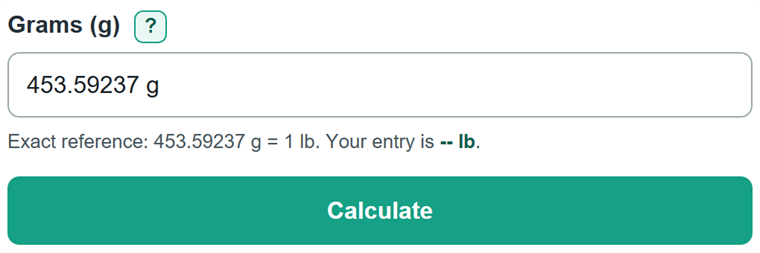
- Enter the weight from a scale, package, food label, lab note, or product specification in Grams (g).
- Enter one value only. Decimals are allowed, and commas must mark thousands, such as 1,000.5.
- Click Calculate to see the decimal-pound answer first, followed by the same weight in pounds and ounces and total ounces.
- Check a known value if needed: 453.59237 g equals exactly 1 lb, which equals 16 oz.
Definitions
Gram (g): A metric unit of mass.
Pound (lb): An ordinary avoirdupois unit of mass. One pound equals exactly 453.59237 g. [1]
Ounce (oz): An ordinary avoirdupois unit of mass. One pound equals 16 oz.
Decimal pounds: A weight written as one number of pounds, such as 2.2046 lb.
Pounds and ounces: The same weight written as whole pounds plus the ounces left over, such as 2 lb 3.27 oz.
Common mistakes and quick fixes
Mistake: Expecting 500 g to equal 0.5 lb.
Fix: Check Grams (g) and then recalculate. 500 g is half a kilogram, not half a pound. It converts to a little more than 1 lb.
Mistake: Entering kilograms, ounces, or pounds in the grams field.
Fix: Check Grams (g) and then recalculate. Enter one mass in grams only. You may add a g suffix, such as 500 g.
Mistake: Typing a comma incorrectly, such as 1,00.
Fix: Check Grams (g) and then recalculate. Use commas only for thousands: 1,000 or 1,000.5.
Mistake: Reading a decimal-pound result as pounds and ounces.
Fix: Check Grams (g) and then recalculate. Use the separate whole-pounds and remaining-ounces values for the pounds-and-ounces form.
Mistake: Treating total ounces as fluid ounces or troy ounces.
Fix: Check Grams (g) and then recalculate. The converter uses ordinary avoirdupois ounces, the everyday mass ounces used with pounds.
Limitations & Key Assumptions / Boundary Conditions
- The converter accepts physical mass of 0 g or more. Negative grams are not valid for this conversion.
- It uses ordinary avoirdupois pounds and ounces, not troy units, pound-force, fluid ounces, cups, or shipping price bands.
- The displayed values can be rounded, but the pounds-and-ounces form is calculated from the unrounded conversion.
- A scale, package, or label may round or measure the original gram value imperfectly. This conversion does not change that source measurement.
Methodology
Conversion method
The converter uses the exact international avoirdupois relationship of 1 lb = 453.59237 g. [1] It keeps the unrounded pound value while finding ounces.
pounds = grams / 453.59237
total ounces = pounds * 16
whole pounds = floor(pounds)
remaining ounces = total ounces - (whole pounds * 16)
Worked example
For 1,000 g, divide 1,000 by 453.59237 to get about 2.2046 lb. Multiply the unrounded pound value by 16 to get about 35.274 oz total. This is 2 lb 3.274 oz.
Rounding
Whole pounds are the whole-number part of the unrounded pound amount. Remaining ounces are found from the unrounded total ounces. If rounding would show 16 oz, the displayed value carries that ounce amount into the next whole pound.