
Enter ounces of weight to find the matching kilograms, with grams shown too for checking smaller amounts.
Advanced options
Table of contents
How to use our Ounces to Kilograms Converter
- Copy the amount marked oz from a package, scale, shipping label, recipe weight, or classroom problem.
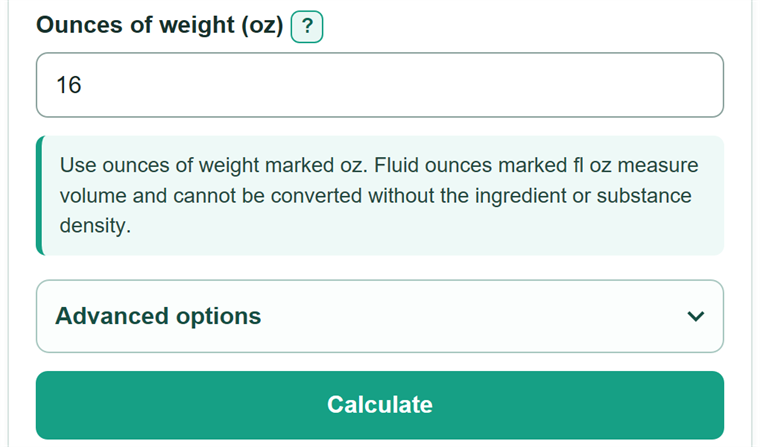
- Enter it in Ounces of weight (oz). Decimals such as 2.5 and grouped values such as 1,000 are accepted.
- Do not enter fl oz. Fluid ounces measure volume, and their mass depends on the substance's density.
- Open Advanced options if you need a certain number of digits after the decimal point for an assignment or measurement.
- Check the answer: 16 oz is about 0.454 kg, and the grams value should be 1,000 times the unrounded kilograms value.
Definitions
Ounce of weight (oz): An ordinary US unit of mass, also called an avoirdupois ounce. This is the unit used by the converter.
Kilogram (kg): A metric unit of mass used for the main converted value.
Gram (g): A smaller metric unit of mass. Exactly 1,000 g equals 1 kg.
Fluid ounce (fl oz): A unit of volume, not mass. The mass of a fluid-ounce amount changes with the material's density.
Troy ounce: A mass unit used especially for precious metals. It differs from the ordinary ounce used here.
Common mistakes and quick fixes
Mistake: Entering fl oz from a bottle or measuring cup.
Fix: Enter only weight marked oz. To find mass from fluid ounces, you also need the substance's density.
Mistake: Using a troy ounce for gold, silver, or another precious metal.
Fix: This converter uses ordinary avoirdupois ounces. Use a troy-ounce conversion for measurements stated in troy ounces.
Mistake: Typing 1,01 or 1,,2.
Fix: Use commas only for thousands, such as 1,000. Use a decimal point for decimals, such as 1.01.
Mistake: Rounding ounces before converting.
Fix: Enter the most precise ounce amount available, then round the displayed kilogram answer only when needed.
Mistake: Treating zero as an invalid amount.
Fix: Zero is valid and converts to 0 kg and 0 g.
Limitations & Key Assumptions / Boundary Conditions
- This calculation applies only to ordinary avoirdupois ounces of mass, normally marked oz.
- Fluid ounces, marked fl oz, cannot be converted directly to kilograms without the material's density.
- Troy ounces are a different mass unit and need a different conversion factor.
- The decimal-place setting changes displayed rounding only; the conversion uses the unrounded value.
- Zero and positive amounts are valid. Negative mass is outside this converter's input range.
Methodology
Conversion method
The converter multiplies ordinary ounces of weight by 0.028349523125 kilograms per ounce. The factor follows from the exact international pound definition of 0.45359237 kg and 16 ordinary ounces per pound.
kg = oz x 0.028349523125
It calculates grams from the unrounded kilogram value.
g = kg x 1000
Worked example
For 16 oz, multiply 16 by 0.028349523125 to get 0.45359237 kg. Then multiply 0.45359237 by 1,000 to get 453.59237 g.
Calculation boundaries
This fixed conversion is for ordinary ounces of mass. Fluid ounces measure volume, so their mass cannot be found without knowing the material's density. The calculator accepts zero and positive values, including decimals, and rejects negative values, malformed comma grouping, and non-finite numbers.