
Enter decimal pounds or pounds and ounces to find the matching weight in grams, with kilograms shown too.
Table of contents
How to use our Pounds to Grams Converter
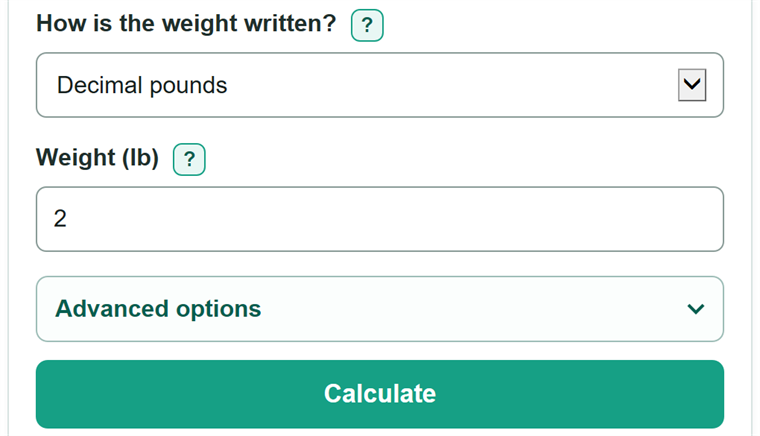
- Choose the format shown by your source: Decimal pounds for a value such as 2.5 lb, or Pounds and ounces for a value such as 2 lb 8 oz.
- Enter the weight exactly as written. In pounds-and-ounces format, enter whole pounds and an ounce amount from 0 up to, but not including, 16.
- Click Calculate to see the converted weight in grams first and kilograms second.
- Check that a larger entered weight gives a larger gram value. If it does not match the source, check that ounces were not typed as decimal pounds.
- Open Advanced options only if you need a different number of displayed decimal places for a recipe, scale, or worksheet.
Definitions
Pound (lb): The ordinary avoirdupois unit of mass used for most everyday US weights. One pound equals exactly 453.59237 grams.
Ounce (oz): One sixteenth of an ordinary avoirdupois pound. One ounce equals 28.349523125 grams.
Gram (g): A metric unit of mass and the main answer from this converter.
Kilogram (kg): A metric unit of mass equal to 1,000 grams.
Decimal pounds: A pound weight written as one number, such as 2.5 lb.
Common mistakes and quick fixes
Mistake: Typing 2.8 when the source says 2 lb 8 oz.
Fix: Choose Pounds and ounces, then enter 2 for the pounds part and 8 for the ounces part. This is 2.5 lb, not 2.8 lb.
Mistake: Entering 16 or more for the ounces part.
Fix: Move each full 16 oz into the pounds part. For example, 3 lb 16 oz should be entered as 4 lb 0 oz.
Mistake: Entering 2.5 for the pounds part in pounds-and-ounces format.
Fix: Enter whole pounds only in that field. Use the ounces field for the remaining part of a pound.
Mistake: Using a comma as a decimal mark, such as 1,5 lb.
Fix: Use a decimal point for decimals: 1.5 lb. Use commas only to group thousands, such as 1,000 lb.
Mistake: Treating the displayed rounded number as the exact converted value.
Fix: Choose more decimal places if your task needs them. The conversion uses the unrounded value before formatting the display.
Limitations & Key Assumptions / Boundary Conditions
- This converter uses ordinary avoirdupois pounds and ounces, the units used for most everyday US weights.
- It does not apply to troy pounds, troy ounces, fluid ounces, or other units with similar names.
- Entered weights must be zero or greater. In pounds-and-ounces format, the pounds part must be a whole number and ounces must be less than 16.
- Display rounding can make a very small nonzero weight look like zero at low precision, although the calculation keeps its unrounded value.
- A conversion cannot restore precision lost when a scale, recipe, or package label has already rounded its stated weight.
Methodology
Conversion method
The converter uses the exact relationship for the ordinary avoirdupois pound.
1 lb = 453.59237 g
grams = pounds * 453.59237
For pounds-and-ounces entry, the calculator converts each part and adds them. One ordinary pound has 16 ounces.
grams = whole pounds * 453.59237 + ounces * 28.349523125
The kilogram companion value uses the unrounded gram value.
kilograms = grams / 1000
Worked example
For 2 lb 8 oz, the pound part is 907.18474 g and the ounce part is 226.796185 g. Adding them gives 1,133.980925 g, or 1.133980925 kg before display rounding.