
Calculate commercial real estate debt yield from NOI, loan amount, and annual reserves in one quick lender-style view.
Table of contents
How to use our Debt Yield Calculator
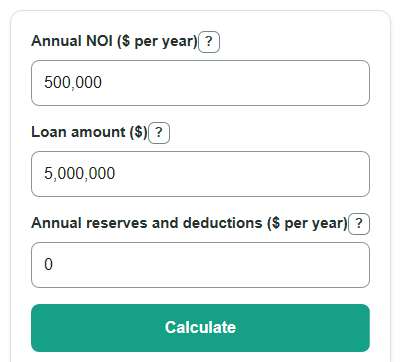
- Enter Annual NOI as the property's yearly net operating income before loan payments and income taxes.
- Enter Loan amount as the loan principal you want to test, not the property value.
- Enter Annual reserves and deductions if replacement reserves, capex reserves, or underwriting deductions should reduce cash flow; use 0 if none apply.
- Click Calculate and read Debt yield after reserves first, then compare it with NOI-only debt yield.
- Sanity-check the output: if reserves are 0, both debt yield percentages should match; if reserves are higher than NOI, the after-reserve cash flow and yield should be negative.
Definitions
Debt yield: A ratio that compares a property's annual income measure with the loan amount. It is shown as a percent.
NOI: Net operating income. It is property income after operating expenses, before debt service and income taxes.
Annual reserves and deductions: Yearly amounts subtracted from NOI for items such as replacement reserves, capex reserves, or underwriting deductions.
Annual cash flow after reserves: Annual NOI minus annual reserves and deductions. A negative value means the deductions are larger than NOI.
Years of after-reserve cash flow to match loan: Loan amount divided by after-reserve annual cash flow. It is not useful when after-reserve cash flow is zero or negative.
Common mistakes and quick fixes
Mistake: Entering property value in Loan amount .
Fix: Use the loan principal being tested in Loan amount , even if the property is worth more.
Mistake: Putting monthly income in Annual NOI .
Fix: Convert it to a yearly number before entering Annual NOI .
Mistake: Treating Annual reserves and deductions as a percent of the loan.
Fix: Enter the yearly dollar amount in Annual reserves and deductions .
Mistake: Leaving Annual reserves and deductions out when reserves are part of the underwriting case.
Fix: Add those yearly deductions so Debt yield after reserves shows the more conservative cash flow view.
Mistake: Reading NOI-only debt yield as the final answer when reserves apply.
Fix: Use Debt yield after reserves for the reserve-adjusted view and keep NOI-only debt yield for comparison.
Limitations & Key Assumptions / Boundary Conditions
- The calculator uses annual numbers. Monthly NOI or monthly reserves must be multiplied by 12 before entry.
- Debt yield is a simple underwriting ratio. It does not include interest rate, amortization, loan fees, taxes, appraised value, cap rate, or debt service coverage ratio.
- Different lenders may define NOI, reserves, and underwriting deductions differently. Use the same definitions as the lender or assignment you are matching.
- Blank Annual reserves and deductions is treated as 0, but a typed negative reserve is not a valid input.
- If Annual cash flow after reserves is zero or negative, the years-to-match-loan output is shown as N/A because dividing the loan by nonpositive cash flow is not useful for this comparison.
- The calculator keeps negative after-reserve cash flow and negative debt yield instead of flooring them at 0, because a negative value can show a real underwriting shortfall.
Methodology
Calculation steps
The calculator first subtracts yearly reserves and deductions from Annual NOI. It then divides that income measure by Loan amount to get debt yield as a percent. The basic debt yield concept is commonly stated as net operating income divided by loan amount [2].
annual_cash_flow_after_reserves = annual_noi - annual_reserves
debt_yield_after_reserves_percent = (annual_cash_flow_after_reserves / loan_amount) * 100
debt_yield_noi_percent = (annual_noi / loan_amount) * 100
years_to_match_loan_after_reserves = loan_amount / annual_cash_flow_after_reserves
The loan amount must be greater than 0. Annual reserves and deductions may be blank, which is treated as 0, but entered reserves must be a valid nonnegative dollar amount. The years-to-match-loan value is shown only when Annual cash flow after reserves is positive.
Mini-example
If Annual NOI is $500,000, Loan amount is $5,000,000, and Annual reserves and deductions are $50,000, then Annual cash flow after reserves is $450,000.
450,000 = 500,000 - 50,000
Debt yield after reserves = (450,000 / 5,000,000) * 100 = 9.00%
NOI-only debt yield = (500,000 / 5,000,000) * 100 = 10.00%
Years of after-reserve cash flow to match loan = 5,000,000 / 450,000 = 11.11 years