
Estimate steady-running conveyor motor power, effective belt tension, and drive-pulley torque from your conveyor geometry, load, speed, and drive data.
Operating load
Drive
Advanced options
Extra running resistance
Optional belt-side tensions
Calculation details
Table of contents
How to use our Conveyor Belt Motor Power Calculator
- Enter the belt-path length, Head elevation change, and Belt speed from the conveyor drawing, VFD, or field measurement.
- Enter Material capacity in US short tons per hour, Belt weight, the Rolling resistance factor, Drive pulley pitch diameter, and Overall drive efficiency.
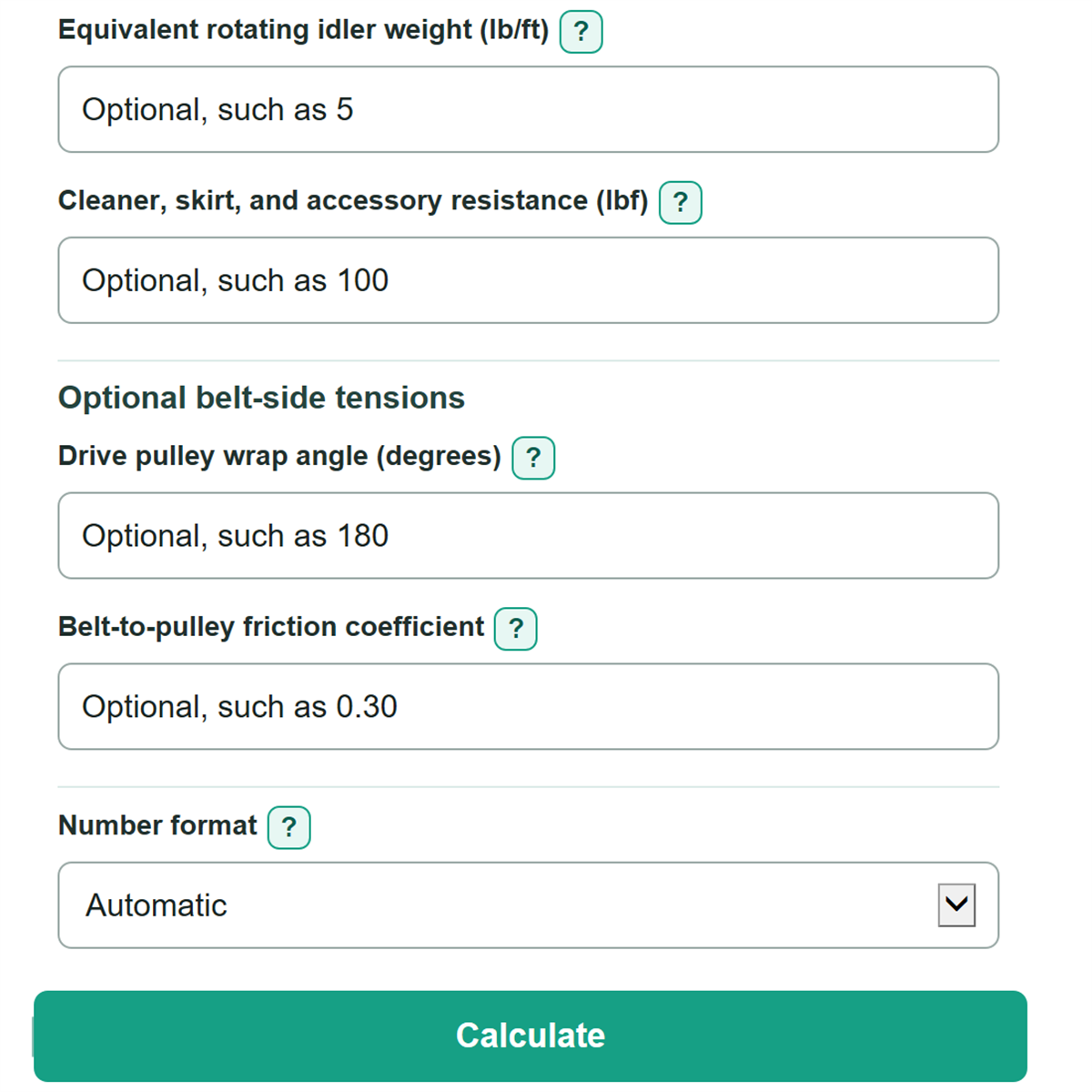
- Open Advanced options only if you have defensible values for idler weight, accessory drag, pulley wrap, or belt-to-pulley friction.
- Click Calculate and read Estimated motor running power first, then Effective belt tension and Drive-pulley running torque.
- Sanity-check the sign and size of the result: a downhill conveyor can produce negative tension and power, while a smaller pulley should produce lower torque for the same Effective belt tension.
Definitions
Effective belt tension: The net steady pulling force needed at the drive pulley. It equals tight-side tension minus slack-side tension.
Material carried per foot of belt: The material load on the carrying strand, in lb/ft, calculated from capacity and belt speed.
Rolling resistance factor: A project-specific multiplier used to estimate force lost to steady belt and idler rolling resistance.
Overall drive efficiency: The combined percent efficiency of the motor, VFD, reducer, and other drive parts used in the estimate.
Drive-pulley running torque: The turning force at the pulley rim, in lb-ft. It is not motor-shaft torque.
Wrap angle: The degrees of belt contact around the drive pulley. With belt-to-pulley friction, it is used to estimate tight-side and slack-side tension.
Common mistakes and quick fixes
Mistake: Entering an incline angle in Head elevation change.
Fix: Enter the signed vertical height difference in ft. Use a positive value when material rises and a negative value when it descends.
Mistake: Using motor RPM instead of Belt speed.
Fix: Enter the belt's linear travel speed in ft/min from the VFD, specification, or tachometer.
Mistake: Entering metric tonnes/hour for Material capacity.
Fix: Convert the value first and enter US short tons per hour. One US short ton is 2,000 lb.
Mistake: Treating Effective belt tension as the tight-side belt tension.
Fix: Effective belt tension is the difference between tight-side and slack-side tension. Supply both traction inputs to estimate the two side tensions.
Mistake: Reading Drive-pulley running torque as motor-shaft torque.
Fix: This torque is at the drive pulley. Reducer ratio and drive losses are needed to determine motor-shaft torque.
Mistake: Leaving only one traction field filled in.
Fix: Enter both Drive pulley wrap angle (degrees) and Belt-to-pulley friction coefficient, or leave both blank.
Limitations & Key Assumptions / Boundary Conditions
- This is a simplified steady-running estimate, not a complete conveyor design method or final motor and reducer selection.
- The model treats the Conveyor length along the belt path as the distance used in the rolling-resistance term and requires the absolute Head elevation change to be no greater than that length.
- Blank Equivalent rotating idler weight (lb/ft) and Cleaner, skirt, and accessory resistance (lbf) are treated as zero. Add them only when they are not already included in your resistance basis.
- Results do not include startup acceleration, transient loading, take-up behavior, belt rating, pulley and shaft strength, thermal duty, service factor, or electrical starting limits.
- Tight-side and slack-side estimates use a simplified friction-and-wrap relation. Belt condition, lagging, contamination, moisture, and tensioning can change actual traction.
- Negative effective tension, pulley power, or motor running power can occur on a downhill conveyor. It can indicate an overhauling or possible regenerative condition that needs engineering review.
Methodology
Calculation method
The calculator first converts Material capacity from US short tons per hour into the material weight carried on each foot of moving belt. It adds both belt strands, the optional equivalent idler weight, and then applies the entered rolling resistance factor over the belt-path length.
material load (lb/ft) = capacity (short tons/hour) x 2,000 / (60 x belt speed (ft/min))
moving weight (lb/ft) = 2 x belt weight (lb/ft) + material load (lb/ft) + optional idler weight (lb/ft)
rolling resistance (lbf) = rolling resistance factor x conveyor length (ft) x moving weight (lb/ft)
The lift term uses the signed Head elevation change. Uphill lift adds force; downhill lift subtracts force. Optional accessory resistance is added directly.
effective tension (lbf) = rolling resistance + material load x head elevation change + optional accessory resistance
Mechanical pulley power is based on force times belt speed. The estimate then divides by Overall drive efficiency to calculate motor running power. Mechanical horsepower uses 33,000 ft-lbf per minute per hp.
mechanical pulley power (hp) = effective tension (lbf) x belt speed (ft/min) / 33,000
motor running power (hp) = mechanical pulley power (hp) / (overall drive efficiency (percent) / 100)
Drive-pulley torque uses the pulley pitch radius, which is half the entered diameter.
drive-pulley torque (lb-ft) = effective tension (lbf) x drive pulley pitch diameter (in) / 24
If both traction fields are entered and effective tension is positive, the calculator uses the capstan relation to estimate the ratio between tight-side and slack-side tension.
traction ratio = e^(belt-to-pulley friction coefficient x pi x wrap angle (degrees) / 180)
slack-side tension (lbf) = effective tension / (traction ratio - 1)
tight-side tension (lbf) = slack-side tension + effective tension
Worked example
With a 100 ft conveyor, 20 ft uphill lift, 200 ft/min Belt speed, 100 short tons/hour capacity, 10 lb/ft Belt weight, 0.03 Rolling resistance factor, no optional resistance, a 24 in pulley, and 90 percent efficiency, the material load is about 16.67 lb/ft. The effective tension is about 443.33 lbf, mechanical pulley power is about 2.69 hp, motor running power is about 2.99 hp, and drive-pulley running torque is about 443.33 lb-ft.