
Compare your conventional and convection oven kWh readings to estimate cost differences per cook, month, and year.
Table of contents
How to use our Convection vs Conventional Oven Energy Cost Calculator
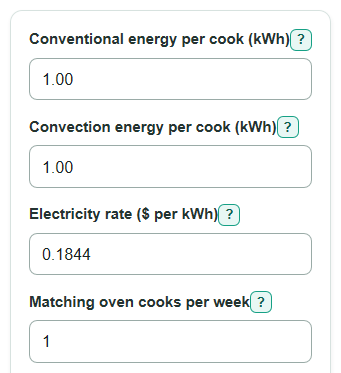
- Enter the total Conventional energy per cook in kWh for one oven session, including preheating only if you also include it for convection.
- Enter the matching Convection energy per cook in kWh for the same food or recipe.
- Enter your usage-based Electricity rate from your bill, leaving out fixed monthly customer charges.
- Enter Matching oven cooks per week, then select Calculate.
- Check the signs: a positive savings value means convection used less energy or cost less; a negative value means it used more for your comparison.
Definitions
kWh per cook: Kilowatt-hours used by one complete oven session. It measures energy, not the oven's power rating.
Electricity rate: The charge for each kWh used. Use usage-dependent supply and delivery charges, not fixed monthly charges. The default $0.1844 per kWh is a US planning estimate. [1]
Conventional energy per cook: Energy used by one session in regular oven mode.
Convection energy per cook: Energy used by a matching session with the oven fan mode on.
Matching oven cooks: Sessions that use the same comparison boundary, such as both including preheat and both cooking similar food.
Signed savings: A value that can be positive or negative. Positive means convection used less; negative means it used more.
Common mistakes and quick fixes
Mistake: Including preheating in Conventional energy per cook but not in Convection energy per cook.
Fix: Use the same start and end points for both kWh readings.
Mistake: Entering the oven's rated watts as Conventional energy per cook.
Fix: Enter total session energy in kWh, measured or estimated, rather than the appliance power rating.
Mistake: Adding a fixed customer charge to Electricity rate.
Fix: Use only supply and delivery charges that change with each kWh used.
Mistake: Treating a negative Convection cost savings per cook as an error.
Fix: Keep the negative result; it means convection cost more for the entered sessions.
Mistake: Counting all baking as Matching oven cooks per week when the kWh readings came from only one type of meal.
Fix: Count only sessions similar enough for the two energy readings to be comparable.
Limitations & Key Assumptions / Boundary Conditions
- Results compare electric oven modes only. They do not compare gas ovens, countertop appliances, or different ovens.
- The two kWh entries must cover comparable sessions. Different food loads, rack positions, temperatures, preheat treatment, or cook times can change the difference.
- Measured session kWh is preferable to a rated wattage estimate because oven heating elements cycle on and off.
- Dollar results include only electricity charges that vary with kWh. Fixed customer charges do not change when you switch oven modes.
- Monthly and yearly values assume the entered Matching oven cooks per week continues for 52 weeks and use an average of 12 months.
- A zero Electricity rate makes dollar savings zero, while the energy comparison remains useful.
Methodology
Calculation method
The calculator first finds each mode's usage-dependent electricity cost for one cooking session. It then subtracts convection from conventional, so negative differences remain visible instead of being changed to zero.
conventional_cost_per_cook = conventional_energy_kwh * electricity_rate
convection_cost_per_cook = convection_energy_kwh * electricity_rate
energy_saved_per_cook = conventional_energy_kwh - convection_energy_kwh
savings_per_cook = energy_saved_per_cook * electricity_rate
annual_savings = savings_per_cook * cooks_per_week * 52
monthly_savings = annual_savings / 12
percent_energy_saved = (energy_saved_per_cook / conventional_energy_kwh) * 100
Worked example
If conventional mode uses 1.50 kWh, convection uses 1.00 kWh, and the electricity rate is $0.1844 per kWh, convection saves 0.50 kWh and $0.0922 per cook. At 3 matching cooks per week, the projected savings are $14.3832 per year, or $1.1986 per average month.
Rate and projection choices
The default electricity rate is a replaceable US residential planning estimate from the U.S. Energy Information Administration. [1] The calculation uses 52 weeks per year and divides the yearly amount by 12 for an average monthly figure. It does not add fixed utility charges, taxes, tiered pricing effects, or time-of-use price changes.