
Enter dry-basis flue-gas readings to estimate excess air, stack loss, net stack temperature, and point-in-time combustion efficiency.
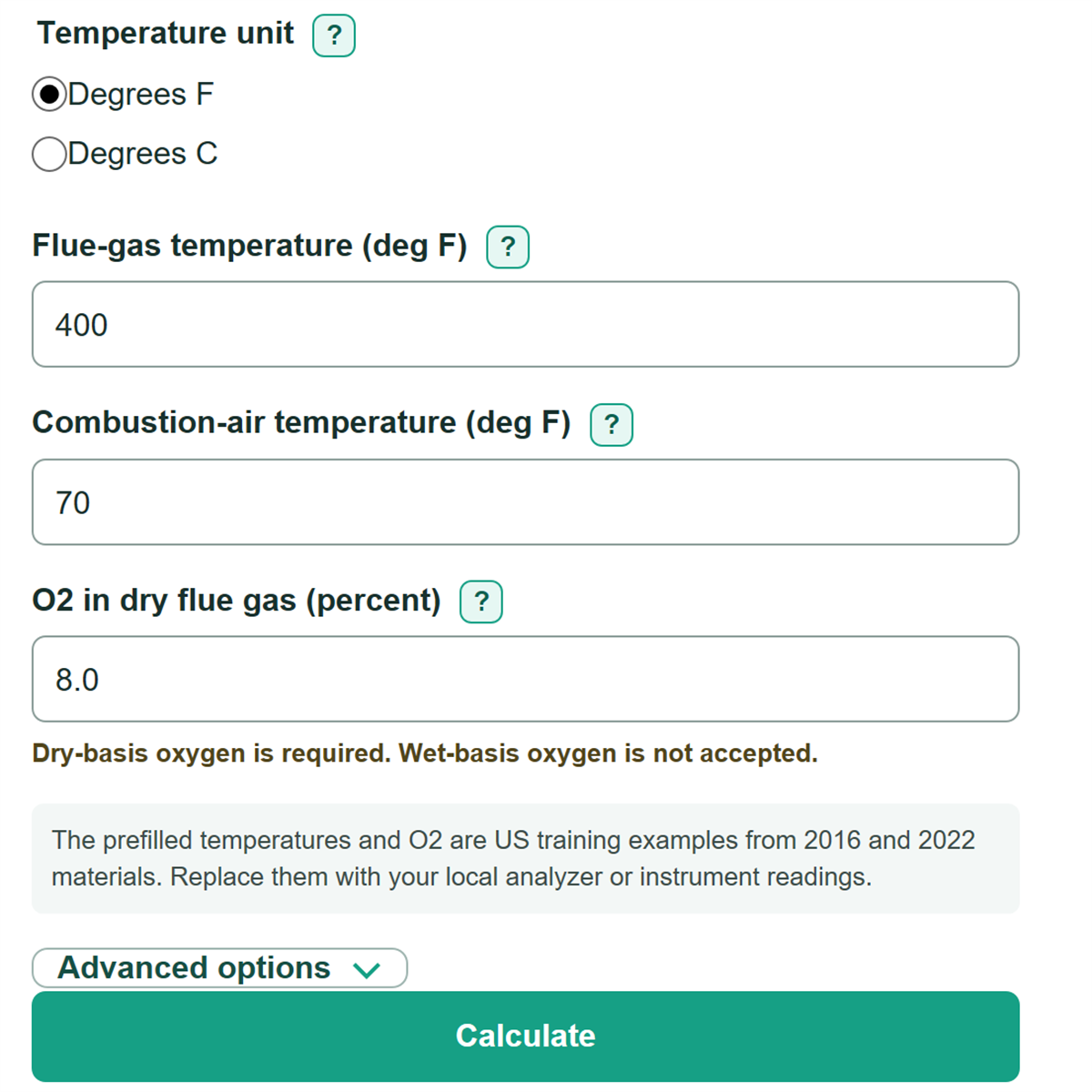
Dry-basis oxygen is required. Wet-basis oxygen is not accepted.
The prefilled temperatures and O2 are US training examples from 2016 and 2022 materials. Replace them with your local analyzer or instrument readings.
Advanced options
Table of contents
How to use our Combustion Excess Air, Flue-Gas O2 and Stack Loss Calculator
- Choose the Fuel type shown on the burner record, fuel bill, or tank label.
- Choose the Temperature unit used by your instruments, then enter the measured Flue-gas temperature and Combustion-air temperature.
- Enter O2 in dry flue gas exactly as the analyzer reports percent, such as 8 for 8 percent.
- Select Calculate and read the efficiency estimate first, then check the stack loss, excess air, and net stack temperature.
- Sanity-check that flue-gas temperature is higher than combustion-air temperature and that the displayed scope says dry-basis O2; investigate unexpected readings with the analyzer and equipment guidance.
Definitions
Dry-basis O2: Oxygen percent after water vapor is removed from the flue-gas sample. This calculator accepts only dry-basis oxygen.
Excess combustion air: Air supplied above the theoretical amount needed for complete combustion. It is estimated from dry-basis O2.
Net stack temperature: Flue-gas temperature minus combustion-air temperature. A temperature difference changes by a factor of 1.8 between degrees F and degrees C.
Dry-flue-gas stack loss: Estimated heat carried away by dry flue gas, expressed as a percent of fuel heat input in this simplified method.
Siegert coefficients: Fuel-specific numbers used with net stack temperature and dry O2 to estimate stack loss. This calculator uses the declared values for natural gas, propane, or No. 2 fuel oil.
Point-in-time combustion efficiency: 100 percent minus the calculated dry-flue-gas stack loss. It describes one operating reading, not seasonal performance.
Common mistakes and quick fixes
Mistake: Entering 0.08 in O2 in dry flue gas when the analyzer says 8%.
Fix: Enter 8 or 8.0 because this field uses percent, not a decimal fraction.
Mistake: Copying a wet-basis sensor value into O2 in dry flue gas.
Fix: Use an analyzer result that explicitly says dry basis. Do not guess a wet-to-dry correction.
Mistake: Entering an already calculated temperature difference as Flue-gas temperature.
Fix: Enter the gross flue reading and the separate Combustion-air temperature ; the calculator finds net stack temperature.
Mistake: Leaving Temperature unit on degrees F while copying degrees C readings.
Fix: Choose the instrument's unit before entering both temperatures. Switching units converts the entered temperature values.
Mistake: Treating Estimated point-in-time combustion efficiency as AFUE or annual boiler efficiency.
Fix: Use it only as a steady-reading, dry-flue-gas stack-loss estimate; account for cycling, shell, blowdown, and other losses separately.
Limitations & Key Assumptions / Boundary Conditions
- The calculation requires a dry-basis O2 reading. Wet-basis oxygen is blocked because converting it needs water-vapor information that is not entered.
- It applies the simplified dry-flue-gas Siegert method during steady firing, with flue gas hotter than combustion air.
- The efficiency estimate excludes radiation and shell loss, blowdown, cycling, standby, distribution loss, moisture-related effects, and unusual fuel composition.
- It is not AFUE, a seasonal efficiency rating, condensing-system performance, or a complete boiler heat balance.
- Low O2 alone does not show safe or complete combustion. Evaluate CO or combustibles using the equipment manufacturer guidance and a suitable combustion test.
- Results at very high O2, very high stack temperature, or calculated stack loss of 100 percent or more are outside the useful range of this simplified model.
Methodology
Calculation method
The calculator first converts the temperature difference to degrees C when needed. It then estimates excess air from dry-basis O2 and uses the selected fuel's Siegert coefficients in a simplified dry-flue-gas stack-loss equation.
ΔT_C = (flue-gas temperature - combustion-air temperature) / 1.8
Excess air (%) = 100 x O2 / (20.9 - O2)
Stack loss (%) = ΔT_C x (A2 / (21 - O2) + B)
Combustion efficiency (%) = 100 - stack loss
O2 is dry-basis percent by volume. A2 and B are selected by Fuel type: natural gas uses 0.66 and 0.009, propane uses 0.63 and 0.008, and No. 2 fuel oil uses 0.68 and 0.007. The simplified stack-loss relationship uses dry-gas temperature rise and flue-gas quantity concepts. [1]
Worked example
For natural gas with flue gas at 400 deg F, combustion air at 70 deg F, and dry O2 at 8.0%, the net stack temperature is 330 deg F, or about 183.33 deg C. The calculation gives about 62.02% excess air, 10.96% dry-flue-gas stack loss, and 89.04% point-in-time combustion efficiency.
Assumptions and limits
The model uses 20.9% as ambient oxygen and 21% as the reference oxygen value in the stack-loss equation. It stops when O2 is 20.9% or higher, when flue gas is not hotter than combustion air, or when the calculated stack loss reaches 100%. Display settings only round or format results; they do not change the calculation.