
Use this combustion analysis calculator to find theoretical air, actual air, lambda, oxygen demand, and dry or wet flue-gas composition from your fuel data.
Advanced options
How to use our Combustion Analysis Calculator
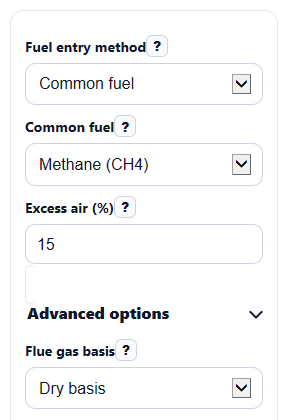
- Choose Fuel entry method. Use Common fuel for a quick example, or switch to custom and enter Carbon in fuel (%), Hydrogen in fuel (%), Sulfur in fuel (%), and Oxygen in fuel (%).
- Enter Excess air (%). A value of 0 means exact theoretical air, while a higher value adds extra air above the minimum needed for complete burning.
- Open Advanced options if needed and choose Flue gas basis as dry or wet. In custom mode, also choose Fuel percent handling to require a true 100% total or normalize your entered fuel percentages.
- Click Calculate and read the main results first: Theoretical air needed, Actual air used, Air-to-fuel ratio, Excess air ratio, and the flue-gas percentages.
- Sanity-check the output before using it: if Excess air (%) goes up, Excess air ratio and O2 in flue gas should also go up, while CO2 in flue gas usually goes down because the products are more diluted.
Definitions
Excess air (%): The extra air supplied above the exact amount needed for complete combustion. A value of 0% means theoretical air only.
Excess air ratio: Also called lambda, this is actual air divided by theoretical air. A value of 1 means exact theoretical air; above 1 means extra air [2].
Theoretical air needed: The minimum dry air required to burn the fuel completely, based on the fuel composition.
Actual air used: The real air supplied after adding the chosen excess air.
O2 needed for complete combustion: The net oxygen that must come from outside air after subtracting oxygen already present in the fuel.
Dry basis: Flue-gas percentages calculated without water vapor in the total.
Wet basis: Flue-gas percentages calculated with water vapor included in the total.
Elemental analysis: The fuel composition entered as mass percent of carbon, hydrogen, sulfur, and oxygen.
Common mistakes and quick fixes
Mistake: In custom mode, the entered Carbon in fuel (%) , Hydrogen in fuel (%) , Sulfur in fuel (%) , and Oxygen in fuel (%) do not add to 100 when Fuel percent handling is set to require 100%.
Fix: Correct the percentages so the total is 100, or switch Fuel percent handling to normalize if you want the calculator to scale them automatically.
Mistake: A negative value is entered for Excess air (%) .
Fix: Use 0 or a positive number. This calculator does not model oxygen-short combustion, carbon monoxide formation, or unburned fuel.
Mistake: You read H2O in flue gas as part of the total while Flue gas basis is set to dry.
Fix: On dry basis, water is left out of the flue-gas total. Switch Flue gas basis to wet if you want water vapor included in the percentages.
Mistake: You change Common fuel while Fuel entry method is set to custom and expect the preset to affect the answer.
Fix: In custom mode, only the custom elemental inputs are used. Switch Fuel entry method back to preset to use Common fuel .
Mistake: The result for O2 needed for complete combustion becomes impossible because Oxygen in fuel (%) is too high for the rest of the fuel analysis.
Fix: Recheck the custom composition. For this complete-combustion model, the fuel cannot already contain more oxygen than the reaction balance allows.
Mistake: You compare CO2 in flue gas from one case to another without noticing that one run uses dry basis and the other uses wet basis.
Fix: Keep Flue gas basis the same when comparing cases, because dry and wet percentages use different totals.
Limitations & Key Assumptions / Boundary Conditions
- This calculator assumes complete combustion to CO2, H2O, and SO2 only. It does not model CO, NOx, unburned hydrocarbons, ash, or dissociation.
- Air is treated as a dry two-part mixture using 0.232 kg O2/kg air and 0.768 kg N2/kg air, so argon and humidity in real air are ignored.
- Preset fuels use ideal chemical formulas, while custom mode uses elemental mass percentages per 1 kg of fuel.
- Negative Excess air (%) is blocked because this version does not handle oxygen-deficient combustion.
- If Flue gas basis is dry, water vapor is excluded from the flue-gas total, so dry and wet percentages should not be compared directly.
- Custom fuel percentages must be physically reasonable. If fuel oxygen is high enough to make net oxygen demand negative, the calculator stops because the simple model no longer fits.
- Results are mass-balance estimates for teaching and engineering screening. Real stack readings can differ because of leaks, moisture, incomplete mixing, measurement error, or fuel variability.
Methodology
Calculation basis
The calculator works on a basis of 1 kg of fuel. In preset mode, it converts the chosen fuel formula into elemental mass fractions of carbon, hydrogen, sulfur, and oxygen. In custom mode, it uses the entered mass percentages directly, either exactly or after normalization.
Step 1: Net oxygen demand
The fuel first needs a net amount of oxygen for complete combustion to carbon dioxide, water, and sulfur dioxide.
m_O2 = 2.6666667*C + 8*H + 1*S - O
Here, C, H, S, and O are fuel mass fractions in kg per kg fuel. The subtraction for O accounts for oxygen already inside the fuel.
Step 2: Theoretical air and actual air
Theoretical air is found from the oxygen mass fraction in dry air, and actual air adds the chosen excess air [1].
m_air_st = m_O2 / 0.232
m_air_act = m_air_st * (1 + EA/100)
lambda = m_air_act / m_air_st = 1 + EA/100
If EA is 15, then lambda is 1.15.
Step 3: Product moles from 1 kg fuel
The calculator then converts each reacting element to product moles and adds nitrogen from the air stream.
n_CO2 = C / 12.011
n_H2O = H / (2 * 1.008)
n_SO2 = S / 32.065
n_O2_excess = (m_air_act*0.232 - m_O2) / 31.9988
n_N2 = (m_air_act*0.768) / 28.0134
This is why the calculator can show both oxygen demand and final flue-gas composition from the same mass balance.
Step 4: Dry or wet flue-gas percentages
Volume percent is based on mole fraction. Wet basis includes water vapor, and dry basis leaves it out [2].
vol_pct_i = 100 * n_i / sum(n_all_on_basis)
For dry basis, the denominator excludes n_H2O. For wet basis, it includes n_H2O.
Mini example
Suppose the fuel is methane and Excess air (%) is 15 on a dry basis. The methane formula gives about 0.749 carbon and 0.251 hydrogen by mass. Using the rounded oxygen-demand factors above gives about 4.01 kg O2/kg fuel, or 17.27 kg air/kg fuel theoretically and 19.86 kg air/kg fuel actually. Lambda is 1.15. The dry flue gas is approximately 9.96% CO2, 3.00% O2, and 87.04% N2. Wet-basis values also include water: each mole of methane produces two moles of H2O.
Assumptions behind the results
This method assumes complete combustion, dry incoming air, and nitrogen-only balance gas in air. It is strongest for quick stoichiometric checks, classroom work, and first-pass engineering estimates. Real systems can differ if combustion is incomplete, air contains moisture, the fuel contains other elements, or measured flue gas includes leaks or sampling effects.
Sources
- Fuels - Combustion Air and Flue Gases - Engineeringtoolbox
- How do I calculate the air required and flue gas composition for combustion of solid fuels? - IFRF
- Purdue University ME418 notes - Combustion/Furnaces (stoichiometric combustion, excess O2 in products) - Purdue
- A-3.2 Calculating Air Requirements and Products of Combustion - Block A: Fuel Gas - TRU