
Use this calculator to find chemical oxygen demand from common COD titration values, with optional dilution correction and a practical chloride caution.
Advanced options
How to use our Chemical Oxygen Demand Calculator
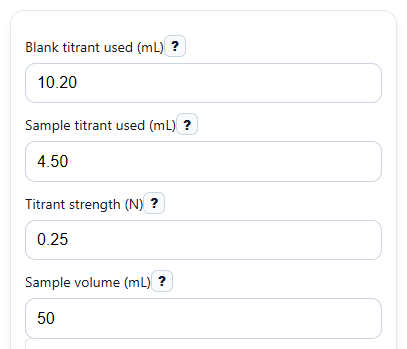
- Enter the four main lab values exactly as recorded: Blank titrant used (mL), Sample titrant used (mL), Titrant strength (N), and Sample volume (mL).
- If you diluted the sample before the COD test, open Advanced options and enter the Dilution factor. Leave it at 1 if there was no dilution.
- If you know chloride, enter Chloride in sample (mg/L) and choose Chloride handling so the warning is more useful.
- Click Calculate to see Chemical oxygen demand, Original sample COD, Oxygen equivalent in tested sample, and Blank minus sample titrant.
- Sanity-check the result: if Blank minus sample titrant is zero or negative, or if Chemical oxygen demand is unexpectedly negative, recheck the blank and sample entries before trusting the COD value.
Definitions
COD: Chemical oxygen demand. It estimates how much oxygen would be needed to chemically oxidize material in a water sample.
Blank titrant used (mL): The titrant volume for the blank run, which represents the method background without the sample.
Sample titrant used (mL): The titrant volume for the actual sample run.
Titrant strength (N): Normality of the titrant. Normality tells how many chemical equivalents are present per liter.
Sample volume (mL): The amount of sample actually tested in the COD procedure, not the total bottle size or collection volume.
Dilution factor: Multiplier used to convert the tested mixture result back to the original sample. A value of 1 means no dilution.
Blank minus sample titrant: The difference between blank and sample titrant volumes. In this calculator, a larger positive difference gives a higher COD.
mg/L as O2: Milligrams per liter expressed as oxygen equivalent, which is the standard way COD is reported.
Chloride interference: Extra reaction caused by chloride that can make COD appear higher than it really is in some methods.
Common mistakes and quick fixes
Mistake: Swapping Blank titrant used (mL) and Sample titrant used (mL) .
Fix: Make sure the blank volume goes in Blank titrant used (mL) and the sample volume goes in Sample titrant used (mL) . A negative Blank minus sample titrant often means these were reversed.
Mistake: Entering the bottle concentration or a percent instead of Titrant strength (N) .
Fix: Enter the actual titrant normality in Titrant strength (N) , such as 0.25, not 25 or a percent value.
Mistake: Typing the original collected volume instead of the tested portion in Sample volume (mL) .
Fix: Enter only the sample volume actually used in the digestion and titration. This directly changes Chemical oxygen demand and Oxygen equivalent in tested sample .
Mistake: Forgetting to apply a pre-test dilution.
Fix: If the sample was diluted before testing, enter the Dilution factor so Original sample COD reflects the undiluted sample.
Mistake: Treating Chloride warning as a correction to the math.
Fix: The calculator does not auto-correct for chloride. Use Chloride in sample (mg/L) and Chloride handling only as a caution about possible interference.
Mistake: Assuming a rounded display changed the lab result.
Fix: If needed, change Decimal places (for mg/L) for display only. The underlying COD math still uses the entered values.
Limitations & Key Assumptions / Boundary Conditions
- This calculator follows the common dichromate reflux titration equation and assumes your lab data come from that type of COD method.
- The result depends on the method used, reagents, digestion conditions, and lab technique. Different COD methods can give different numbers for the same sample.
- The chloride feature gives a practical warning only. It does not mathematically correct COD for chloride interference.
- If Sample titrant used (mL) is greater than Blank titrant used (mL), the calculator allows a negative COD because that can help you spot suspect data.
- Original sample COD is only as good as the entered Dilution factor. If the dilution factor is wrong, the corrected result will also be wrong.
- This tool reports how much oxidizable material is indicated by the test, but it does not identify which chemicals caused the demand.
- Very salty, unusual, or strongly contaminated samples may need a special method, different digestion range, or a new dilution before the result is reliable.
Methodology
Formula used
This calculator uses the standard titration-style COD equation with the blank volume, sample volume, titrant normality, and tested sample volume.
COD = ((A - B) x N x 8000) / V
Here, A is Blank titrant used (mL), B is Sample titrant used (mL), N is Titrant strength (N), and V is Sample volume (mL).
Extra outputs
Original sample COD = COD x DF
Oxygen equivalent in tested sample = COD x V / 1000
Blank minus sample titrant = A - B
DF is the Dilution factor. Use 1 when there was no dilution before testing.
Why the 8000 constant appears
The constant 8000 comes from the oxygen equivalent weight of 8 g per equivalent and the conversion between liters and milliliters. That lets the titration terms convert to COD in mg/L as O2.
Mini example
Suppose the blank used 10.20 mL, the sample used 4.50 mL, the titrant strength was 0.25 N, and the sample volume was 50 mL.
Blank minus sample titrant = 10.20 - 4.50 = 5.70 mL
COD = (5.70 x 0.25 x 8000) / 50 = 228 mg/L as O2
Oxygen equivalent in tested sample = 228 x 50 / 1000 = 11.4 mg O2
If the sample had been diluted 10 times before the test, then:
Original sample COD = 228 x 10 = 2280 mg/L as O2
Interpretation notes
A higher COD means the sample showed more chemically oxidizable material. If the blank and sample titrant volumes are equal, COD is 0 by this equation. If the sample titrant is larger than the blank, COD becomes negative, which usually means the data should be checked rather than treated as a real negative pollution level.
Assumptions behind the warning notes
The Chloride warning is a user aid, not a correction formula. Chloride can interfere with dichromate COD methods, so the calculator shows a caution when your chloride entry and handling choice suggest the reported COD may be less trustworthy. COD is also method-based, so the calculator cannot identify the specific pollutants present or replace your lab's written procedure.