
Estimate an electric industrial oven's warm-up energy, run-period electricity cost, completed batches, and good output from your operating records.
Production plan
Electricity price
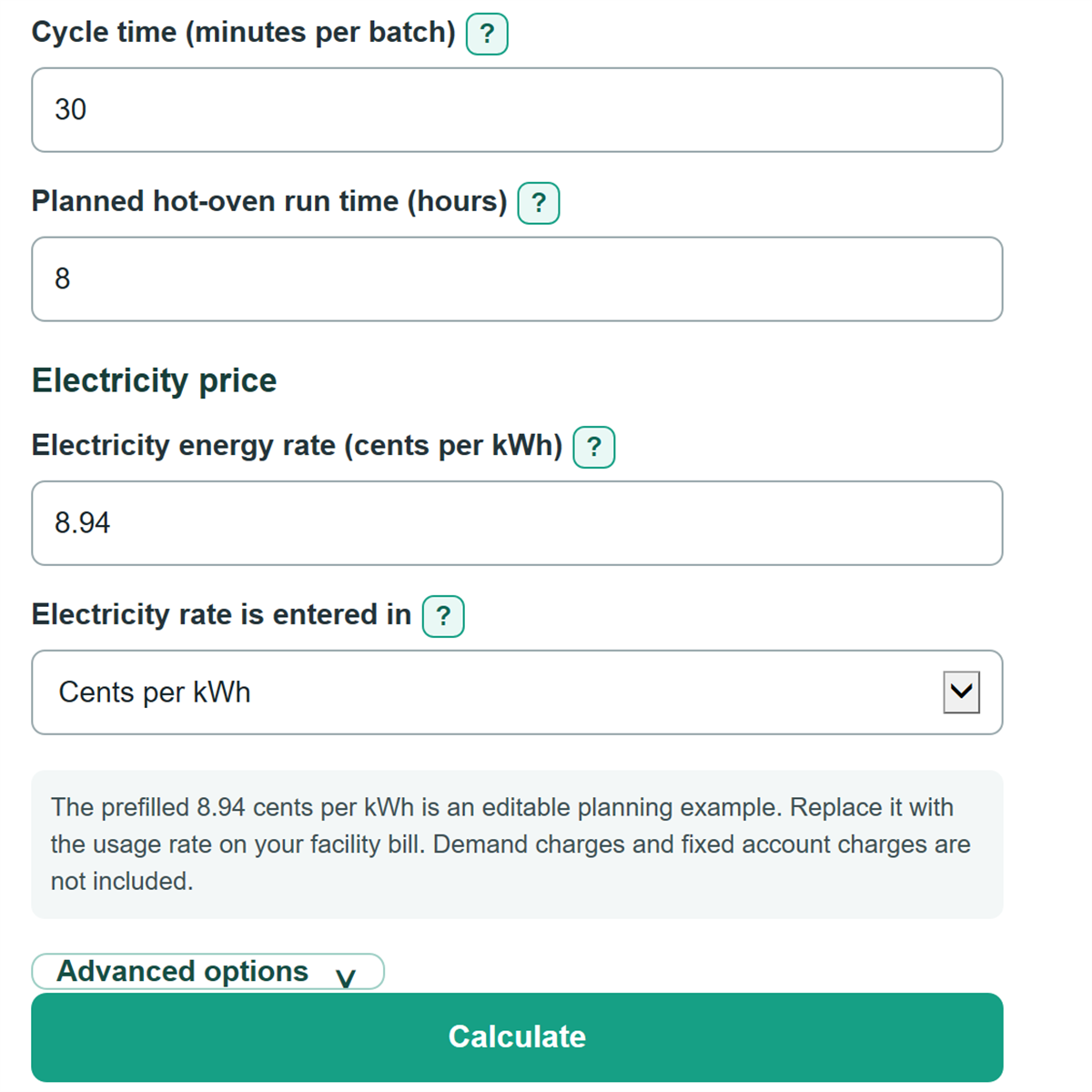
The prefilled 8.94 cents per kWh is an editable planning example. Replace it with the usage rate on your facility bill. Demand charges and fixed account charges are not included.
Advanced options
Run adjustments
Number display
Calculation details
Table of contents
How to use our Industrial Oven Energy, Throughput and Cost Calculator
- Choose the unit shown on the oven record under "Power values are entered in," then enter "Oven connected load" and "Average operating power."
- Enter "Warm-up time" for one startup and "Planned hot-oven run time" after the oven is ready to produce.
- Choose "Count good output as," then enter "Loaded output per batch" and "Cycle time" from the job traveler, recipe, or production record.
- Enter "Electricity energy rate" and select the exact bill unit under "Electricity rate is entered in." Replace the example rate with your facility rate.
- Calculate, then check "Electricity rate used in the calculation" and "Whole batches completed" before using the cost-per-unit results for a quote or plan.
Definitions
Connected load: The oven's rated electric input during modeled full-power warm-up, usually found on a nameplate or in a manual.
Average operating power: Average electric power while the oven is hot and running. It can be lower than connected load because heaters may cycle.
kW: Kilowatt, a measure of electric power. One kW equals 1,000 W.
kWh: Kilowatt-hour, a measure of electricity use. Using 1 kW for 1 hour equals 1 kWh.
Warm-up: A cold or cooled-down startup that uses the entered warm-up time and connected load.
Good output: The part count or pounds expected to pass and be usable after applying "Good output (percent)."
Normalized rate: The entered electricity price converted to $ per kWh so the cost calculation uses one price unit.
Common mistakes and quick fixes
Mistake: Using "Oven connected load" as "Average operating power" after the oven reaches temperature.
Fix: Use metered average hot-oven power when possible, or make a separate engineering estimate for "Average operating power."
Mistake: Including startup time in "Planned hot-oven run time."
Fix: Put startup duration in "Warm-up time" and enter only production-ready time in "Planned hot-oven run time."
Mistake: Entering 8.94 as dollars when the bill says cents per kWh.
Fix: Select "Cents per kWh" under "Electricity rate is entered in" and confirm "Electricity rate used in the calculation" is $0.0894 per kWh, not $8.94 per kWh.
Mistake: Counting a partly finished cycle in "Whole batches completed."
Fix: Use the actual "Cycle time"; the calculator counts only whole cycles that fit within "Planned hot-oven run time."
Mistake: Treating loaded material as usable production when scrap is expected.
Fix: Enter the expected pass share in "Good output (percent)" so "Planned good output" and "Electricity cost per good output unit" use good output.
Limitations & Key Assumptions / Boundary Conditions
- This is a planning estimate for an electric batch oven. It multiplies entered power by time and does not model heater cycling, product heat capacity, exhaust losses, or room conditions.
- Warm-up uses the full entered "Oven connected load" for the entire entered "Warm-up time." Actual startup power can vary.
- Operating energy depends heavily on "Average operating power." A submeter or energy logger gives a better value than a nameplate estimate.
- Only whole cycles count as "Whole batches completed." Loading, unloading, breaks, changeovers, and unplanned downtime are not added unless they reduce the entered hot-oven run time.
- Electricity cost includes modeled kWh times the entered energy rate only. It excludes demand charges, fixed customer charges, taxes, and plant-specific cost allocations.
- Parts and pounds are separate output bases. The calculator does not convert between them or determine product quality.
Methodology
Calculation method
The calculator first converts both power entries to kW and converts the electricity rate to $ per kWh. A blank "Warm-ups during this run period" uses 1; a blank "Good output (percent)" uses 100. An entered 0 is kept as 0.
warmup_energy_per_start = connected_load_kW * warmup_minutes / 60
warmup_energy = warmup_energy_per_start * warmups_during_run_period
operating_energy = average_operating_power_kW * planned_hot_oven_run_hours
total_electricity_energy = warmup_energy + operating_energy
whole_batches_completed = floor(planned_hot_oven_run_hours * 60 / cycle_minutes)
planned_good_output = whole_batches_completed * loaded_output_per_batch * good_output_percent / 100
good_output_per_hour = loaded_output_per_batch * good_output_percent / 100 * 60 / cycle_minutes
electricity_cost = total_electricity_energy * normalized_rate
Cost per completed batch divides electricity cost by whole completed batches. Cost per good output unit divides electricity cost by planned good output. Either value is shown as N/A when its divisor is zero.
Worked example
With 120 kW connected load, 45 warm-up minutes, one warm-up, 48 kW average operating power, and 8 hot-oven hours, warm-up energy is 90 kWh and operating energy is 384 kWh. Total energy is 474 kWh. At 8.94 cents per kWh, the electricity cost is $42.3756. A 30-minute cycle completes 16 whole batches; at 200 parts per batch and 100 percent good output, planned good output is 3,200 parts.
Calculation choices
Power and time are treated as steady averages within each phase. The model separates warm-up from hot-oven operation because extra starts can add energy without adding completed batches. Demand charges and fixed account charges are excluded because they do not scale directly with this modeled kWh.