
Estimate induction generator power or heating time, electrical energy, and variable electricity cost for one heated metal part.
Heated part
Temperature
Heating process
Electricity price
Advanced options
Heating assumptions
Result format
Calculation details
Table of contents
How to use our Induction Heating Power, Time and Energy Cost Calculator
- Choose the needed answer under Calculate: required generator power for a planned cycle, or heating time for an available generator.
- Enter the Heated part weight for only the metal zone heated in this cycle, then enter Specific heat from a suitable material data sheet.
- Choose the Temperature unit and enter the actual Start temperature and Target temperature.
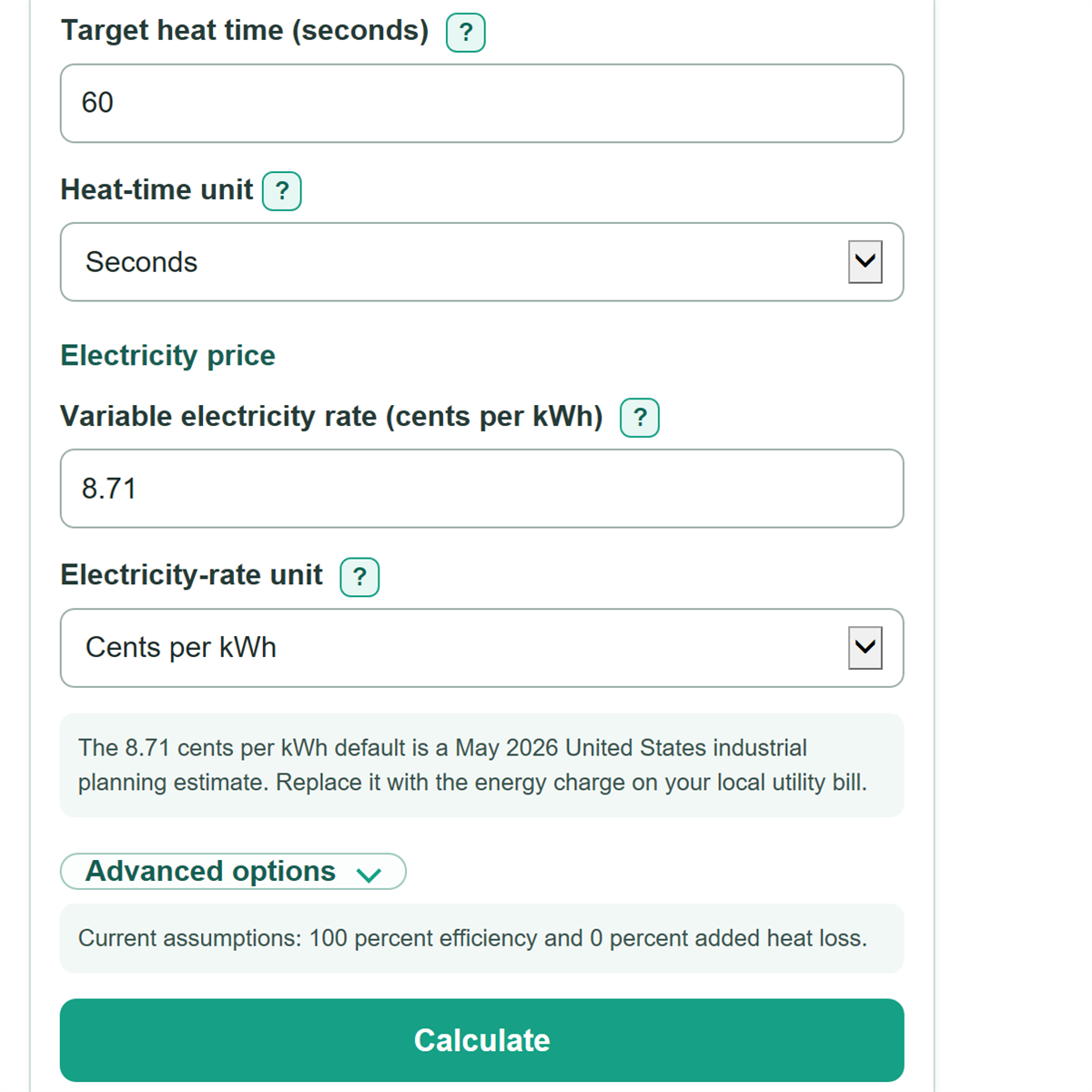
- Enter Target heat time or Available generator power, then enter the Variable electricity rate using the matching Electricity-rate unit.
- Check that the calculated temperature rise matches the process plan and compare estimated electrical energy per part with logged kWh per cycle when measurements are available.
Definitions
Induction heating: Heating conductive metal with an alternating electromagnetic field, usually from a coil near the workpiece. [2]
Specific heat: The heat needed to raise one pound of a material by 1 F. This calculator uses Btu per lb-F.
Calculated temperature rise: Target temperature minus start temperature, expressed as Fahrenheit degrees for the thermal equation.
Overall electrical-to-part efficiency: The percent of generator input energy estimated to become heat in the part.
Additional heat-loss allowance: An extra percent added to ideal part heat for losses not already included in efficiency.
Electrical energy per part: Estimated generator input energy for one cycle, in kWh.
Variable electricity rate: The kWh-based charge from an electricity bill. It does not include fixed monthly or demand charges.
Common mistakes and quick fixes
Mistake: Entering the full casting or assembly weight in Heated part weight when only a small zone is heated.
Fix: Enter only the metal mass that reaches the target temperature in this cycle.
Mistake: Entering a temperature rise in Start temperature or Target temperature.
Fix: Enter two actual temperatures. Target temperature must be higher than Start temperature.
Mistake: Treating Available generator power as power absorbed by the metal.
Fix: Enter the generator rating and adjust Overall electrical-to-part efficiency when measured or supplier process data is available.
Mistake: Using 8.71 as dollars in Variable electricity rate when Electricity-rate unit is $ per kWh.
Fix: Choose Cents per kWh for 8.71, or enter 0.0871 after choosing $ per kWh.
Mistake: Reducing Overall electrical-to-part efficiency and also adding the same losses in Additional heat-loss allowance.
Fix: Check Calculate and then recalculate. Leave Additional heat-loss allowance at 0 when the efficiency already includes coil, radiation, conduction, and setup losses.
Mistake: Reading Estimated variable electricity cost per part as the complete utility cost.
Fix: This output uses kWh-based energy charges only; fixed customer charges and peak-demand charges are excluded.
Limitations & Key Assumptions / Boundary Conditions
- This is a sensible-heat planning estimate based on heated weight, one average specific-heat value, and the entered temperature rise.
- It does not model coil geometry, coupling, frequency, magnetic changes, skin depth, part movement, or power control during the cycle.
- It excludes latent heat and phase changes. Do not use it alone where melting, major phase changes, or temperature-dependent material behavior matter.
- Efficiency defaults to 100 percent and additional heat-loss allowance defaults to 0 percent. These are ideal assumptions, not typical induction-system performance claims.
- Do not add a heat-loss allowance if the entered overall efficiency already includes those same losses.
- Estimated variable electricity cost per part includes only kWh-based cost. Fixed customer charges and peak-demand charges can change total plant cost but are not proportional to one cycle.
- Use measured kWh per part and actual heating trials to size equipment or approve a production process.
Methodology
Thermal energy calculation
The calculator first finds the part temperature rise. A Celsius temperature difference is converted to Fahrenheit degrees by multiplying by 1.8.
ΔT (temperature rise in F) = target temperature - start temperature
Q (ideal heat in Btu) = heated part weight (lb) x specific heat (Btu per lb-F) x ΔT (F)
It converts Btu to kWh thermal using 0.00029307107 kWh per Btu.
Ideal part heat (kWh thermal) = Q (Btu) x 0.00029307107
Losses, energy, and the selected answer
Additional heat-loss allowance increases ideal part heat. Overall electrical-to-part efficiency then converts that adjusted part heat into estimated generator input energy.
Electrical energy per part (kWh) = ideal part heat x (1 + heat-loss allowance / 100) / (efficiency / 100)
In Required generator power mode, the calculator divides input energy by the target heat time. In Heating time mode, it divides input energy by available generator power.
Generator power needed (kW) = electrical energy per part x 3600 / target heat time (seconds)
Heating time (seconds) = electrical energy per part x 3600 / available generator power (kW)
For cost, cents per kWh are divided by 100 before multiplication. The default 8.71 cents per kWh is a May 2026 United States industrial planning estimate; replace it with the applicable kWh-based bill charge. [1]
Variable electricity cost per part ($) = electrical energy per part (kWh) x electricity rate ($ per kWh)
Worked example
A 10 lb part with specific heat 0.10 Btu per lb-F heated from 70 F to 1,070 F has a 1,000 F rise. Its ideal part heat is 10 x 0.10 x 1,000 = 1,000 Btu, or 0.29307107 kWh thermal. With 80 percent efficiency and a 10 percent added heat-loss allowance, estimated input energy is about 0.4030 kWh. Over 60 seconds, the estimated generator power needed is about 24.18 kW.
Assumptions and limits
The calculation uses an average user-entered specific heat and does not model changing material properties, phase changes, coil coupling, frequency, or power changes during heat-up. Electricity cost is a variable kWh cost only; fixed and demand charges are excluded.