
Convert a veterinarian-approved plain diphenhydramine dose guide into liquid mL or tablet parts. Confirm the dose, product and schedule with your vet before giving it.
Advanced options
How to use our Cat Benadryl Dosage Calculator
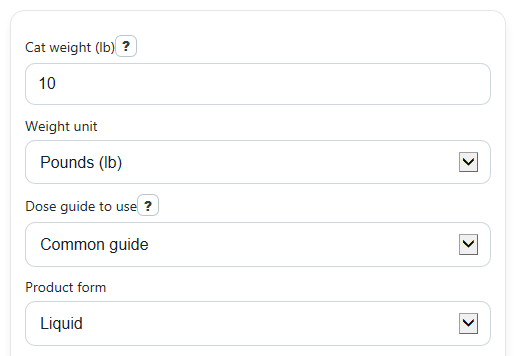
- Enter your cat's current weight in Cat weight, then choose the matching Weight unit.
- Pick a Dose guide to use. Use Common guide for the familiar 1 mg per lb estimate, or Range view to see the lower and upper mg per dose range and choose a Target inside range.
- Select Product form and enter Product strength exactly as the label shows: mg per 5 mL for liquid or mg per tablet for tablets.
- Open Advanced options to match How often to your veterinarian-approved schedule or adjust Practical rounding step, then click Calculate.
- Check that Target dose, How much to give from your product, and Product strength check make sense together. If the amount is tiny, awkward to split, or the product is not plain diphenhydramine, do not guess and contact your vet.
Definitions
Diphenhydramine: The medicine in Benadryl. For cats, use only plain diphenhydramine, not combination products.[1]
Target dose: The estimated amount of diphenhydramine for one dose, shown in mg per dose.
Dose range: The lower and upper guideline amounts based on body weight, shown in mg per dose.
Product strength: How much medicine is in your product. For liquid, this calculator reads it as mg per 5 mL. For tablets, it reads it as mg per tablet.
mL: Milliliters, a liquid volume unit used on oral syringes and medicine cups.
Tablet fraction: Part of one tablet, such as 1/4 tablet or 1/2 tablet.
Total in 24 hours: The amount in mg your cat would get across a full day based on the selected schedule.
Common mistakes and quick fixes
Mistake: Typing a number in Cat weight but leaving the wrong Weight unit selected.
Fix: Make sure pounds use Pounds (lb) and kilograms use Kilograms (kg) before you calculate.
Mistake: Entering liquid concentration in a different format than the Product strength label expects.
Fix: In liquid mode, enter Product strength as mg per 5 mL only. If your bottle uses another format, convert it first or ask a pharmacist or vet.
Mistake: Using Common guide but expecting Dose range to replace the main single estimate.
Fix: Read Target dose as the main one-dose estimate, and use Range view when you want the full Dose range and a chosen point inside it.
Mistake: Trying to measure a very tiny liquid amount from How much to give from your product .
Fix: If the amount is below 0.1 mL or the Product strength check says it is hard to measure, ask your vet about a different strength or a compounded liquid.
Mistake: Trying to split a tablet into a very small piece because the How much to give from your product result is less than one-quarter tablet.
Fix: Use the exact tablet fraction as a guide, but if Product strength check warns it is too small to split well, contact your vet instead of eyeballing it.
Mistake: Ignoring Safety notes when the medicine is a combo cold or allergy product.
Fix: Use only plain diphenhydramine and stop if the label includes extra active ingredients such as a decongestant.
Limitations & Key Assumptions / Boundary Conditions
- This tool estimates an oral plain diphenhydramine dose from body weight. It does not diagnose the cause of itching, swelling, vomiting, or breathing trouble.
- The common guide uses 1 mg per lb, while Range view uses 2 to 3 mg per kg. AAHA lists the range for oral treatment of feline allergic skin disease every 12 hours.[3] Other indications and intervals require a veterinarian-specific plan.
- Liquid calculations assume Product strength is entered as mg per 5 mL only. Tablet calculations assume mg per tablet only.
- Practical rounding is for easier measuring, but rounded amounts can differ from the exact result. That difference matters more in small cats.
- Very small liquid volumes and tablet pieces smaller than one-quarter tablet may be too hard to measure accurately at home.
- Results can differ from a vet's instructions if your cat has other health problems, takes other medicines, is very young, is elderly, or needs a different schedule.
- Urgent signs such as facial swelling, trouble breathing, collapse, repeated vomiting, or seizures need prompt veterinary care instead of home dosing.
Methodology
How the calculator works
This calculator first converts weight so it can show both the familiar consumer estimate in pounds and the veterinary range in kilograms. It then converts the chosen mg dose into either liquid mL or a tablet fraction, based on the product form you selected.
Formula steps
weight_kg = weight_lb / 2.2046226218
weight_lb = weight_kg * 2.2046226218
target_dose_mg = weight_lb * 1
low_dose_mg = weight_kg * 2
high_dose_mg = weight_kg * 3
mid_dose_mg = (low_dose_mg + high_dose_mg) / 2
liquid_ml = target_dose_mg / (strength_mg_per_5ml / 5)
tablet_fraction = target_dose_mg / strength_mg_per_tablet
doses_per_day = 24 / interval_hours
daily_total_mg = target_dose_mg * doses_per_day
Worked mini-example
Suppose your cat weighs 10 lb, you use Common guide, you have liquid, and the label says 12.5 mg per 5 mL. The target dose is 10 mg because 10 lb x 1 mg per lb = 10 mg.[1]
target_dose_mg = 10 * 1 = 10 mg
The liquid has 2.5 mg in each mL because 12.5 divided by 5 = 2.5 mg per mL.
liquid_ml = 10 / (12.5 / 5) = 4 mL
If How often is every 12 hours, that is 2 doses per day.
daily_total_mg = 10 * 2 = 20 mg per day
How to read the range view
In Range view, the calculator always shows both ends of the weight-based range and then uses your selected Target inside range for the product conversion. Low end uses 2 mg per kg, high end uses 3 mg per kg, and middle uses the average of those two values. AAHA lists the range every 12 hours for feline allergic skin disease; selecting a point in the range does not establish the right dose for your cat.[3]
Assumptions behind the results
The calculator assumes the product is plain diphenhydramine, the entered strength matches the form you chose, and the dose is being estimated for oral use. It also assumes home measuring is reasonable, so it warns when the amount is below 0.1 mL for liquid or below one-quarter tablet for tablets, because those amounts are often hard to give accurately.