
Use this cat BMI calculator to estimate a rough body-size score from weight and body length, then compare it with optional body condition score guidance.
Advanced options
Body condition score (BCS)
Score label
Number display
How to use our Cat BMI Calculator
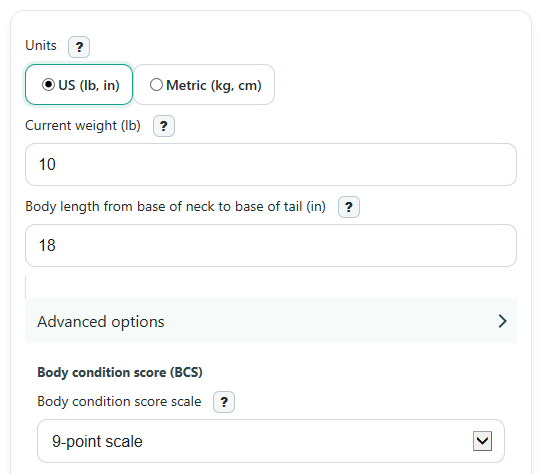
- Pick Units, then enter Current weight (lb) and Body length from base of neck to base of tail (in) or the metric versions if you measured in kg and cm.
- Measure body length along the body from the base of the neck to the base of the tail, without including the tail or stretching your cat.
- If you know it, open Advanced options and choose Body condition score scale and Body condition score to estimate Estimated ideal weight from BCS and Weight change to reach estimated ideal.
- Click Calculate, then read Cat BMI-style score first and compare it with What the score suggests and Body condition score meaning if shown.
- Sanity-check the result: if the score seems extreme, remeasure Body length from base of neck to base of tail carefully and make sure you used the active unit system for every entry.
Definitions
Cat BMI-style score: A rough index based on body weight and body length. Higher values usually mean more weight for the cat's length.
Body condition score (BCS): A hands-on body fat check used in pet care. It is more standard than a simple BMI-style ratio for screening body condition [1].
Body condition score scale: The scoring system used for BCS, usually 9-point or 5-point. You must match the scale to the score you enter.
Estimated ideal weight from BCS: A target weight estimated from the current weight and chosen BCS. It uses the selected weight unit.
Weight change to reach estimated ideal: Current weight minus estimated ideal weight. Positive means weight above the estimated ideal, and negative means weight below it.
Score guide: The interpretation setting that either shows a simple under-ideal-over label or shows only the raw score with a caution note.
Common mistakes and quick fixes
Mistake: Entering pounds in Current weight (kg) or kilograms in Current weight (lb) .
Fix: Match the number to the selected Units option and fill in only the weight field for that active unit system.
Mistake: Measuring the full cat including the tail for Body length from base of neck to base of tail .
Fix: Measure only from the base of the neck to the base of the tail along the body, then enter that number in the active length field.
Mistake: Treating Cat BMI-style score like a diagnosis or exact body-fat test.
Fix: Use What the score suggests as rough guidance and compare it with Body condition score meaning if you entered BCS.
Mistake: Picking the wrong Body condition score scale before choosing Body condition score .
Fix: Use the same scale your chart or vet uses, because a 5-point score and a 9-point score are not interchangeable.
Mistake: Reading Weight change to reach estimated ideal backwards.
Fix: A positive value means the current weight is above the estimated ideal, while a negative value means the current weight is below it.
Mistake: Ignoring Important notes when the cat is a kitten, pregnant, very muscular, or has fluid buildup.
Fix: Treat the calculator as a screening tool and ask a vet to confirm concerns when those notes apply.
Limitations & Key Assumptions / Boundary Conditions
- This calculator uses a BMI-style ratio from weight and body length, which is only a rough screening number for cats.
- Veterinary screening more commonly uses body condition score, body weight, muscle condition, and exam findings together rather than a single ratio [1].
- Small measurement errors in Body length from base of neck to base of tail can change the score a lot because length is squared in the formula.
- Breed, frame size, body shape, amputations, and unusual muscle mass can make the index less representative.
- Kittens, pregnant cats, and cats with fluid buildup or major muscle loss may not fit the ideal-weight estimate well.
- The BCS-based ideal weight is an estimate from rule-of-thumb mappings, not a personalized treatment target.
- If your cat's score, weight trend, appetite, or activity seems concerning, real-world care decisions should be confirmed with a veterinarian.
Methodology
How the calculator works
This calculator first converts the active inputs to metric units when needed, then computes a cat BMI-style index from weight and body length. It can also estimate an ideal weight from body condition score, which is often more useful for screening than the raw index alone [1].
cat_bmi = weight_kg / (length_m^2)
length_m = length_cm / 100
weight_kg = weight_lb x 0.45359237
length_cm = length_in x 2.54
The score is reported in kg/m^2. If you choose the simple score guide, the calculator gives a rough plain-language interpretation. Because online cat BMI pages use different cutoffs, that interpretation is only a guide, not a clinical label.
BCS-based ideal weight
If you enter a body condition score, the calculator estimates ideal weight from the current weight and the selected BCS scale.
ideal_weight_9_point = current_weight / (1 + 0.10 x (bcs9 - 5))
ideal_weight_5_point = current_weight / factor
factor = 0.70, 0.85, 1.00, 1.15, 1.30 for BCS 1 to 5
weight_change_needed = current_weight - ideal_weight
A positive weight change means the current weight is above the estimated ideal. A negative value means the current weight is below the estimated ideal. If the difference is tiny after rounding, the cat is treated as near the estimated ideal weight.
Mini example
Suppose a cat weighs 10 lb and measures 18 in from the base of the neck to the base of the tail. The calculator converts 10 lb to 4.5359 kg and 18 in to 45.72 cm, or 0.4572 m. Then the BMI-style score is 4.5359 / (0.4572 x 0.4572) = about 21.71 kg/m^2. If the same cat has a BCS of 5 on the 9-point scale, the estimated ideal weight stays 10 lb, so the weight change needed is 0 lb.
Assumptions used
The method assumes body length was measured correctly along the body and that hidden unit fields are ignored. It also assumes the BCS mapping is only an estimate. Real veterinary assessment may differ because clinicians also consider muscle condition, overall build, age, health status, and physical exam findings [1].