
Estimate your dog's body size index, compare it with body condition score, and see an estimated ideal weight in one quick check.
Advanced options
How to use our Dog BMI Calculator
- Choose a method under What do you want to calculate?, then enter Current weight and the matching size measure: Body length or Height at shoulders.
- Select Body condition score (1 to 9) based on how your dog looks and feels, especially ribs, waist, and abdominal tuck.
- If needed, open Advanced options to switch Units or decide whether to show Show weight change estimate from BCS.
- Click Calculate, then read BCS meaning and Estimated ideal weight before focusing on the Body size index, since the index alone is only a rough screen.
- Sanity-check the result: if Method note mentions a caution, or if the number seems extreme, remeasure the same body part while your dog is standing and compare it with your selected Body condition score (1 to 9).
Definitions
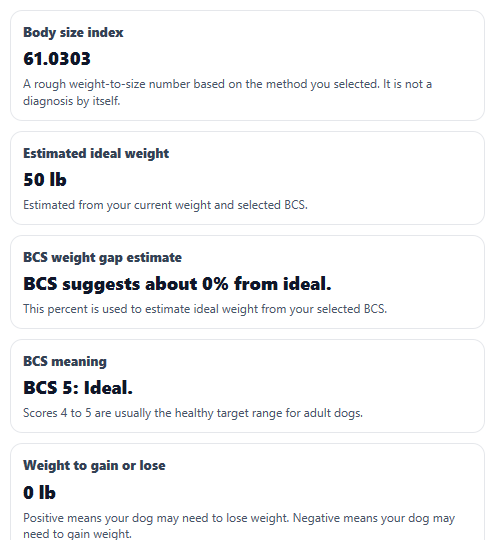
Body size index: A rough weight-to-size number calculated from weight and either body length or shoulder height. Higher or lower values can help screening, but this number alone does not measure body fat directly.
Body condition score (1 to 9): A hands-on body fat check used in veterinary practice. On this scale, 4 to 5 is usually the ideal range, while higher scores suggest excess body fat.
Estimated ideal weight: A target weight estimated from your dog's current weight and selected body condition score, not from the body size index alone.
Weight to gain or lose: The difference between Current weight and Estimated ideal weight. A positive value means lose weight; a negative value means gain weight.
Percent from ideal weight: How far your dog's current weight is above or below the estimated ideal weight as a percent.
Body length: The distance from the point of shoulder to the point of buttock while your dog is standing.
Height at shoulders: The distance from the floor to the top of the shoulders, also called the withers.
Common mistakes and quick fixes
Mistake: Entering Height at shoulders while What do you want to calculate? is set to Body length method, then expecting that height to affect the answer.
Fix: If you want to use height, switch What do you want to calculate? to the height method. Otherwise, enter and recheck Body length .
Mistake: Measuring Body length from nose to tail instead of shoulder point to buttock point.
Fix: Remeasure Body length from the point of shoulder to the point of buttock while your dog is standing.
Mistake: Leaving Units on US but typing kilograms or centimeters into Current weight , Body length , or Height at shoulders .
Fix: Match the entry units to Units first, then re-enter Current weight and the measurement in the same system.
Mistake: Picking the wrong Body condition score (1 to 9) and trusting the Estimated ideal weight too much.
Fix: Recheck ribs, waist, and tummy tuck, then choose the closest Body condition score (1 to 9) because that score drives the weight target estimate.
Mistake: Reading Weight to gain or lose backwards when the value is negative.
Fix: Use the sign rule shown on the page: positive means your dog may need to lose weight, and negative means your dog may need to gain weight.
Mistake: Using this tool for a puppy, very muscular dog, or unusual body shape without noticing the caution in Method note .
Fix: Treat Body size index as a rough screen only and put more weight on BCS meaning and veterinary advice when Method note flags reliability issues.
Limitations & Key Assumptions / Boundary Conditions
- This calculator is a screening tool. It combines a morphometric index with Body condition score (1 to 9), but it does not directly measure body fat.
- Estimated ideal weight depends mostly on the selected BCS. If the BCS is off by even one point, the target weight can change a lot.
- The body length and height formulas are broad size-to-weight estimates, so dogs with very unusual proportions, amputations, or heavy muscle may look mismatched to the index.
- Results are less reliable for puppies, pregnant or lactating dogs, many seniors, and dogs with illness, fluid buildup, or recent major weight change.
- For BCS 1 to 3, underweight estimates are especially rough. Weight loss from illness or low muscle can make body-shape formulas misleading.
- This page does not use breed-specific math. That avoids unsupported guesses, but it also means breed build differences are not fully captured.
- If a very small measurement creates an extreme Body size index, the math still runs, but the first step should be to recheck the measurement.
Methodology
How the calculator works
This page uses one rough body-size formula plus a required body condition score check. The main idea is simple: the body-size number gives a screening estimate, but the selected Body condition score (1 to 9) gives the more practical weight-target result.
Formulas used
MBMI = body_weight_kg / (body_length_m ^ 2)
The body length method uses weight in kilograms and body length in meters.
HBMI = body_weight_kg / (height_withers_m ^ 2)
The height method uses weight in kilograms and shoulder height in meters.
ideal_weight = current_weight / (1 + p)
For BCS above 5, p is the extra-weight fraction implied by the selected score. This page uses 10% for BCS 6, 20% for BCS 7, 30% for BCS 8, and 40% for BCS 9.
ideal_weight = current_weight / (1 - u)
For BCS below 4, u is an estimated underweight fraction. This page uses a simple symmetric estimate: 10% below ideal for BCS 3, 20% below ideal for BCS 2, and 30% below ideal for BCS 1. These low-BCS estimates are rougher than the overweight side.
weight_change = current_weight - ideal_weight
A positive result means the current weight is above the estimated ideal weight. A negative result means the current weight is below the estimated ideal weight.
percent_from_ideal = ((current_weight - ideal_weight) / ideal_weight) * 100
This keeps the sign. Positive means above ideal. Negative means below ideal.
Unit conversions
kg = lb x 0.45359237
m = in x 0.0254
m = cm / 100
US entries are converted before the body-size index is calculated. Ideal-weight math stays in the unit system you selected so the output is easy to use.
Mini example
Suppose your dog weighs 60 lb, What do you want to calculate? is the body length method, Body length is 24 in, and Body condition score (1 to 9) is 7.
ideal_weight = 60 / 1.20 = 50 lb
weight_change = 60 - 50 = 10 lb
percent_from_ideal = (10 / 50) x 100 = 20%
So the most useful takeaway is that the dog is about 20% above the estimated ideal weight and may need to lose about 10 lb, while the body-size index is only a supporting screen.
How to interpret the results
Start with BCS meaning and Estimated ideal weight. Use Body size index as a second opinion, not as the final answer. If the body-size number and the BCS story do not match, recheck the measurements and trust the hands-on body condition assessment more heavily.
Assumptions built into the math
This tool assumes the dog is standing for measurement, the chosen BCS is reasonably accurate, and the standard BCS weight percentages are close enough for screening. Real dogs can differ because of breed build, muscle mass, age, pregnancy, illness, hydration, or body shape, so veterinary assessment can differ from the estimate.
Sources
- Supplementing five-point body condition score with body fat percentage increases the sensitivity for assessing overweight status of small to medium sized dogs - PMC - NIH
- Possibility of morphometric body condition scoring in dogs - GO
- University of North Carolina (PDF) - Canine Body Condition Scores handout (BCS development/validation summary) - UNC
- Canine Obesity: Contributing Factors and Body Condition Evaluation[v1] | Preprints.org - Preprints