
Estimate a plain diphenhydramine dose for your dog by weight, then convert it into tablets or liquid while checking for products you should not use.
Advanced options
How to use our Benadryl Dosage Calculator for Dogs
- Enter your dog's current weight in Dog weight (lb), then set Weight unit to pounds or kilograms so the calculator uses the right starting value.
- Choose Product form, confirm Active ingredient check says plain diphenhydramine only, and set Release type to regular release before you calculate.
- Enter either Tablet strength (mg per tablet) or Liquid concentration (mg per mL), depending on the product you picked, and choose How often to give it.
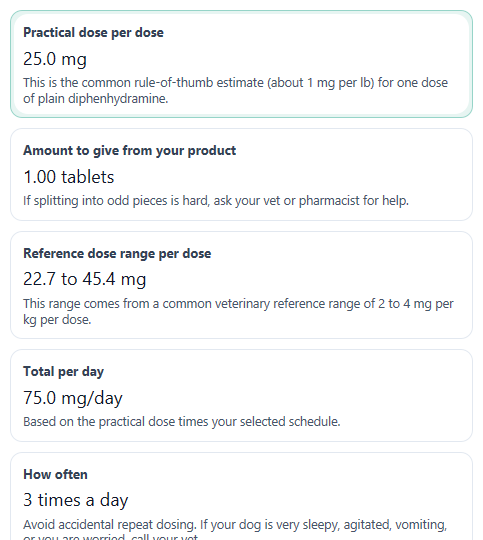
- Click Calculate, then read Safety check first, followed by Practical dose per dose, Reference dose range per dose, and Amount to give from your product.
- Sanity-check the result: the Practical dose per dose should fall inside the Reference dose range per dose, and the converted Amount to give from your product should match your label strength or concentration.
Definitions
Diphenhydramine: The medicine in plain Benadryl. This calculator is only for products where diphenhydramine is the only active ingredient.
Practical dose per dose: A simple one-number estimate for one dose, based on about 1 mg for each pound of body weight.
Reference dose range per dose: A wider veterinary reference range, shown in milligrams for one dose, based on 2 to 4 mg per kilogram of body weight [2].
Tablet strength (mg per tablet): How many milligrams of diphenhydramine are in one tablet or capsule, such as 25 mg.
Liquid concentration (mg per mL): How many milligrams of diphenhydramine are in each 1 mL of liquid. You may need to convert the bottle label first.
Total per day: The estimated number of milligrams over a full day after multiplying one dose by the schedule you selected.
Safety check: A stop-and-check result that warns when the product is not plain diphenhydramine or may be time-release.
Common mistakes and quick fixes
Mistake: Entering a combination cold medicine while leaving Active ingredient check on yes.
Fix: Read the package and use yes only if diphenhydramine is the only active ingredient. If it is not, follow the Safety check and stop using this calculator for that product.
Mistake: Using a time-release product but not changing Release type .
Fix: Set Release type to time-release or not sure if the label says long-acting, extended-release, or you are unsure. The Safety check should then block home dosing from this tool.
Mistake: Typing kilograms into Dog weight while Weight unit is still set to pounds.
Fix: Make sure Weight unit matches the number you entered so the Practical dose per dose is not too high or too low.
Mistake: Entering the bottle label as 12.5 mg per 5 mL directly into Liquid concentration (mg per mL) .
Fix: Convert the label first. For 12.5 mg per 5 mL, enter 2.5 in Liquid concentration (mg per mL) , then check Amount to give from your product .
Mistake: Leaving Tablet strength (mg per tablet) or Liquid concentration (mg per mL) blank for the selected Product form .
Fix: Fill in the matching product field for the form you chose. Tablet products need Tablet strength (mg per tablet) , and liquid products need Liquid concentration (mg per mL) .
Mistake: Treating Total per day as one single dose.
Fix: Use Practical dose per dose for each dose, and use Total per day only as the sum for the full day based on How often to give it .
Limitations & Key Assumptions / Boundary Conditions
- This calculator estimates dose from body weight only. It does not adjust for age, breed, pregnancy, other medicines, or health conditions.
- It is only for plain diphenhydramine products. If Active ingredient check is no or not sure, the tool should not be used for that product.
- It does not calculate dosing for time-release or uncertain release products. If Release type is not regular release, dosing is blocked.
- Amount to give from your product depends completely on the label strength or concentration you enter. A wrong value there gives a wrong tablet or mL amount.
- Tablet splitting can be impractical for odd fractions. A decimal tablet amount is a math conversion, not proof that the tablet can be split accurately.
- The displayed range is a reference range, not a promise that every dog should receive any value within that range.
- If your dog has severe symptoms, possible overdose, or you are unsure about the product label, contact a veterinarian or poison service instead of relying on a calculator.
Methodology
How the calculator works
The tool first checks whether the product is suitable for this calculation. If Active ingredient check is anything other than plain diphenhydramine only, or if Release type is time-release or not sure, it shows a stop message instead of converting the dose into tablets or mL.
Next, it converts body weight as needed so both pound-based and kilogram-based dose rules can be shown.
weight_kg = weight_lb * 0.45359237
weight_lb = weight_kg * 2.2046226218
The practical one-dose estimate uses the common rule of about 1 mg per pound.
dose_mg_practical = 1 * weight_lb
The reference range uses 2 to 4 mg per kilogram per dose [2].
dose_mg_low = 2 * weight_kg
dose_mg_high = 4 * weight_kg
Then the calculator converts the practical milligram dose into the selected product form.
tablets_per_dose = dose_mg_practical / tablet_strength
ml_per_dose = dose_mg_practical / liquid_concentration
The daily total is based on the schedule you choose.
daily_total_mg = dose_mg_practical * doses_per_day
Mini example
Suppose your dog weighs 25 lb, the product is a regular-release plain diphenhydramine tablet, the tablet strength is 25 mg per tablet, and you choose 3 times a day.
dose_mg_practical = 1 * 25 = 25 mg per dose
weight_kg = 25 * 0.45359237 = 11.34 kg
dose_mg_low = 2 * 11.34 = 22.7 mg
dose_mg_high = 4 * 11.34 = 45.4 mg
tablets_per_dose = 25 / 25 = 1 tablet
daily_total_mg = 25 * 3 = 75 mg per day
So the practical one-dose estimate is 25 mg, which sits inside the 22.7 to 45.4 mg reference range, and that equals 1 tablet per dose.
Assumptions used
This method assumes the label entry is correct, the product is plain diphenhydramine, and the release type is regular. It also assumes the product amount is calculated from the practical estimate, while the wider range is shown mainly for context. Real veterinary advice may differ based on your dog's history, other medicines, and the reason the medicine is being considered.