
Enter your DNA fragment lengths, vector mass, and insert-to-vector ratio to calculate the insert DNA mass needed for ligation.
Advanced options
DNA stock volumes
Reaction capacity
Table of contents
How to use our Ligation Calculator
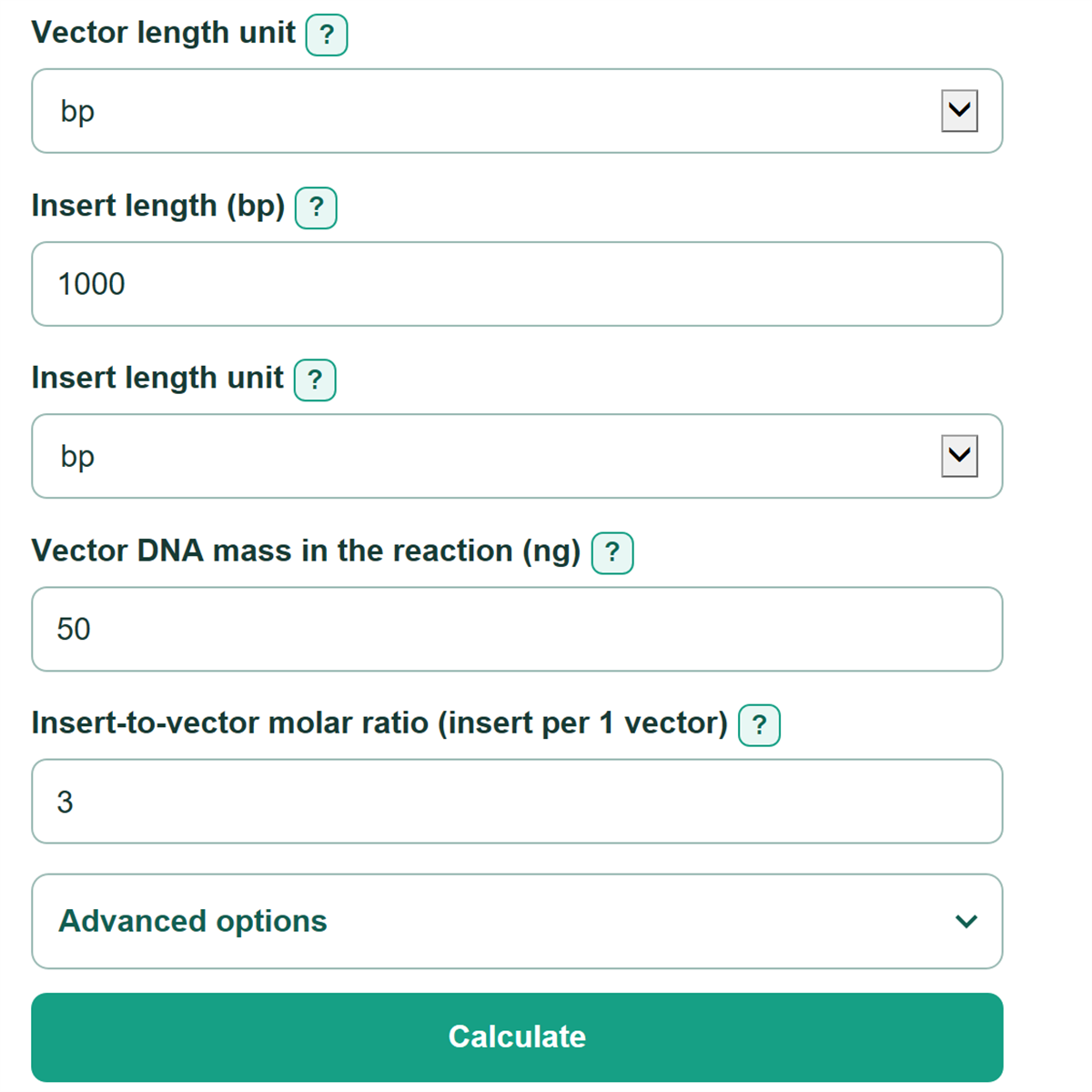
- Enter the vector and insert lengths, and choose bp or kb to match the value in your plasmid map, sequence record, or fragment plan.
- Enter the vector DNA mass for one reaction and the insert-to-vector molar ratio. For a 3:1 plan, enter 3 because it means three insert molecules per one vector molecule.
- Click Calculate to get the required insert DNA mass in ng. Sanity-check it by confirming that, with the other values unchanged, a longer insert needs more mass and a longer vector needs less insert mass.
- Open Advanced options if you need pipetting volumes. Enter each DNA stock concentration to convert the mass targets into uL.
- Add the planned reaction volume and fixed component volumes to see water remaining, then compare each DNA volume with your own minimum practical pipetting volume.
Definitions
Vector: The DNA backbone that receives the insert fragment.
Insert: The DNA fragment intended to join the vector.
Base pair (bp): A paired DNA unit used to measure fragment length.
Kilobase (kb): 1,000 base pairs.
Insert-to-vector molar ratio: A ratio of DNA molecule counts. A value of 3 means three insert molecules for every one vector molecule.
ng: Nanogram, a unit of DNA mass.
ng/uL: Nanograms per microliter, a DNA concentration used to convert a mass target into a liquid volume.
Common mistakes and quick fixes
Mistake: Reversing the insert-to-vector molar ratio.
Fix: Enter the insert-side number. For a 3:1 insert-to-vector plan, enter 3, not 1/3.
Mistake: Treating a molar ratio as an equal-mass ratio.
Fix: Use the calculated insert mass. Different DNA fragment lengths usually need different masses to provide the same number of molecules.
Mistake: Entering a kb value while bp is selected.
Fix: Select kb before entering a value such as 5, or enter 5,000 with bp selected.
Mistake: Entering DNA mass in a stock concentration field.
Fix: Enter the measured concentration in ng/uL for each DNA stock. The calculator divides mass by concentration to find pipetting volume.
Mistake: Assuming a reaction that fits by volume will ligate successfully.
Fix: Follow the exact kit or enzyme protocol and separately confirm DNA-end compatibility, DNA quality, required components, temperature, and incubation conditions.
Limitations & Key Assumptions / Boundary Conditions
- The mass calculation treats DNA mass as proportional to fragment length, so the same average mass-per-base-pair factor cancels when comparing the insert and vector.
- The required insert mass is a target for the selected molecular ratio. It does not verify compatible DNA ends, orientation, phosphorylation, sequence accuracy, fragment purity, or DNA integrity.
- Reaction capacity appears only when both DNA stock concentrations and a planned reaction volume are supplied. Blank buffer, ligase, and other reserved volumes count as 0 uL only for that optional capacity check.
- A positive water value means the listed volumes fit within the stated reaction volume. It does not show that those volumes match the instructions for a specific enzyme or kit.
- The pipetting check uses the minimum volume entered by the user. Appropriate minimum volumes depend on the pipette, tips, liquid handling method, and local laboratory procedure.
- Use the instructions for the exact ligase or cloning kit to select reaction volume, buffer amount, enzyme amount, temperature, and incubation time.
Methodology
Mass calculation
The calculator converts both lengths to base pairs first. A length entered in kb is multiplied by 1,000, and each final length must be a positive whole number of base pairs.
required insert mass (ng) = vector mass (ng) × insert-to-vector ratio × insert length (bp) / vector length (bp)
The formula scales the vector mass by the desired number of insert molecules and by the insert-to-vector length ratio. Since both fragments are DNA, the same average mass-per-base-pair factor applies to both and cancels.
Worked example
With a 5,000 bp vector, a 1,000 bp insert, 50 ng of vector, and a 3:1 insert-to-vector ratio, the required insert mass is 30 ng.
50 × 3 × 1,000 / 5,000 = 30 ng
This is three insert molecules per vector molecule. It does not mean the insert should have three times the vector mass.
Optional pipetting calculations
For each DNA stock concentration entered, the calculator divides the DNA mass by its concentration to find the liquid volume to pipette.
DNA stock volume (uL) = DNA mass (ng) / stock concentration (ng/uL)
If both DNA volumes and the total reaction volume are entered, water remaining is calculated after subtracting the vector, insert, buffer, ligase, and other reserved volumes. A negative water value is retained because it shows how far the plan exceeds the reaction volume.
water remaining (uL) = reaction volume - vector volume - insert volume - buffer volume - ligase volume - other reserved volume