
Enter the first service or AI date to estimate a sow or gilt's farrowing date, and add a later service date for a planning window.
Table of contents
How to use our Swine Gestation Calculator
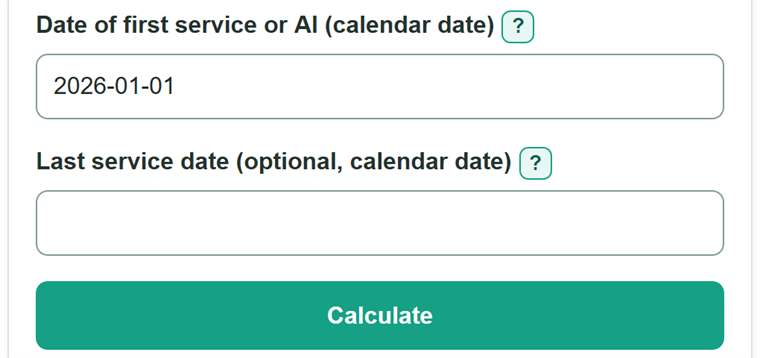
- Find the earliest recorded service or artificial insemination date on the sow card, breeding log, or AI record.
- Enter that date as the first service or AI date.
- If there was service or AI on later days, enter the latest recorded service date; otherwise, leave that field blank.
- Select Calculate, then check that the displayed service span and farrowing window match the dates in the breeding record before using them for planning.
Definitions
Service or AI: A recorded breeding date from natural service or artificial insemination.
Farrowing: The birth of piglets.
Estimated farrowing date: The date found by adding the calculator's 115-day planning interval to the first recorded service date.
Service-based farrowing window: The date range from 115 days after the first recorded service through 115 days after the last recorded service.
Time between first and last service: The number of calendar days between the recorded dates. A value of 0 means one date was used or both dates are the same.
Gestation planning interval: The 115 calendar days used for this projection.
Common mistakes and quick fixes
Mistake: Putting the latest service date in the first date field.
Fix: Enter the earliest recorded service or AI date first, then enter the latest date in the optional field.
Mistake: Entering a last service date before the first service date.
Fix: Check the breeding record. The last service date must be the same as or later than the first service date.
Mistake: Filling in the optional last service field when only one service date was recorded.
Fix: Leave it blank. The calculator will use the first date for both ends of the planning window.
Mistake: Entering a planned farrowing date as the last service date.
Fix: Enter only an actual recorded natural service or AI date in the last service field.
Mistake: Treating the estimate as proof of pregnancy or an exact farrowing date.
Fix: Use it for scheduling and continue to use farm records and veterinary guidance for pregnancy and health decisions.
Limitations & Key Assumptions / Boundary Conditions
- The calculation uses a fixed 115-day planning interval. An individual sow or gilt may farrow earlier or later than the projected date.
- The service-based window reflects only the gap between recorded service dates. It does not include all biological, health, or management factors that can affect timing.
- The estimate depends on accurate breeding records. A missing, incorrect, or reversed date changes the projected date.
- The result is a calendar planning estimate. It does not confirm pregnancy, litter size, animal health, or the start of labor.
- For repeated services, use the actual first and last recorded service dates, not a heat date or planned farrowing date.
Methodology
Calculation method
The calculator starts with the first recorded service or AI date and adds a 115-calendar-day planning interval. If a last service date is entered, it adds the same interval to that date to find the latest estimate.
estimated farrowing date = first service date + 115 calendar days
latest estimate = last service date + 115 calendar days
service span = last service date - first service date
If the optional last service date is blank, the first service date is used for both calculations. If both dates are the same, the service span is 0 days and the farrowing window contains one date. A last service date before the first date is rejected.
Worked example
For a first service date of March 3, 2026, adding 115 calendar days gives June 26, 2026. If the last service date is March 5, 2026, its projection is June 28, 2026. The service-based farrowing window is June 26, 2026 to June 28, 2026, and the service span is 2 days.
Calendar handling
The calculation adds whole calendar days. Month ends, year ends, leap years, and daylight-saving changes do not change the day count.