
Calculate a receiver size for a short air-demand event or estimate compressor cycling for an existing tank.
Table of contents
How to use our Air Receiver Tank Size and Compressor Cycle Time Calculator
- Choose "Choose a receiver size" for a short peak-demand event, or "Check an existing receiver" to estimate cycling from a tank you already have.
- For sizing, enter Peak air demand, Peak event time, Compressor start pressure, and Compressor stop pressure. Choose seconds or minutes for the event time.
- For an existing receiver, copy Existing receiver volume from the tank label, Compressor delivered airflow from its specification, and Average air use while cycling from a demand study or operating estimate.
- Click Calculate. For a tank-size result, choose a nominal receiver at or above the Required receiver size after margin.
- Sanity-check that Compressor stop pressure is higher than Compressor start pressure and, for cycling, that Compressor delivered airflow is greater than Average air use while cycling.
Definitions
SCFM: Standard cubic feet per minute. It is an airflow rate stated at a defined standard-air reference condition.
PSIG: Gauge pressure in pounds per square inch. A tank gauge reads pressure above the surrounding atmosphere.
Compressor start pressure: The receiver pressure where the pressure switch starts the compressor. It is often called cut-in pressure.
Compressor stop pressure: The receiver pressure where the pressure switch stops the compressor. It is often called cut-out pressure.
Usable pressure swing: Compressor stop pressure minus Compressor start pressure. This pressure range supplies usable stored air.
Safety margin: An optional percentage added to the calculated receiver size for planning uncertainty. A 20% margin multiplies the base size by 1.20.
Standard cubic feet: A volume of air expressed at the calculator's atmospheric pressure reference, used to compare stored air with SCFM demand.
Common mistakes and quick fixes
Mistake: Entering a tool's peak rating as Average air use while cycling.
Fix: Use the average demand across the checked operating period for Average air use while cycling.
Mistake: Using motor horsepower instead of Compressor delivered airflow.
Fix: Copy Compressor delivered airflow in SCFM from the compressor manual or specification at its stated pressure.
Mistake: Entering a regulated tool setting as Compressor start pressure or Compressor stop pressure.
Fix: Use the receiver tank pressure where the compressor automatically starts and stops.
Mistake: Reversing Compressor start pressure and Compressor stop pressure.
Fix: Enter the lower automatic-start setting as Compressor start pressure and the higher automatic-stop setting as Compressor stop pressure.
Mistake: Treating Peak event time as a full compressor cycle.
Fix: Enter only the short period that Peak air demand must be supplied in sizing mode.
Mistake: Choosing a tank smaller than Required receiver size after margin.
Fix: Round upward to the next available nominal receiver size and confirm its pressure rating is suitable for the system.
Limitations & Key Assumptions / Boundary Conditions
- The sizing mode assumes the receiver supplies the full Peak air demand for the entered Peak event time. It does not credit compressor airflow during that event.
- The cycle estimate assumes Average air use while cycling stays constant. Real tool use often rises and falls.
- The cycle estimate requires Compressor delivered airflow to be greater than Average air use while cycling. If it is not, the receiver will keep losing pressure under the stated steady demand.
- The storage model uses an idealized isothermal pressure-volume relationship and the editable 14.6959 psi Atmospheric pressure reference. Air temperature, altitude, moisture, piping losses, leaks, and control behavior can change actual results.
- Starts per hour is an estimate, not a manufacturer-approved cycling limit. Check the exact compressor, motor, starter, and control documentation before using it as an operating limit.
- A larger receiver can buffer short demand changes, but it cannot make an undersized compressor meet sustained air demand.
Methodology
Calculation method
The calculator first finds the usable receiver pressure range from the two pressure-switch settings. Gauge pressures are converted through the atmospheric pressure reference so stored receiver air can be compared with SCFM airflow. The default reference is 14.6959 psi, one standard atmosphere expressed in psi. [1]
pressure_swing_psi = cut_out_pressure - cut_in_pressure
For sizing, Peak event time is converted to minutes when seconds are selected. The base receiver volume assumes the receiver alone supplies the entered peak airflow during that short event.
event_duration_minutes = event_duration / 60
receiver_volume_cubic_feet = peak_air_demand * event_duration_minutes * atmospheric_pressure_psi / pressure_swing_psi
base_receiver_gallons = receiver_volume_cubic_feet * 7.48051948
adjusted_receiver_gallons = base_receiver_gallons * (1 + safety_margin_percent / 100)
Existing receiver cycle
For an existing tank, the same pressure relationship estimates usable stored standard air. Off time is storage divided by average demand. On time is storage divided by the compressor's net refill airflow after ongoing demand is supplied.
stored_standard_air_scf = tank_volume / 7.48051948 * pressure_swing_psi / atmospheric_pressure_psi
compressor_off_minutes = stored_standard_air_scf / average_air_demand
compressor_on_minutes = stored_standard_air_scf / (compressor_delivery - average_air_demand)
total_cycle_minutes = compressor_on_minutes + compressor_off_minutes
starts_per_hour = 60 / total_cycle_minutes
Worked example
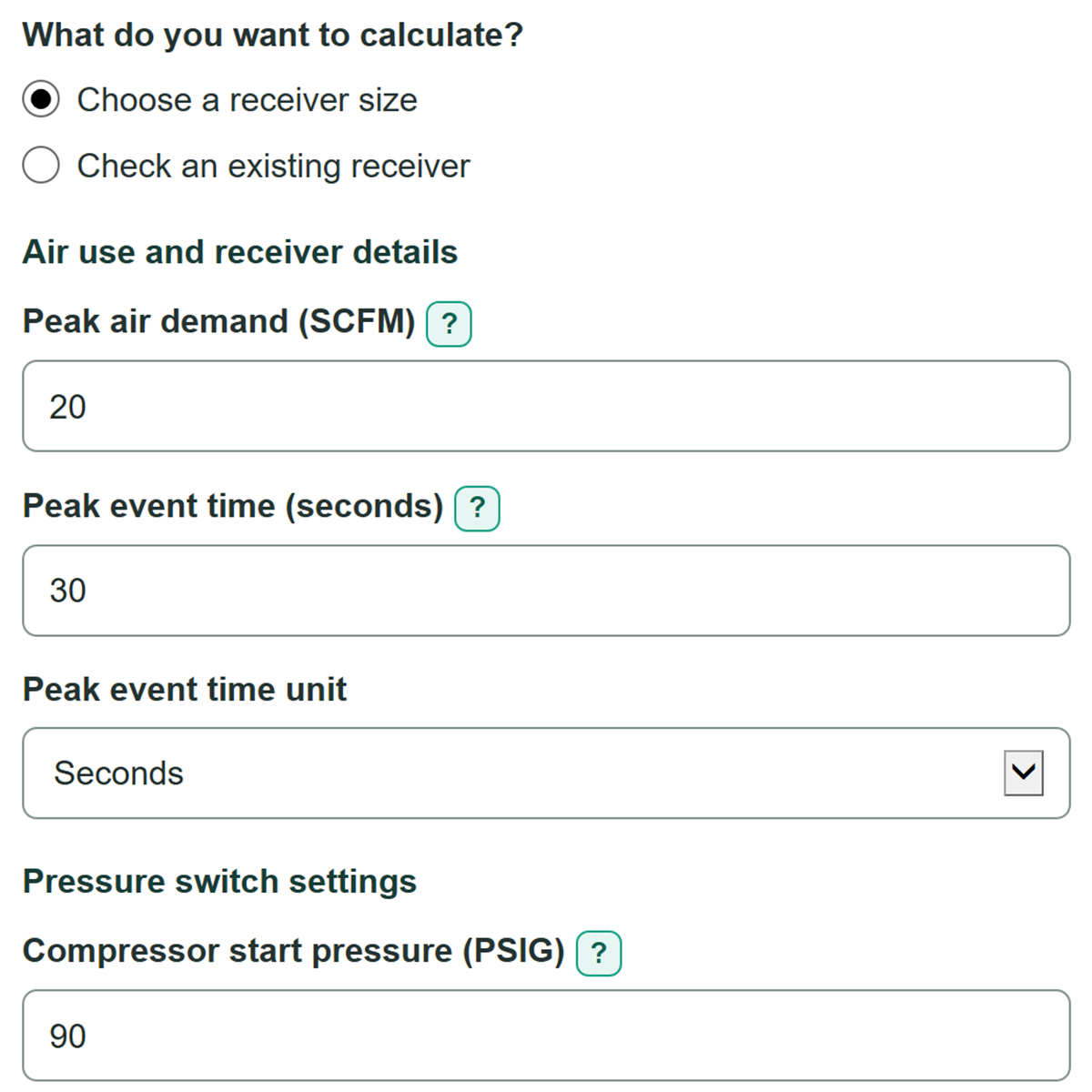
With 20 SCFM peak demand for 30 seconds, a 90 PSIG start pressure, and a 120 PSIG stop pressure, the pressure swing is 30 psi. With no Safety margin, the model gives about 36.64 gallons before rounding up to a nominal receiver size. For a 60-gallon receiver with 15 SCFM Compressor delivered airflow and 5 SCFM Average air use while cycling, the model gives about 1.64 minutes on, 3.27 minutes off, and 4.91 minutes per cycle.