
Enter airflow and a transport-velocity target to size a round dust duct or check air speed in an existing duct.
Table of contents
How to use our Dust Collector Duct Size and Fan Power Calculator
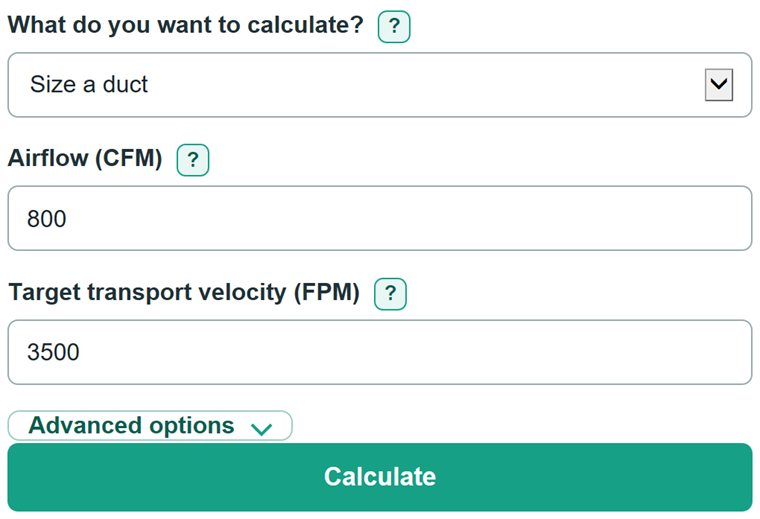
- Choose "Size a duct" to calculate a needed inside diameter, or "Check an existing duct" to test a duct you already have.
- Enter Airflow (CFM) for the hood, machine, branch, or combined points that run at the same time.
- Enter Target transport velocity (FPM) from the dust guidance or engineering specification you are using. In check mode, also enter the Existing round duct inside diameter (inches).
- Click Calculate. For a size result, choose an available inside diameter at or below the calculated diameter, then switch to check mode to test it.
- For an optional power estimate, open Advanced options and enter Total static pressure (in. w.g.) and Fan total efficiency (percent). Sanity-check that the checked duct speed meets your target and that the airflow and pressure match the same fan operating point.
Definitions
Airflow (CFM): Air volume moving through the duct each minute, measured in cubic feet per minute.
Target transport velocity (FPM): The planned air speed inside a duct, measured in feet per minute, used to keep dust moving through that duct.
Inside diameter: The clear width across the inside of a round duct. This width determines its open area.
Total static pressure (in. w.g.): The system resistance the fan must overcome at the planned airflow, measured in inches of water gauge.
Fan total efficiency (percent): The share of fan input power converted into useful air power at the selected operating point.
Air speed above or below the target: Actual duct velocity minus the target velocity. A negative value means the duct is below the selected target.
kWh: A kilowatt-hour, the unit used for electrical energy on most utility bills.
Common mistakes and quick fixes
Mistake: Entering a collector's free-air rating as Airflow.
Fix: Use airflow available at the expected system pressure from a fan curve, measurement, or equipment selection.
Mistake: Using hood capture speed as Target transport velocity.
Fix: Enter the air speed required inside the duct in FPM, not the speed needed at a hood opening.
Mistake: Entering nominal size or outside size for Existing round duct inside diameter.
Fix: Measure the clear inside diameter or use the maker's inside-diameter specification.
Mistake: Entering pressure in Pa for Total static pressure (in. w.g.).
Fix: Convert or obtain total system static pressure in inches of water gauge before entering it.
Mistake: Using motor efficiency for Fan total efficiency (percent).
Fix: Use total fan efficiency at the planned airflow and pressure from the fan curve or fan selection.
Mistake: Treating Estimated monthly variable electricity cost as the whole electric bill.
Fix: Use Electricity price ($ per kWh) for the variable energy charge only; fixed and demand charges are excluded.
Limitations & Key Assumptions / Boundary Conditions
- The duct calculation assumes a round duct and uses its clear inside diameter. It does not size rectangular ducts, branches, hoods, or duct fittings.
- Transport velocity is air speed inside a duct. It does not show capture velocity at a hood or prove that a hood captures dust.
- The calculated diameter is an exact geometric size. Available duct sizes, joints, flex hose, elbows, blast gates, and filter loading can change real airflow and pressure.
- Fan power is calculated only from the entered airflow, total static pressure, and fan total efficiency at one operating point. Confirm available airflow and pressure with the manufacturer fan curve.
- The monthly cost is a variable-energy estimate. It excludes fixed customer charges, demand charges, taxes, equipment costs, and changes in fan load over time.
- The default 3500 FPM value is a replaceable planning value, not a universal target. Dust that is wet, sticky, heavy, abrasive, or combustible may need dust-specific engineering review.
- This tool does not assess combustible-dust hazards, explosion protection, electrical safety, noise, or code compliance.
Methodology
Duct sizing
The calculator first finds the duct area needed for the stated airflow and target transport velocity. The circle constant π (pi) is used to turn that area into a round inside diameter.
A (duct area in sq ft) = Q (airflow in CFM) / V (target velocity in FPM)
d (inside diameter in inches) = 12 x sqrt(4 x A / π)
For example, 800 CFM divided by 3,500 FPM needs 0.228571 square feet of area. The calculated round inside diameter is 6.47362 inches.
Existing duct check
In check mode, the calculator finds the open area of the entered round duct, then divides airflow by that area. The margin stays signed so a shortfall remains visible.
A (existing duct area in sq ft) = π x (d / 12)^2 / 4
Vactual (duct speed in FPM) = Q / A
Vmargin (FPM) = Vactual - Vtarget
With 800 CFM in a 6-inch inside-diameter duct, air speed is about 4,074.37 FPM. Compared with a 3,500 FPM target, the margin is about +574.37 FPM.
Fan power and energy
Fan power is calculated only when both total static pressure and fan total efficiency are entered. Airflow is converted from CFM to cubic meters per second, and pressure is converted from inches of water gauge to pascals before pressure times flow is calculated. The conversion approach follows NIST SI unit guidance [2].
Qm3/s = QCFM x 0.00047194745
Ppa = P(in. w.g.) x 249.08891
Wair = Qm3/s x Ppa
Winput = Wair / (fan efficiency / 100)
HP = Winput / 745.6998715822702
kWh per month = kW x fan runtime per day x operating days per month
$ per month = kWh per month x electricity price per kWh
The prefilled electricity price of $0.0862 per kWh is a 2025 US industrial planning estimate from EIA; replace it with the variable energy price on the local bill [1].