
Choose or check a Schedule 40 steam pipe size using dry-steam flow, velocity, route length, and pressure-drop limits.
Steam data
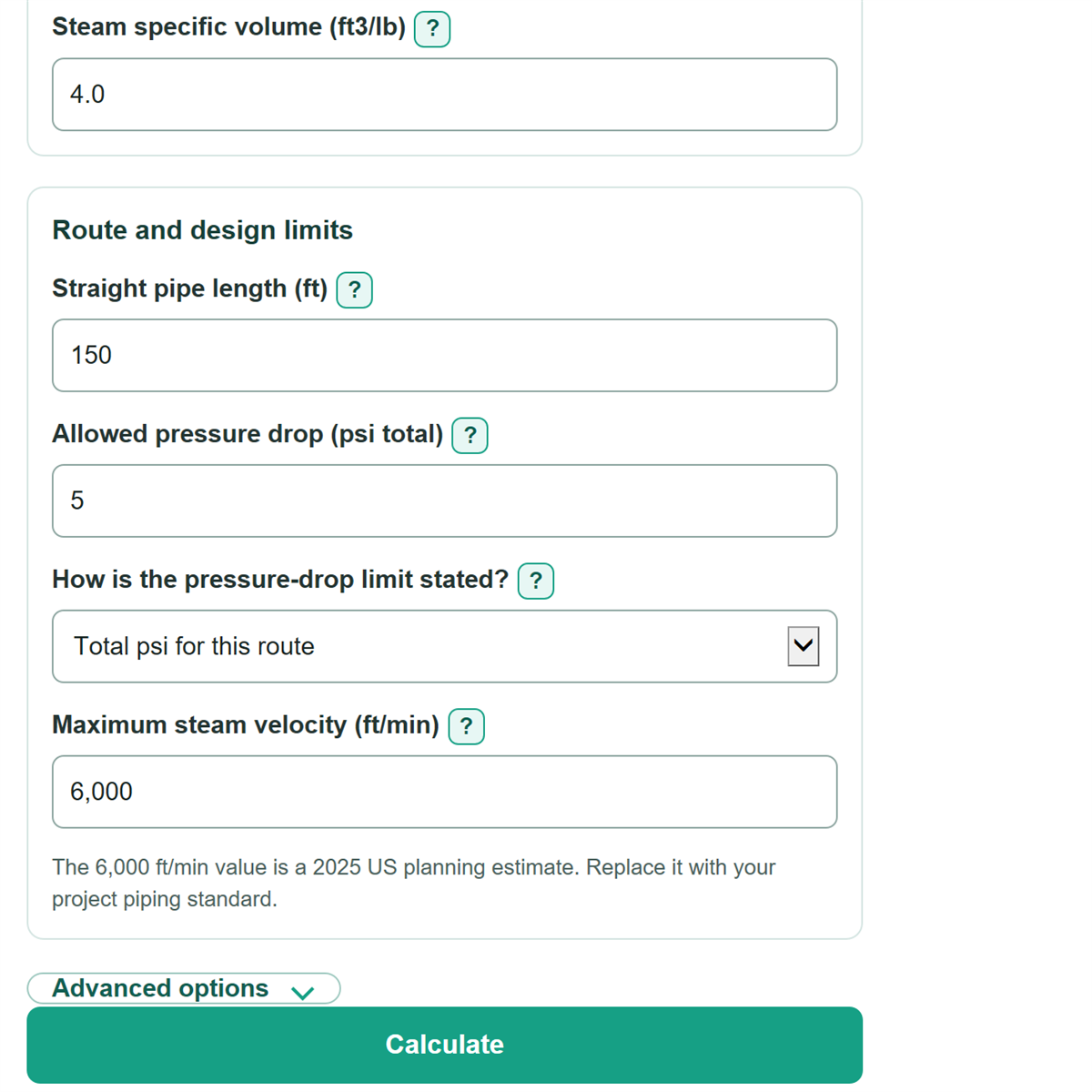
Route and design limits
The 6,000 ft/min value is a 2025 US planning estimate. Replace it with your project piping standard.
Advanced options
Calculation details
Table of contents
How to use our Steam Pipe Size, Velocity and Pressure Drop Calculator
- Choose Choose a pipe size for a new line or Check an existing pipe to test a marked nominal pipe size.
- Enter Steam flow rate (lb/hr), the inlet pressure, its Pressure reference, and Steam specific volume (ft3/lb) from your project steam-property source.
- Enter Straight pipe length (ft), Allowed pressure drop, its basis, and Maximum steam velocity (ft/min) from the project design criteria.
- Open Advanced options only if needed to add Fitting and valve equivalent length (ft) or replace the Darcy friction factor assumption.
- Click Calculate, then check that the estimated outlet pressure meets equipment needs and that both limit-use percentages are at or below 100%.
Definitions
Schedule 40: A common pipe wall-thickness schedule. This calculator uses loaded Schedule 40 steel-pipe nominal sizes and inside diameters. [1]
NPS: Nominal Pipe Size, the named pipe size on a drawing or marking. It is not the actual inside diameter.
psig: Gauge pressure, measured above local atmospheric pressure.
psia: Absolute pressure, measured above a perfect vacuum. The calculator adds 14.6959 psi to a psig inlet value.
Specific volume: The space occupied by one pound of steam, in ft3/lb. Higher specific volume means the same mass flow takes up more pipe area.
Equivalent length: A fitting or valve resistance expressed as an added length of straight pipe.
Darcy friction factor: A unitless value used in the Darcy-Weisbach pressure-loss equation.
Limit used: The estimated value divided by its entered limit, shown as a percent. More than 100% exceeds that limit.
Common mistakes and quick fixes
Mistake: Entering a gauge reading as absolute pressure under Pressure reference.
Fix: Most field gauges use psig. Choose Gauge pressure (psig), or choose Absolute pressure (psia) only when the source labels the value psia.
Mistake: Using NPS as if it were the actual bore size when checking Existing pipe size (NPS, in).
Fix: Choose the marked nominal size. Use Schedule 40 inside diameter used to see the actual diameter used in the calculation.
Mistake: Including elbows and valves in Straight pipe length (ft) and again in Fitting and valve equivalent length (ft).
Fix: Enter measured straight footage in the first field and only added equivalent length in the second field.
Mistake: Treating a psi per 100 ft value as the total Allowed pressure drop for the route.
Fix: Set How is the pressure-drop limit stated? to Psi per 100 ft so the calculator scales it to the full equivalent length.
Mistake: Copying a steam-table value at a different pressure into Steam specific volume (ft3/lb).
Fix: Use the dry saturated-steam specific volume at the inlet absolute pressure shown by Inlet pressure used for calculations.
Mistake: Calling a pipe acceptable after looking only at Estimated steam velocity.
Fix: In check mode, use Existing pipe check and review both the velocity and pressure-drop limit percentages.
Limitations & Key Assumptions / Boundary Conditions
- This is a simplified steady-flow estimate for dry steam. Do not use it for wet steam, two-phase flow, condensate return, startup condensate loading, or water-hammer analysis.
- The model keeps specific volume, density, and the Darcy friction factor constant across the route. Large pressure losses can change steam properties enough to require a compressible-flow calculation.
- Only the listed Schedule 40 steel-pipe nominal sizes are scanned or checked. Different schedules, materials, liners, corrosion allowance, or actual pipe condition can have different inside diameters and friction behavior.
- Fittings and valves affect pressure loss only when their equivalent length is added. Do not double count length already included in a piping-model route.
- Meeting the entered velocity and pressure-drop limits is not a piping-code approval. Confirm drainage, trapping, supports, thermal expansion, noise, erosion, equipment minimum pressure, and project requirements.
- The estimated outlet pressure is a gauge-pressure estimate. It can be negative if the entered inlet pressure and calculated loss produce that mathematical result; such a case needs engineering review.
Methodology
Calculation method
The calculator converts mass flow to inlet volumetric flow using the entered steam specific volume. It then tests each supported Schedule 40 inside diameter from smallest to largest, or tests the selected existing NPS. The nominal-size and actual-inside-diameter table follows the cited Schedule 40 reference. [1]
Q = m * v / 3600
Q is inlet volumetric flow in ft3/s, m is Steam flow rate in lb/hr, and v is Steam specific volume in ft3/lb.
A = π * D^2 / 4
A is pipe flow area in ft2 and D is actual inside diameter converted to feet.
velocity = Q / A * 60
Velocity is reported in ft/min. The recommended size is the first supported size at or below both entered limits.
pressure drop = f * L / D * ρ * velocity^2 / (2 * g * 144)
f is the Darcy friction factor, L is total equivalent length in feet, ρ is steam density in lb/ft3, velocity is converted to ft/s, g is 32.174 ft/s2, and 144 converts the US customary force result to psi.
allowed route drop = entered drop, or entered drop * total equivalent length / 100
This converts a total-psi limit or a psi-per-100-ft limit into one route-level comparison.
Worked example
For 1,000 lb/hr of steam with 4.0 ft3/lb specific volume, 150 ft of straight pipe, no added fitting length, a 5 psi total allowance, a 6,000 ft/min velocity limit, and a 0.02 Darcy friction factor, the first passing loaded size is NPS 1-1/2. Its 1.610 in inside diameter produces about 4,716 ft/min velocity and 3.73 psi estimated route pressure drop.
Pressure reference
inlet psia = inlet psig + 14.6959, or entered psia
The calculator subtracts the estimated pressure loss from inlet psia, then subtracts 14.6959 psi to report estimated outlet pressure in psig.