
Compare quoted hot-pipe insulation choices to find the lowest annualized cost and the fastest simple payback for your project.
Energy use
Quoted insulation choices
Advanced options
Thermal assumptions
Economic assumptions
Table of contents
How to use our Economic Pipe Insulation Thickness and Payback Calculator
- Enter the pipe run length, actual outside diameter, average process temperature, nearby air temperature, and yearly operating time.
- Choose the exact Energy bill rate unit shown on your bill, then enter the consumption-sensitive Energy rate in the selected bill unit and Heat-source efficiency.
- For $/Mcf or $/Ccf, enter the Gas heat content from the bill or supplier record.
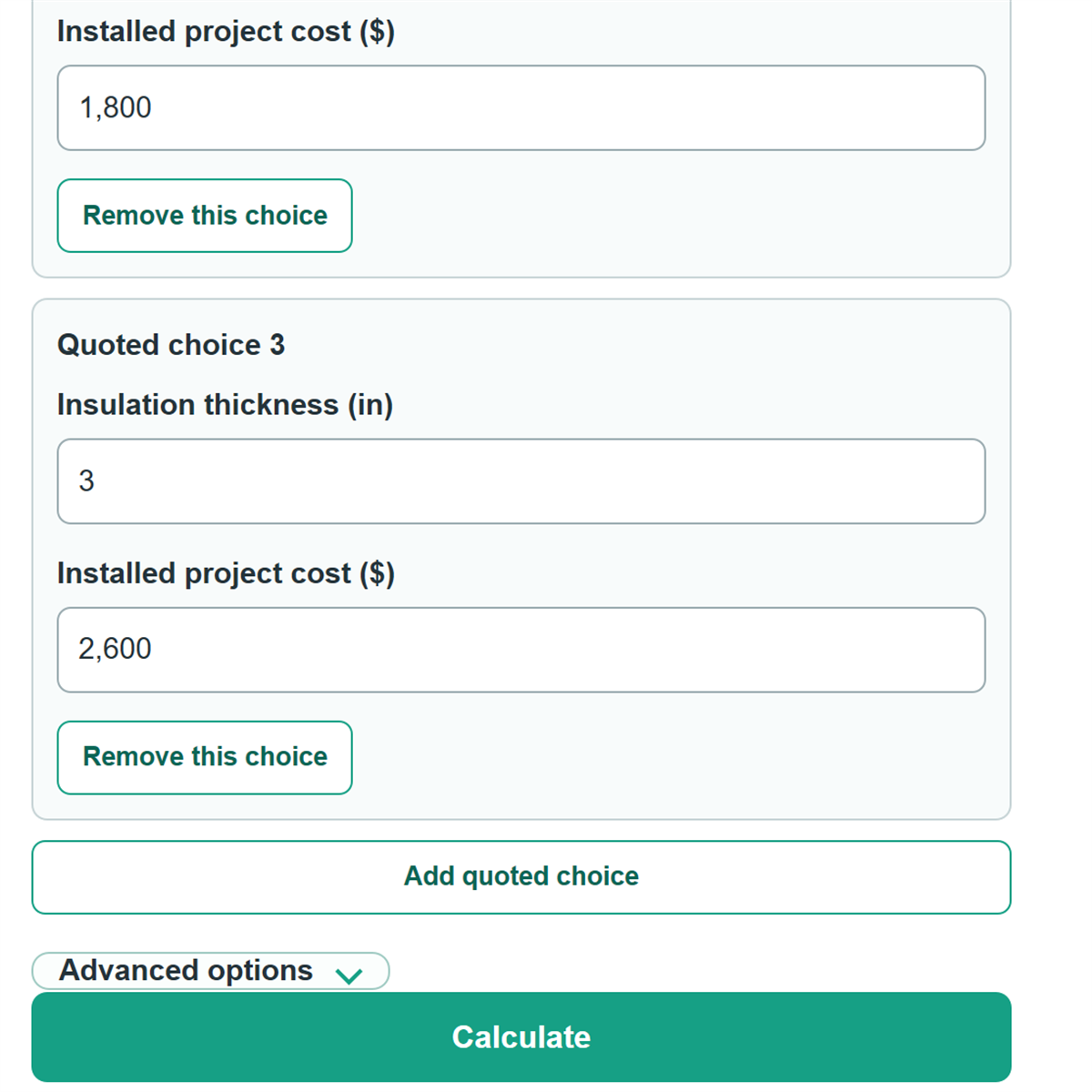
- Replace the Quoted insulation choices example rows with each available thickness and its total installed project cost, including labor and related project work.
- Click Calculate, then compare Recommended quoted thickness with Quoted thickness with the shortest simple payback; check that the cost scope and Advanced options match your project assumptions.
Definitions
Actual pipe outside diameter: The measured outside width of the pipe in inches. It is different from Nominal Pipe Size.
Heat-source efficiency: The share of purchased energy that reaches the pipe as useful heat. Enter 80 for 80 percent.
Heat loss: Heat leaving the hotter pipe and moving into nearby air, reported for the full entered pipe run in Btu/hr.
Insulation conductivity: A material property that describes how readily heat moves through insulation. Lower conductivity means more resistance to heat flow.
Annualized energy and project cost: Annual energy cost plus the yearly equivalent of the installed project cost over the selected Project life and Discount rate.
Simple payback: Installed project cost divided by positive annual energy-cost savings. It does not discount future savings.
Mcf and Ccf: Billing volumes of 1,000 cubic feet and 100 cubic feet of gas. Gas heat content converts either volume to energy.
Therm and kWh: Energy billing units. This calculator uses 100,000 Btu per therm and 3,412.141633 Btu per kWh for rate conversion. [1]
Common mistakes and quick fixes
Mistake: Entering Nominal Pipe Size instead of Actual pipe outside diameter.
Fix: Use the actual outside diameter from a pipe schedule, drawing, or field measurement.
Mistake: Typing a $/therm or cents/kWh number while Energy bill rate unit is set to $/Mcf.
Fix: Choose the exact Energy bill rate unit before entering Energy rate in the selected bill unit.
Mistake: Including a fixed monthly customer charge in Energy rate in the selected bill unit.
Fix: Use a consumption-sensitive rate unless the insulation project will actually change the fixed charge.
Mistake: Using a peak reading for Average process temperature or counting shutdown hours in Operating time.
Fix: Use the average operating temperature and only the hours when the pipe is near that temperature.
Mistake: Entering insulation material cost alone as Installed project cost for the recommended thickness.
Fix: Make each Quoted insulation choices cost include applicable labor, fittings, jacketing, access, removal, and outage work.
Mistake: Treating Estimated outer-surface temperature as a safety approval.
Fix: Use it as a screening estimate and separately verify personnel protection, condensation control, material limits, and project requirements.
Limitations & Key Assumptions / Boundary Conditions
- This is a steady-state hot-pipe screening model. It requires Average process temperature to be higher than Air temperature near the pipe and does not model cold-service heat gain.
- The model uses one insulation conductivity and one combined Outside heat transfer assumption. Air movement, radiation, surface finish, weather, and orientation can change actual heat loss and surface temperature.
- Annual savings include consumption-sensitive energy charges only. Fixed utility customer charges are excluded unless the project changes them.
- The recommendation compares only the quoted thicknesses you enter and the existing bare-pipe case. It cannot recommend a thickness that is missing from Quoted insulation choices.
- Installed project cost must include the scope needed for a fair comparison, such as labor, fittings, jacketing, vapor control, access, removal, and outage work when applicable.
- Estimated outer-surface temperature is not a burn-protection, condensation-control, code-compliance, corrosion, or insulation service-temperature approval.
- Simple payback ignores discounting, maintenance, energy-price changes, taxes, and future operating changes. The annualized-cost result depends on the entered Project life and Discount rate.
Methodology
Heat-loss calculation
The calculator treats the pipe as a cylinder. It first calculates bare-pipe heat loss per foot from the temperature difference and the outside heat-transfer resistance. For each quoted thickness, it adds cylindrical insulation resistance and a new outside resistance at the larger outer radius.
ΔT = process temperature - air temperature
q_bare = ΔT / R_out,bare
R_insulation = ln(r_outer / r_pipe) / (2 π k)
q_insulated = ΔT / (R_insulation + R_out,insulated)
In these equations, q is heat loss per foot, r is radius in feet, and k is Insulation conductivity in Btu per hr-ft-F. Full-run heat loss equals heat loss per foot times Pipe run length.
Energy cost and savings
The selected Energy bill rate unit is converted to dollars per Btu, then the model adjusts pipe heat loss for Heat-source efficiency. This avoids treating a fuel bill as if every purchased Btu reaches the pipe.
annual energy cost = q x pipe length x operating time x energy price per Btu / efficiency
annual energy-cost savings = bare annual energy cost - insulated annual energy cost
For therm and kWh bill entries, the conversion uses 100,000 Btu per therm and 3,412.141633 Btu per kWh. [1]
Economic comparison
Each quote row is evaluated separately. The calculator converts its one-time Installed project cost into an equivalent yearly cost using the entered Project life and Discount rate, then adds annual energy cost. The lowest value wins. If every quote has an annualized cost at least as high as bare pipe, the bare condition is recommended.
annualized cost = annual energy cost + installed cost x capital recovery factor
simple payback = installed cost / annual energy-cost savings
At a 0 percent Discount rate, the capital recovery factor is 1 divided by Project life. At other rates, it uses the standard capital-recovery equation. Simple payback is shown only when annual savings are positive. A $0 installed cost with positive savings has a payback of 0 years.
Worked mini-example
For a quote with a $1,000 installed cost and modeled annual energy-cost savings of $668, simple payback is about 1.50 years. A different quote can have a longer payback yet still have the lower annualized cost over the chosen project life.