
Estimate heat, energy, and utility-bill savings from adding insulation to accessible hot-water pipes in your home.
Advanced options
Table of contents
How to use our Hot Water Pipe Insulation Savings Calculator
- Enter the accessible Insulated pipe length, Pipe outside diameter, and the usual Hot-water temperature and Air around the pipe temperatures.
- Enter the insulation now on the pipe as Current insulation R-value and the planned upgrade as New insulation R-value.
- Choose the Water-heater energy source, then open Advanced options to check the hours, efficiency, utility price, and installed cost.
- Click Calculate and read Estimated annual utility-bill savings first, followed by purchased energy saved and simple payback time.
- Sanity-check the result: a higher New insulation R-value should produce positive heat-loss reduction and positive savings when hot-water temperature is above surrounding air temperature.
Definitions
R-value: A measure of resistance to heat flow. A higher insulation R-value means less heat moves through the insulation under the same conditions.
Pipe outside diameter: The measured width across the outside of the pipe, not its nominal plumbing size.
Water-heater efficiency: The share of purchased energy that becomes useful heat in the water. For example, 90 percent is entered as 90.
Therm: A natural-gas billing unit equal to 100,000 Btu.
Btu: British thermal unit, a unit of heat energy. This calculator uses Btu per hour for heat-loss rate and Btu per year for annual heat kept from escaping.
Simple payback time: Installed insulation cost divided by estimated annual utility-bill savings, without financing, maintenance, or future price changes.
Common mistakes and quick fixes
Mistake: Entering a nominal pipe size instead of the actual Pipe outside diameter .
Fix: Measure the outside of the pipe or check the pipe manufacturer's dimensions.
Mistake: Setting Hot-water temperature equal to or lower than Air around the pipe .
Fix: Enter a water temperature that is higher than the surrounding air for this hot-water heat-loss estimate.
Mistake: Using 0 for Current insulation R-value to mean bare pipe.
Fix: This comparison requires an R-value above zero. Use a small verified effective R-value only if you have one, or use the result for an insulated-to-insulated comparison.
Mistake: Entering the natural-gas bill price as if it were an electricity price in Utility price .
Fix: Use $ per kWh for electricity and $ per therm for natural gas after choosing Water-heater energy source .
Mistake: Assuming Hours hot water is kept hot each year is always 8,760.
Fix: Use 8,760 only when the pipe stays hot all year; enter fewer hours for a timed system.
Mistake: Treating Estimated simple payback time as a guarantee.
Fix: Use it as installation cost divided by this estimate's annual bill savings; your actual prices and operating time can differ.
Limitations & Key Assumptions / Boundary Conditions
- This is a simplified steady-temperature planning estimate, not an engineering design, code-compliance calculation, or field measurement.
- It treats the entered pipe as a straight cylinder and does not add area for elbows, valves, tees, fittings, or insulation seams.
- It uses labeled insulation R-values with pipe surface area. It does not model bare-pipe convection, radiation, air movement, insulation compression, moisture, gaps, or pipe-wall thermal resistance.
- The entered water-to-air temperature difference is assumed to apply for all entered Hours hot water is kept hot each year. Real pipe temperature changes as water use and heater cycling change.
- Utility-bill savings depend on your actual utility price and Water-heater efficiency. Rates, equipment performance, standby losses, and fuel charges can differ from the entered values.
- Negative savings are retained if the New insulation R-value is lower than the current R-value. In that case, simple payback is not calculated.
Methodology
Heat-loss estimate
The calculator first estimates the outside surface area of the straight pipe. Diameter is converted from inches to feet.
A = π x (D / 12) x L
A is pipe surface area in square feet, D is Pipe outside diameter in inches, and L is Insulated pipe length in feet.
It estimates heat loss for the current and new insulation using the water-to-air temperature difference and each entered R-value.
Q = A x (Twater - Tair) / R
Q is heat loss in Btu per hour. A positive difference between current and proposed heat loss means the new insulation keeps more heat from escaping.
Qreduction = Qcurrent - Qproposed
Annual energy and bill estimate
The hourly heat-loss reduction is multiplied by Hours hot water is kept hot each year. That useful heat is divided by Water-heater efficiency, entered as a decimal in the calculation, to estimate purchased energy avoided.
Hsaved = Qreduction x hours
Esaved = Hsaved / efficiency
For electricity, purchased energy is divided by 3,412.142 Btu per kWh. For natural gas, it is divided by 100,000 Btu per therm. Annual utility-bill savings equal saved kWh or therms multiplied by Utility price.
annual savings = fuel units saved x utility price
Estimated simple payback time is Installed insulation cost divided by positive annual utility-bill savings. It is not shown for zero or negative savings.
payback years = installation cost / annual savings
Worked example
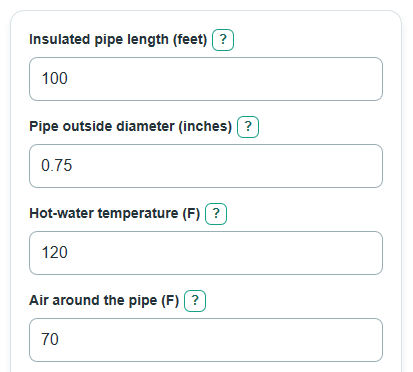
With 100 feet of 0.75-inch pipe, 120 F water, 70 F air, current R-1 insulation, and new R-3 insulation, the estimated heat-loss reduction is about 654.50 Btu per hour. If the pipe stays hot for 8,760 hours, the heater is 100 percent efficient, and electricity costs $0.15 per kWh, the estimated annual utility-bill savings are about $252.04. A $100 installation cost gives a simple payback of about 0.40 years.