
Estimate yearly electricity savings, avoided standby energy, and timer payback from your electric tank water heater schedule and rates.
Advanced options
Table of contents
How to use our Water Heater Timer Savings Calculator
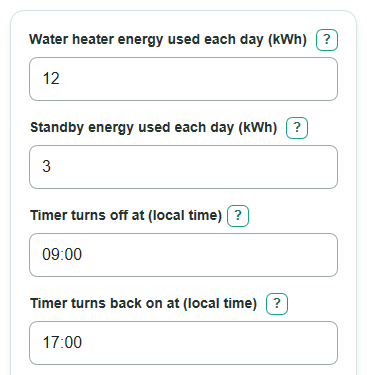
- Enter your Water heater energy used each day and Standby energy used each day. Standby energy must not be higher than total daily energy.
- Set Timer turns off at and Timer turns back on at for the daily period when you plan to keep the tank off.
- Enter your utility's Peak electricity rate and Off-peak electricity rate.
- Open Advanced options to set the peak period and add Timer purchase price and Timer setup cost if you want a payback estimate.
- Check that the reported off-window length and estimated standby energy avoided each day match your schedule. Then compare estimated annual electricity bill savings with the timer's total one-time cost.
Definitions
Standby energy: Electricity used to replace heat lost from stored tank water while no hot water is being drawn. Electric storage water heaters have standby and cycling losses. [1]
Peak period: The daily hours your utility charges at the higher electricity price.
Off-peak rate: The electricity price used outside the peak period in this estimate.
Timer off window: The time from Timer turns off at until Timer turns back on at, including a window that crosses midnight.
Payback time: The one-time timer and setup cost divided by estimated yearly bill savings.
Common mistakes and quick fixes
Mistake: Entering total water-heating energy as Standby energy used each day.
Fix: Enter only the energy used to keep stored water hot when no hot water is being used. It must be no more than Water heater energy used each day.
Mistake: Setting Timer turns off at and Timer turns back on at to the same time.
Fix: Choose different times so the daily off period is clear. Use an overnight end time if needed.
Mistake: Using one blended utility price for both Peak electricity rate and Off-peak electricity rate when your plan has time-based pricing.
Fix: Copy the two rates from your electricity plan and set Peak period starts at and Peak period ends at to the matching daily hours.
Mistake: Reading Estimated annual electricity bill savings as savings from all water-heater use.
Fix: This estimate prices only standby energy avoided while the timer is off. It does not reduce hot-water energy based on fewer showers or loads of laundry.
Mistake: Forgetting electrician labor in Timer setup cost.
Fix: Include all one-time setup charges with Timer purchase price before using Estimated timer payback time to make a buying decision.
Limitations & Key Assumptions / Boundary Conditions
- This is for an electric tank water heater. It does not model gas, heat-pump, tankless, or solar water heaters.
- The estimate assumes standby energy is spread evenly across all 24 hours. Real tank heat loss can change with room temperature, tank temperature, insulation, and hot-water draws.
- It counts only standby energy avoided while the timer is off. It does not model extra reheating after power returns, a timer's own electricity use, or changes in hot-water demand.
- Peak and off-peak periods are treated as one repeating daily window each. Plans with seasonal rates, weekends, holidays, demand charges, or more than two price periods need a separate calculation.
- A timer can leave less hot water available and may not fit every household schedule. Follow the water heater and timer instructions, local electrical rules, and any safety requirements before installation.
- Payback is omitted when one-time cost or estimated annual bill savings is $0.
Methodology
Calculation method
The calculator compares an always-available electric tank with a timer that turns the tank off for part of each day. It treats only the entered standby energy as avoidable during that off window.
off_hours = (off_end_hour - off_start_hour + 24) mod 24
Equal start and end times are rejected because they could mean either no off time or a full-day off period. Timer and peak periods can cross midnight. The calculator splits overnight periods at midnight to find their overlap.
daily_energy_avoided_kwh = daily_standby_kwh * off_hours / 24
daily_bill_savings = daily_standby_kwh * (peak_overlap_hours / 24) * peak_rate + daily_standby_kwh * ((off_hours - peak_overlap_hours) / 24) * offpeak_rate
annual_energy_avoided_kwh = 365 * daily_energy_avoided_kwh
annual_energy_before_kwh = 365 * daily_energy_kwh
annual_energy_after_kwh = annual_energy_before_kwh - annual_energy_avoided_kwh
annual_bill_savings = 365 * daily_bill_savings
timer_payback_years = (timer_cost + installation_cost) / annual_bill_savings
Mini-example
Suppose standby energy is 3 kWh per day and the timer is off from 9:00 AM to 5:
00 PM, or 8 hours. Avoided standby energy is 3 * 8 / 24 = 1 kWh per day, or 365 kWh per year. If one of those hours overlaps a $0.30 per kWh peak period and seven hours use a $0.10 per kWh off-peak rate, yearly bill savings are $45.625. With a $30 timer and $70 setup cost, estimated payback is about 2.19 years.
The yearly comparison uses 365 days and 24 hours per day. A $0 one-time cost has no payback time because there is no cost to recover; $0 estimated annual bill savings also prevents a payback calculation.