
Estimate how changing your water heater setting may change yearly energy use and utility cost.
Table of contents
How to use our Water Heater Temperature Savings Calculator
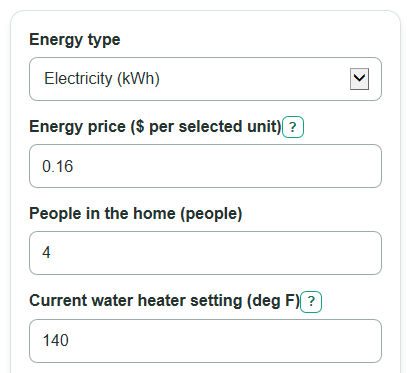
- Choose the Energy type that matches your utility bill, then enter the Energy price in dollars per selected unit.
- Enter People in the home, Current water heater setting, and New water heater setting.
- Open Advanced options if you want to change Hot water used per person, Cold water entering heater, or Heater efficiency from the defaults.
- Select Calculate and read Estimated annual bill savings first; a positive number means the new setting costs less, and a negative number means it costs more.
- Sanity-check the result by comparing Estimated yearly energy at current setting with Estimated yearly energy at new setting; the lower temperature should usually use less energy when all other inputs stay the same.
Definitions
Energy type: The utility fuel or energy unit used by the water heater: electricity in kWh, natural gas in therms, propane in gallons, or heating oil in gallons.
Energy price: The cost of one selected energy unit, such as dollars per kWh or dollars per therm.
Setpoint: The temperature setting on the water heater control, shown in this calculator as Current water heater setting and New water heater setting.
Hot water used per person: Gallons per day of hot water leaving the heater for each person, not the larger mixed-water amount at a showerhead or faucet.
Cold water entering heater: The starting temperature of water before the heater warms it.
Heater efficiency: The percent of purchased energy that becomes heat in the water. A lower percent means more utility energy is bought for the same hot water.
Btu: A heat unit used inside the calculation. One Btu is the heat needed to warm about one pound of water by 1 deg F.
Common mistakes and quick fixes
Mistake: Entering Energy price in the wrong unit for the selected Energy type.
Fix: Use $ per kWh for electricity, $ per therm for natural gas, or $ per gallon for propane or heating oil.
Mistake: Using total mixed shower water for Hot water used per person.
Fix: Enter only the hot water leaving the heater, before it mixes with cold water at the faucet.
Mistake: Setting Cold water entering heater equal to or above Current water heater setting or New water heater setting.
Fix: Enter an inlet temperature lower than both heater settings, such as 55 deg F if you do not know it.
Mistake: Treating a negative Estimated annual bill savings as an error.
Fix: A negative value means the New water heater setting is higher-cost than the Current water heater setting.
Mistake: Leaving Heater efficiency at 100 percent for a fuel-fired heater when you know its real efficiency is lower.
Fix: Enter the known Heater efficiency percent so Estimated yearly energy at current setting and Estimated yearly energy at new setting are based on purchased fuel.
Limitations & Key Assumptions / Boundary Conditions
- The estimate covers energy used to heat the entered hot water volume. It is not the whole-home utility bill.
- The calculator assumes Hot water used per person stays the same after the setpoint changes. Real use can change if people adjust showers, fixtures, or mixing valves.
- Tank standby losses, pipe losses, recirculation loops, vacation schedules, and time-of-use utility rates are not modeled.
- Cold water entering heater is a single average value. Seasonal inlet temperature changes can move the real yearly result up or down.
- Heater efficiency is treated as one steady percent. Real fuel-fired and heat pump water heaters can vary by operating condition.
- A New water heater setting below 120 deg F or above 140 deg F may have safety or comfort concerns. The calculator warns about that range but still shows the math.
Methodology
How the calculator estimates heat
The calculator estimates the heat needed to raise the entered daily hot water volume from Cold water entering heater to each water heater setting. It uses 8.34 pounds per gallon for water and the Btu heat relationship for water.
delivered_btu = people * gallons_per_person_day * 365 * 8.34 * (setpoint_f - inlet_temp_f)
The formula is run once for Current water heater setting and once for New water heater setting. Each setting must be above Cold water entering heater.
How purchased energy is found
The delivered heat is divided by Heater efficiency so the result reflects energy bought from the utility or fuel supplier.
input_btu = delivered_btu / (heater_efficiency_percent / 100)
Then input Btu is converted to the selected utility unit.
energy_units = input_btu / btu_per_selected_unit
The conversion is 3,412.142 Btu per kWh, 100,000 Btu per therm, 91,500 Btu per propane gallon, or 138,500 Btu per heating oil gallon.
How savings is calculated
Each yearly energy estimate is multiplied by Energy price. Savings is the current-setting cost minus the new-setting cost.
annual_cost = energy_units * energy_price
annual_bill_savings = current_annual_cost - new_annual_cost
monthly_bill_savings = annual_bill_savings / 12
annual_energy_saved = current_energy_units - new_energy_units
Positive savings means the New water heater setting costs less than the Current water heater setting. Negative savings is allowed and means the new setting costs more.
Mini example
For 4 people using 15 gallons per person per day, electricity at $0.16 per kWh, 100 percent Heater efficiency, 55 deg F Cold water entering heater, a 140 deg F current setting, and a 120 deg F new setting, the calculator estimates about 4,549.90 kWh per year at the current setting and 3,479.34 kWh per year at the new setting. The difference is about 1,070.57 kWh per year, or about $171.29 per year and $14.27 per month.