
Estimate first-year exterior door energy savings, net installed cost, and simple payback using your door details, utility rates, and confirmed incentives.
Advanced options
Table of contents
How to use our Exterior Door Replacement Energy Savings and Payback Calculator
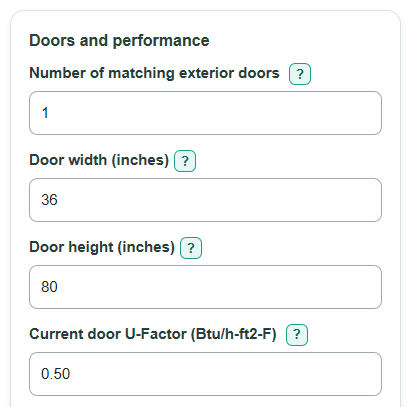
- Enter the number, width, and height of exterior doors that have the same size and U-Factors. Calculate unlike doors as separate groups.
- Enter the Current door U-Factor and Replacement door U-Factor from labels, product specifications, or an energy audit. Lower U-Factor usually means less heat flow.
- Add local Annual heating degree days, choose Main heating energy, and enter the matching usage rate from your utility bill. Exclude fixed monthly customer charges.
- Enter Heating system efficiency, Installed project cost, and only Confirmed incentives that apply to the exact project. Add both cooling fields in Advanced options only if you want cooling included.
- Check that Estimated first-year energy-cost savings is positive before using the payback results. Compare Simple payback after confirmed incentives with Simple payback without incentives to see the incentive effect.
Definitions
U-Factor: A rating for how quickly heat passes through a door. Lower values usually reduce conductive heat flow. Product-specific U-Factor information is used for energy-efficient door comparisons. [2]
Heating degree days: A yearly measure of how cold a location is. More F-days generally mean a larger heating effect from a U-Factor change.
SEER: Seasonal Energy Efficiency Ratio. It describes seasonal cooling output per watt-hour of electricity; a higher value uses less electricity for the same cooling load.
Therm: A natural gas billing unit equal to 100,000 Btu.
Simple payback: Net installed cost divided by estimated first-year energy-cost savings. It estimates years to recover cost from energy savings alone.
Confirmed incentives: Rebates, credits, or similar project incentives that you have verified apply to the exact replacement project.
Common mistakes and quick fixes
Mistake: Entering an R-value in Current door U-Factor or Replacement door U-Factor.
Fix: Enter the product's U-Factor instead. U-Factor is a heat-flow rating, while R-value is a resistance rating.
Mistake: Using the whole utility bill as Electricity usage rate or Natural gas usage rate.
Fix: Use only charges that change with energy use, such as cents per kWh or $ per therm. Leave out fixed monthly customer charges.
Mistake: Entering a monthly heating number in Annual heating degree days.
Fix: Enter a full-year local F-days value from a weather reference, energy audit, or building-energy report.
Mistake: Including a hoped-for rebate in Confirmed incentives.
Fix: Enter only incentives you have confirmed apply to the exact door and project. The calculator keeps Installed project cost separate.
Mistake: Filling in Annual cooling degree days but leaving Cooling system SEER blank.
Fix: Complete both cooling fields or clear both fields. Cooling savings need climate data and equipment efficiency.
Mistake: Treating a long Simple payback after confirmed incentives as a reason not to replace a failing door.
Fix: Use payback as an energy-only comparison. Consider drafts, comfort, water resistance, security, and appearance separately.
Limitations & Key Assumptions / Boundary Conditions
- This is a conductive heat-flow estimate through the measured door area. It does not calculate air leakage, drafts, weatherstripping, solar heat gain, glass sidelights, or moisture effects.
- All doors entered together are assumed to have the same width, height, current U-Factor, and replacement U-Factor. Calculate different door groups separately.
- Annual heating degree days, utility usage rates, heating efficiency, and optional cooling inputs can substantially change the estimate. Replace sample entries with local and project-specific values.
- Electricity and gas rates include only usage-dependent charges. Fixed customer charges are excluded because a door replacement normally does not remove them.
- Simple payback uses first-year energy-cost savings. It excludes financing, maintenance, future utility-rate changes, energy-price inflation, resale value, comfort, security, water resistance, and appearance.
- If the replacement U-Factor is equal to or higher than the current U-Factor, estimated energy savings can be zero or negative. Payback is then shown as N/A.
- A negative net installed cost means entered confirmed incentives exceed the installed project cost. Verify incentive eligibility and whether amounts can be combined.
Methodology
Calculation method
The calculator first finds the combined area of matching doors, then estimates the change in annual conductive heating load from the difference between the current and replacement U-Factors. Heating cost savings use the selected heating fuel, entered system efficiency, and the matching usage rate. Optional cooling savings use the electricity rate and SEER.
door_area_sq_ft = door_count * door_width_inches * door_height_inches / 144
heating_load_btu = (current_u_factor - new_u_factor) * door_area_sq_ft * heating_degree_days * 24
purchased_heating_btu = heating_load_btu / (heating_efficiency_percent / 100)
gas_savings = purchased_heating_btu / 100000 * gas_rate
electric_savings = purchased_heating_btu / 3412.142 * electricity_rate / 100
cooling_kwh = (current_u_factor - new_u_factor) * door_area_sq_ft * cooling_degree_days * 24 / cooling_seer / 1000
annual_energy_cost_savings = heating_cost_savings + cooling_kwh * electricity_rate / 100
net_installed_cost = installed_cost - confirmed_incentive
simple_payback_years = net_installed_cost / annual_energy_cost_savings
Worked example
For one 36 by 80 inch door, the area is 20 sq ft. If U-Factor drops from 0.50 to 0.25 and annual heating degree days are 5,000, the estimated heating-load reduction is 600,000 Btu per year, or 0.6 million Btu. With natural gas heat at 80% efficiency and a $1.50 per therm usage rate, heating savings are $11.25 per year. A $2,000 project with a $500 confirmed incentive has a $1,500 net installed cost, so simple payback is about 133.3 years before any optional cooling savings.
Rate and conversion choices
The electricity-rate sample is a 2025 US residential planning average and should be replaced with the usage-dependent rate on your bill. [1] The calculation uses 144 square inches per square foot, 24 hours per day, 100,000 Btu per therm, 3,412.142 Btu per kWh, and 1,000 watt-hours per kWh.