
Compare projected ICF and wood-frame heating and cooling costs using your bids, energy-cost estimates, and expected years in the home.
Advanced options
Table of contents
How to use our ICF vs Wood-Frame Lifetime Energy Cost Calculator
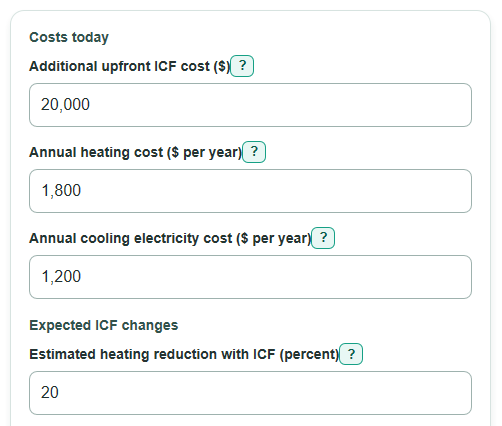
- Enter the net price difference in Additional upfront ICF cost using comparable bids with matching scope.
- Enter the portions of annual bills or an energy model assigned to space heating and air conditioning in Annual heating cost and Annual cooling electricity cost.
- Enter project-specific assumptions in Estimated heating reduction with ICF and Estimated cooling reduction with ICF, then enter Years you expect to own the home.
- Open Advanced options only if you need to remove fixed utility charges or model separate future heating and cooling price changes.
- Check whether Net savings during your ownership period is positive and whether Estimated payback time falls within your ownership period; change uncertain reduction assumptions to see how much the decision depends on them.
Definitions
ICF: Insulating concrete form construction, where foam forms remain around poured concrete walls.
Wood-frame: The comparison home built with conventional wood-framed walls.
Usage-dependent cost: The part of a heating or cooling bill that can change when energy use changes. Fixed charges entered in Advanced options are removed first.
Fixed charges: Customer, meter, or minimum charges that may stay the same even if heating or cooling energy use falls.
ICF premium: The signed upfront price difference between comparable ICF and wood-frame bids. A negative premium is an upfront ICF credit.
Nominal projection: A future-dollar estimate that applies entered energy-price changes but does not adjust future dollars for the time value of money.
Payback time: The earliest whole month when projected energy savings equal or exceed a positive ICF premium.
Common mistakes and quick fixes
Mistake: Entering the full utility bill in Annual heating cost when it also includes water heating or other fuel uses.
Fix: Enter only the annual amount assigned to space heating.
Mistake: Putting appliances, lighting, or electric-vehicle charging into Annual cooling electricity cost.
Fix: Use only the electricity cost assigned to air conditioning.
Mistake: Applying the same customer or meter charge to both Heating fixed charges to exclude and Cooling fixed charges to exclude.
Fix: Exclude a shared fixed charge once, or leave it out if you cannot assign it to one use.
Mistake: Treating Estimated heating reduction with ICF as a percent reduction in the whole utility bill.
Fix: Use a heating-use reduction from a project-specific energy estimate, builder document, or energy model.
Mistake: Comparing bids with different wall, insulation, air-sealing, finish, foundation, or HVAC scope in Additional upfront ICF cost.
Fix: Enter one net ICF price difference after known credits and matching-scope adjustments.
Mistake: Reading a negative ICF premium left to recover as an error.
Fix: A negative amount means projected heating and cooling savings exceed the upfront ICF premium during the selected period.
Limitations & Key Assumptions / Boundary Conditions
- This is a planning estimate based on your entered costs and reduction percentages, not a whole-home energy model, code calculation, or standardized energy rating.
- ICF wall type alone does not determine heating or cooling use. Windows, roof and foundation insulation, air leakage, HVAC equipment, orientation, shading, weather, and household behavior can change actual costs.
- Heating and cooling reductions stay constant throughout the projection. The calculator does not model equipment aging, repairs, replacements, or changing occupancy.
- Fixed charges are excluded only when you enter them. Some delivery charges can vary with use, so review utility bills before treating a charge as fixed.
- Future heating and cooling price changes are user assumptions, not forecasts. The projection is nominal and does not discount future savings.
- The ownership-period result covers only the years entered. It does not estimate full building service life, resale value, insurance, maintenance, resilience, or unrelated household energy uses.
Methodology
Calculation method
The calculator first removes any entered fixed charges from each annual cost. It then applies separate ICF reduction percentages to the remaining heating and cooling costs.
heating_usage_cost = annual_heating_cost - annual_heating_fixed_charges
cooling_usage_cost = annual_cooling_cost - annual_cooling_fixed_charges
first_year_energy_savings = heating_usage_cost * heating_reduction_pct / 100 + cooling_usage_cost * cooling_reduction_pct / 100
For each energy type, the annual cost is projected for the entered ownership period. With a 0 percent annual price increase, the factor is simply the number of years. Otherwise, it uses compound annual price changes.
factor = years if rate = 0; otherwise ((1 + rate) ^ years - 1) / rate
cumulative_energy_savings = wood_lifetime_energy_cost - icf_lifetime_energy_cost
net_lifetime_savings = cumulative_energy_savings - net_icf_premium
The payback search adds estimated heating and cooling savings one month at a time and reports the first whole month that reaches a positive upfront ICF premium. If no month reaches it under the entered assumptions, payback is shown as Not reached.
Worked example
Suppose heating costs $1,800 per year, cooling costs $1,200 per year, fixed charges are $0, ICF reduces heating by 20 percent and cooling by 15 percent, and prices stay flat. First-year savings are $540: $360 from heating plus $180 from cooling. Over 20 years, projected energy savings are $10,800. With a $20,000 ICF premium, net savings during ownership are -$9,200, meaning part of the premium remains unrecovered.
Calculation choices
Costs are limited to usage-dependent space heating and air conditioning. The entered reductions are held constant, and future price changes are applied separately to heating and cooling. Negative net savings and negative premium-left-to-recover values remain signed so the result shows the size and direction of the difference.