
Estimate insulation savings, payback time, and long-term net savings using your bill, project cost, R-values, and assumptions.
Table of contents
How to use our Insulation Savings Calculator
- Enter your Heating and cooling cost ($ per year), Project cost ($), Current R-value, and New R-value after the project.
- Set Heating and cooling bill affected (%) to the part of your heating and cooling bill the insulated area can realistically change.
- Open Advanced options if you want to change Real-world adjustment (%), Years to compare, Energy price increase (% per year), Discount rate (% per year), or Project area (sq ft).
- Select Calculate and read Estimated first-year savings first, then Simple payback time and Net savings after project cost.
- Sanity-check the output: if Estimated first-year savings is larger than the whole affected bill share, or the Heat flow cut through this insulated part looks impossible for your R-values, recheck the inputs.
Definitions
R-value: A number that shows how strongly insulation slows heat flow. Higher R-value means better resistance to heat flow for the insulated part [3].
Heating and cooling cost ($ per year): The yearly part of your utility bills used for space heating and air conditioning, not the whole household energy bill unless that is your best estimate.
Heating and cooling bill affected (%): The share of your heating and cooling cost that the project area could change. This keeps the estimate from assuming one insulation job affects the whole bill.
Real-world adjustment (%): A user-chosen reduction to account for gaps, air leaks, uneven installation, or uncertainty. Use 100% for no reduction.
Discount rate (% per year): A rate used to value future bill savings less than savings today. Use 0 for a simple total.
Simple payback time: Project cost divided by first-year savings. It is shown only when savings are positive, with an immediate payback when project cost is $0 and savings are positive.
Return compared with project cost: Net savings divided by project cost, shown as a percent. Negative means the project does not earn back its cost during the chosen years.
Common mistakes and quick fixes
Mistake: Putting the full utility bill in Heating and cooling cost ($ per year) when it includes lights, appliances, and water heating.
Fix: Use only the heating and cooling part if you know it, or enter a careful yearly estimate.
Mistake: Entering only the added insulation layer in New R-value after the project.
Fix: Enter the total R-value after the project, including the Current R-value plus the added insulation.
Mistake: Setting Heating and cooling bill affected (%) to 100 for a small attic, wall, floor, or crawlspace job.
Fix: Use a smaller share unless the project can affect nearly all heat loss and heat gain in the home.
Mistake: Treating Real-world adjustment (%) as a discount on Project cost ($).
Fix: Use Real-world adjustment (%) to reduce estimated savings when installation gaps, air leaks, or uncertain home details may lower results.
Mistake: Reading Net savings after project cost as the same thing as Total bill savings before project cost.
Fix: Use Total bill savings before project cost for bill reduction only, and Net savings after project cost to see what is left after subtracting Project cost ($).
Mistake: Entering Project area (sq ft) as linear feet or wall height only.
Fix: Enter square feet of the project area, or leave Project area (sq ft) blank if you do not need Project cost per square foot.
Limitations & Key Assumptions / Boundary Conditions
- This is a bill-share estimate, not a room-by-room energy model or professional energy audit.
- The method assumes heat flow through the insulated part is roughly proportional to 1 divided by R-value. Real homes also lose heat through air leaks, windows, doors, ducts, and framing.
- Heating and cooling bill affected (%) is an important assumption. A small project should usually affect only part of the heating and cooling bill.
- Real-world adjustment (%) is user controlled. Poor installation, compressed insulation, moisture, missing air sealing, or hidden gaps can reduce actual savings.
- Energy price increase (% per year) and Discount rate (% per year) affect long-term totals, but they do not change Estimated first-year savings.
- If New R-value after the project is lower than Current R-value, the calculator keeps negative savings instead of forcing the result to zero.
- Project cost ($) does not include future repairs, rebates, tax credits, financing costs, or changes in home resale value unless you put them into the cost yourself.
Methodology
Core idea
The calculator uses a transparent bill-share method. It first estimates how much heat flow is cut through the insulated part, then applies that cut to the part of your heating and cooling bill that the project can affect. Insulation provides resistance to heat flow, and proper insulation can lower heating and cooling costs [3]. ENERGY STAR reports an average 15% heating and cooling cost saving for cost-effective air sealing and insulating, but this calculator does not use that number as a hidden multiplier [1].
Formulas
heat_flow_cut = 1 - (current_r_value / new_r_value)
first_year_savings = annual_hvac_cost * (affected_bill_share_percent / 100) * heat_flow_cut * (real_world_adjustment_percent / 100)
monthly_savings = first_year_savings / 12
simple_payback_years = project_cost / first_year_savings
The simple payback formula is used only when Project cost ($) is greater than 0 and Estimated first-year savings is positive. If Project cost ($) is 0 and savings are positive, the payback is shown as immediate. If savings are 0 or negative, the calculator shows no simple payback.
savings_in_year_n = first_year_savings * (1 + energy_price_growth_percent / 100)^(n - 1)
total_savings_over_years = sum of savings_in_year_n / (1 + discount_rate_percent / 100)^n
net_savings_over_years = total_savings_over_years - project_cost
roi_percent = (net_savings_over_years / project_cost) * 100
cost_per_sqft = project_cost / project_area_sqft
The calculator adds savings year by year instead of using a shortcut formula. That avoids divide-by-zero problems when Energy price increase (% per year) and Discount rate (% per year) are the same. Cost per square foot appears only when Project area (sq ft) is entered and greater than 0. Return compared with project cost is shown as N/A when Project cost ($) is 0.
Mini-example
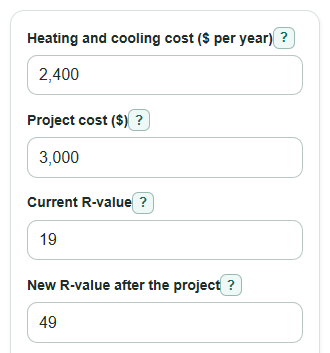
Suppose Heating and cooling cost ($ per year) is $2,400, Project cost ($) is $3,000, Current R-value is 19, New R-value after the project is 49, Heating and cooling bill affected (%) is 25, and Real-world adjustment (%) is 100. The heat flow cut is 1 - 19 / 49, or about 61.22%. Estimated first-year savings is $2,400 * 25% * 61.22% * 100%, or about $367.35 per year. Average first-year monthly savings is about $30.61. Simple payback time is $3,000 / $367.35, or about 8.17 years.
If Years to compare is 10, Energy price increase (% per year) is 3, and Discount rate (% per year) is 0, total bill savings before project cost is about $4,211.22. Net savings after project cost is about $1,211.22, and Return compared with project cost is about 40.37%.