
Estimate smart thermostat savings, payback time, and long-term net savings from your energy bill, rebate, and cost.
Table of contents
How to use our Smart Thermostat Savings Calculator
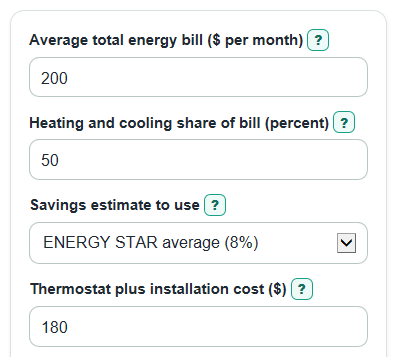
- Enter your Average total energy bill ($ per month), using electric plus gas if both pay for heating or cooling.
- Set Heating and cooling share of bill (percent); if you are unsure, start with 50% and adjust it after checking your seasonal bills.
- Choose Savings estimate to use; if you pick Use my own percent, fill in Your savings estimate (percent).
- Enter Thermostat plus installation cost ($) and Rebates or credits ($), then adjust Years to compare and Yearly change in energy prices (percent) if you want a longer view.
- Click Calculate, then sanity-check Heating and cooling cost used; if that monthly number feels too high or low, revise the heating and cooling share before trusting the payback.
Definitions
Average total energy bill ($ per month): Your usual combined monthly energy cost for the home, before splitting out heating and cooling.
Heating and cooling share of bill (percent): The percent of the total bill that goes to space heating and air conditioning.
Savings estimate to use: The percent reduction applied to heating and cooling cost. The default ENERGY STAR average preset is 8% of heating and cooling bills [1].
Cost after rebates: Thermostat plus installation cost minus rebates or credits. It can be negative if rebates are larger than the entered cost.
Payback: The estimated time for savings to cover the cost after rebates.
Money ahead: Savings minus cost after rebates. A positive value means the thermostat is ahead; a negative value means it has not paid back yet.
Common mistakes and quick fixes
Mistake: Using only the electric bill in Average total energy bill ($ per month) when gas also pays for heat.
Fix: Add the average monthly electric and gas bills before entering the amount.
Mistake: Setting Heating and cooling share of bill (percent) to 100% because the whole bill is energy.
Fix: Enter only the part used for heating and cooling, not lights, appliances, water heating, or other uses.
Mistake: Reading Savings estimate to use as a percent cut to the whole utility bill.
Fix: Remember that the selected percent is applied only to the heating and cooling cost used.
Mistake: Leaving Your savings estimate (percent) blank after choosing Use my own percent.
Fix: Enter a number from 0 to 100, such as 10, or switch back to a preset savings estimate.
Mistake: Entering the device price only in Thermostat plus installation cost ($) when you will pay for an adapter or installer.
Fix: Include the device, adapter, wiring help, and professional installation cost you expect to pay.
Mistake: Putting a rebate you may not qualify for in Rebates or credits ($) .
Fix: Use only rebates, instant discounts, or credits you expect to receive, or run a second case with $0.
Limitations & Key Assumptions / Boundary Conditions
- The savings percent is applied only to the heating and cooling share, so a wrong share can move every savings result up or down.
- The preset savings cases are planning scenarios, not guarantees. Actual savings depend on climate, home insulation, HVAC equipment, schedules, comfort settings, and how the old thermostat was used.
- Rebates and credits can depend on utility rules, product eligibility, installation date, and paperwork. The calculator does not verify eligibility.
- The yearly bill change is applied once per year to the estimated savings stream. It does not separately model fuel price changes, rate tiers, or fixed utility fees.
- Years to compare uses whole years only. It does not prorate partial years or include thermostat replacement, repairs, subscriptions, or moving costs.
- If you rent, the financial result may not matter unless you are allowed to install the thermostat and you pay the heating or cooling bills.
Methodology
How the estimate is calculated
The calculator first estimates the heating and cooling part of your bill, then applies the selected smart thermostat savings percent to that part only. This avoids treating the whole energy bill as thermostat-controlled spending.
monthly_hvac_cost = monthly_energy_bill * (hvac_share_percent / 100)
annual_hvac_cost = monthly_hvac_cost * 12
savings_percent = 5, 8, 12, or custom_savings_percent
annual_savings = annual_hvac_cost * (savings_percent / 100)
The 8% default is the ENERGY STAR average smart thermostat savings preset used by the calculator [1]. The 5% and 12% presets are lower and higher planning cases, not promises.
Cost, payback, and net savings
Upfront cost is kept as a signed value because rebates can be larger than the entered cost.
net_upfront_cost = thermostat_total_cost - rebate_credit
payback_months = (net_upfront_cost / annual_savings) * 12
If net upfront cost is $0 or less and annual savings is positive, payback is shown as 0 months. If annual savings is $0 and net upfront cost is positive, payback is shown as N/A instead of Infinity.
first_year_net = annual_savings - net_upfront_cost
For multi-year savings, the calculator either multiplies by the number of years or uses a yearly growth formula when you enter a nonzero yearly bill change.
total_savings = annual_savings * years_owned
total_savings = annual_savings * (((1 + annual_bill_change_percent / 100) ^ years_owned - 1) / (annual_bill_change_percent / 100))
multi_year_net = total_savings - net_upfront_cost
Worked example
Suppose the average total energy bill is $200 per month, the heating and cooling share is 50%, the selected savings case is 8%, the thermostat plus installation cost is $180, rebates are $50, the comparison length is 5 years, and yearly bill change is 0%. The heating and cooling cost used is $100 per month, or $1,200 per year. Annual savings are $96. Cost after rebates is $130. Payback is 16.25 months, first-year net is -$34, and 5-year net savings are $350.