
Enter your vented attic floor measurements to estimate the loose-fill insulation depth, added R-value, and whole bags needed for your target.
Existing insulation
Insulation product to add
Advanced options
Current value and order options
Table of contents
How to use our Attic Insulation Calculator
- Choose "Vented attic floor" only when insulation will be added on the flat attic floor and the attic vents to outside air.
- Enter the attic floor area, then measure existing insulation depth in several undisturbed spots and choose the material you see.
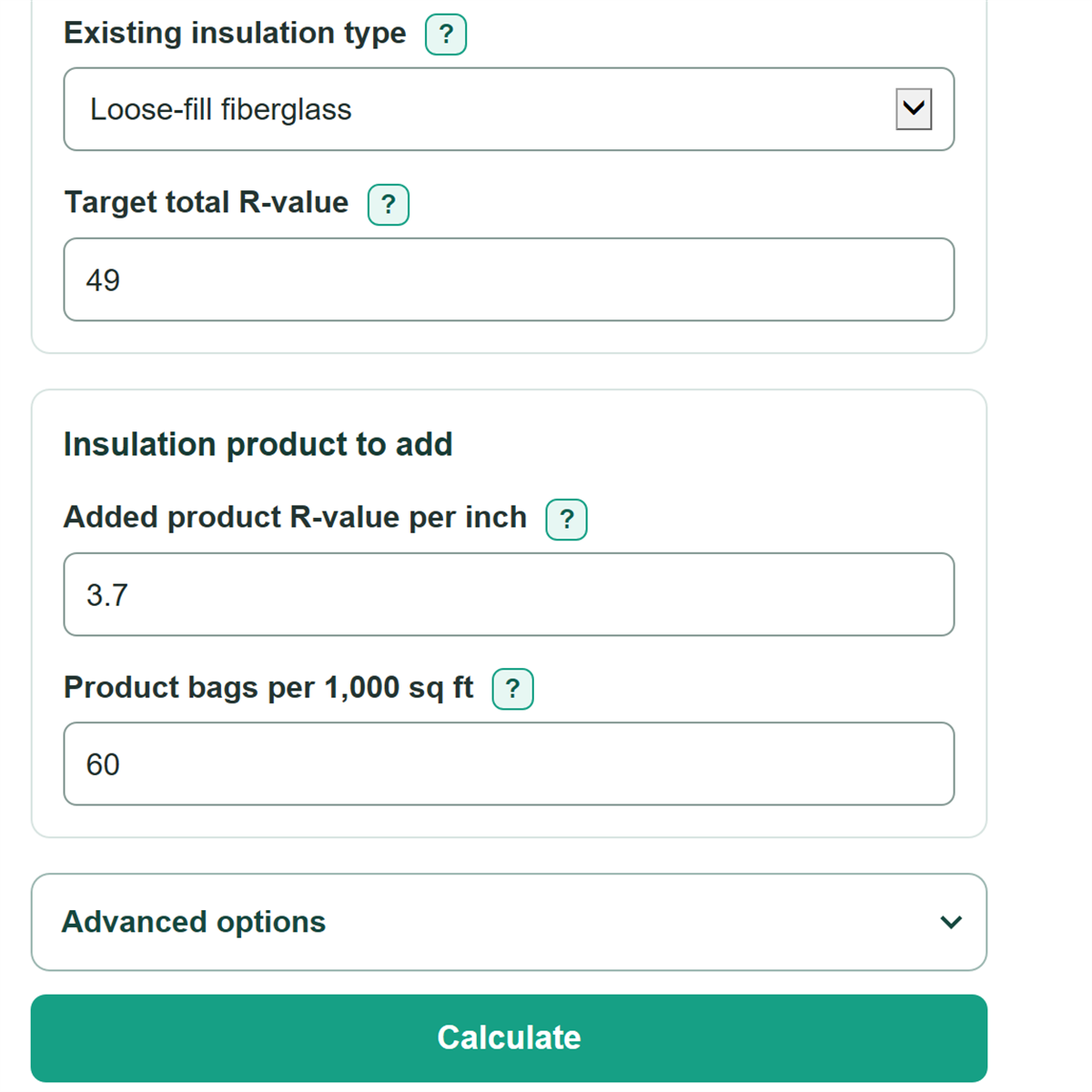
- Enter the target total R-value, the new product's R-value per inch, and its bags-per-1,000-sq-ft coverage-chart value.
- Open Advanced options only if you have a documented current R-value, want to add a purchase allowance, or want a bags-only material cost estimate.
- Check that the added depth and bag count agree with the exact product chart and fit around baffles, vents, and required clearances before buying bags.
Definitions
R-value: A measure of resistance to heat flow. A higher R-value means more resistance.
Target total R-value: The R-value wanted after the insulation project, based on local guidance or project documents.
Estimated current attic R-value: The current R-value estimated from insulation depth and material, unless a documented current R-value is entered.
Added product R-value per inch: The R-value provided by one installed inch of the new insulation product.
Product bags per 1,000 sq ft: The bag quantity listed on the exact product coverage chart for 1,000 square feet at the applicable R-value.
Vented attic floor: An attic where insulation sits on the flat floor and outside air moves through soffit, ridge, gable, or other roof vents.
Common mistakes and quick fixes
Mistake: Using roof area or total house size as attic floor area.
Fix: Check Where will insulation be added? and then recalculate. Measure the flat attic floor length times width, then add separate sections for an irregular attic.
Mistake: Entering the desired finished R-value as the amount to add.
Fix: Enter it as Target total R-value. The calculator subtracts the estimated current R-value.
Mistake: Measuring insulation where boxes or flooring have compressed it.
Fix: Check Where will insulation be added? and then recalculate. Measure several undisturbed spots from the attic floor to the insulation top and enter a representative depth.
Mistake: Using bag volume instead of the product coverage chart.
Fix: Copy Product bags per 1,000 sq ft from the exact product chart row for the needed added R-value.
Mistake: Using this estimate for an unvented roof deck or cathedral ceiling.
Fix: Check Where will insulation be added? and then recalculate. Stop and use project-specific guidance. This calculation applies only to loose-fill insulation added on a vented attic floor.
Mistake: Treating estimated bag material cost as the complete project price.
Fix: Check Where will insulation be added? and then recalculate. Budget separately for labor, blower rental, delivery, air sealing, baffles, ventilation work, disposal, taxes, and other site costs.
Limitations & Key Assumptions / Boundary Conditions
- This calculator applies only to loose-fill insulation added on a vented attic floor. It does not design insulation for an unvented roof deck, cathedral ceiling, or an attic with an unknown insulation location.
- Depth-based current R-values are planning estimates. It uses 2.5 R per inch for loose-fill fiberglass, 3.7 for cellulose, and 2.8 for rock wool; compression, settling, gaps, mixed materials, and moisture can change actual performance.
- The target R-value is entered by you. Local code, permit rules, climate guidance, and project specifications may require a different target.
- The bag count depends on the entered product coverage-chart rate. Confirm the final order on the exact product label using the applicable added-R row.
- The optional cost includes whole bags and bag price only. It excludes labor, blower rental, delivery, air sealing, baffles, ventilation work, disposal, and taxes.
- Stop and seek qualified guidance for suspected vermiculite, wet or contaminated insulation, unsafe wiring, blocked ventilation, or missing required clearances.
Methodology
How calculations work
The calculator estimates current attic R-value from measured depth and existing material. ENERGY STAR planning factors are 2.5 R per inch for loose-fill fiberglass, 3.7 for cellulose, and 2.8 for rock wool. A nonblank documented current R-value replaces the depth-based estimate. [1]
estimated current R-value = existing insulation depth x material R-value per inch
It subtracts the current R-value from the target total R-value. The added R-value is set to zero when the entered current value already meets or exceeds the target.
insulation R-value to add = max(0, target total R-value - estimated current attic R-value)
Added depth uses the R-value per inch of the new product. The bag estimate uses the product's coverage-chart rate, applies any extra purchase allowance, then rounds up to a whole bag.
added insulation depth = insulation R-value to add / added product R-value per inch
loose-fill bags to buy = ceil((attic floor area / 1000) x product bags per 1,000 sq ft x (1 + extra purchase allowance / 100))
If a price per bag is entered, the material-only cost is the rounded bag count multiplied by that price.
estimated bag material cost = loose-fill bags to buy x price per bag
Worked example
A 1,000 sq ft vented attic floor has 6 inches of loose-fill fiberglass. Its estimated current value is 6 x 2.5 = R-15. With a target of R-49, it needs R-34 more. A new product rated R-3.7 per inch needs 34 / 3.7 = about 9.2 inches. If that product chart lists 60 bags per 1,000 sq ft for the needed added R-value, the estimate is 60 whole bags.
Using product chart data
Use the coverage value from the exact added product and the chart row that matches the needed added R-value. If the exact row is not shown, use the next higher chart row for planning and confirm the final order against the bag label.