
Enter your blower-door CFM50 reading and conditioned volume to find the home's ACH50 airtightness result at 50 Pa.
Advanced options
This is a test-pressure airtightness result. It is not the home's normal natural air-change rate.
At or below the entered target means the measured result meets that number. It does not by itself prove code compliance.
Use this as a planning or report-checking value, not as a substitute for a measured test result.
Table of contents
How to use our Blower Door Test Calculator
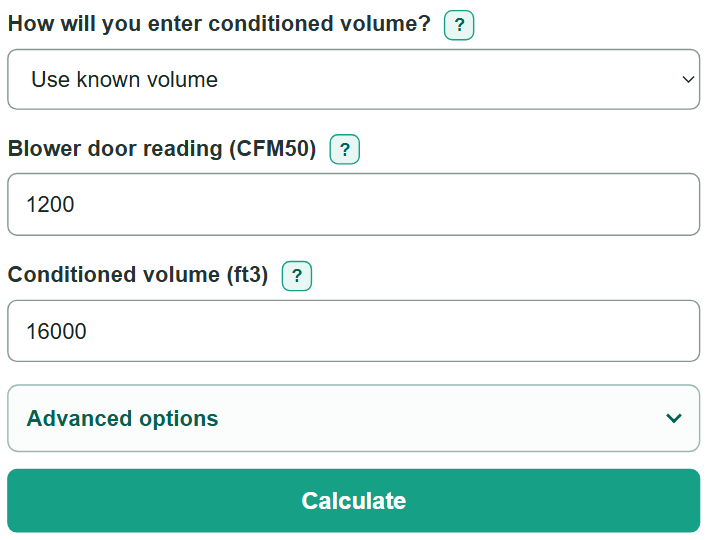
- Choose "Use known volume" if the blower-door report or rater worksheet lists conditioned volume.
- Enter the report's "Blower door reading (CFM50)" value. It must be measured at 50 Pa.
- Enter "Conditioned volume (ft3)" for the same air boundary used during the test.
- If the report has no volume, choose "Estimate from floor area" and enter the conditioned floor area plus average ceiling height.
- Select "Calculate" to see air changes per hour at 50 Pa, called ACH50. For the same volume, a lower ACH50 means less test airflow.
- Open "Advanced options" to enter a confirmed project target or change only the displayed decimal places.
Definitions
CFM50: Fan airflow in cubic feet per minute while a blower door holds a 50 pascal pressure difference across the building.
ACH50: Air changes per hour at a 50 pascal test pressure. It is calculated from CFM50 and conditioned volume, not measured as the home's normal ventilation rate.
Conditioned volume: The cubic feet of heated or cooled space inside the air boundary used for the test.
Air boundary: The surfaces that separate the tested conditioned space from outside or excluded spaces.
Pascal (Pa): A unit of pressure. The "50" in CFM50 and ACH50 means 50 Pa.
Common mistakes and quick fixes
Mistake: Entering airflow measured at a pressure other than 50 Pa.
Fix: Use the report value labeled CFM50 or CFM at 50 Pa. This calculator does not convert readings from another test pressure.
Mistake: Including an attached garage, porch, or other space outside the tested air boundary.
Fix: Use only the conditioned space inside the same air boundary used for the blower-door test.
Mistake: Treating floor area times ceiling height as an exact volume in a home with vaulted ceilings or open stairwells.
Fix: Use the report volume when available. Otherwise, use an area-weighted average ceiling height for the estimate.
Mistake: Treating an ACH50 target as proof of code compliance.
Fix: Check the applicable local code, program, building type, and project requirement separately.
Limitations & Key Assumptions / Boundary Conditions
- ACH50 describes airflow during a 50 Pa blower-door test. It does not by itself predict natural infiltration, ventilation needs, comfort, energy use, or indoor air quality.
- The CFM50 reading and conditioned volume must cover the same tested air boundary. A mismatch changes the ACH50 calculation.
- The floor-area method estimates volume as floor area times average ceiling height. It can be less accurate for vaulted ceilings, open stairwells, split levels, and irregular shapes.
- An optional target compares the result with the number entered. Requirements vary by location, code edition, amendments, building type, and energy program.
- This calculator does not convert airflow readings measured at pressures other than 50 Pa.
Methodology
Calculation
The calculator uses the reported conditioned volume, or estimates volume from conditioned floor area and average ceiling height. It converts the blower-door airflow from cubic feet per minute to cubic feet per hour by multiplying by 60.
conditioned volume = conditioned floor area x average ceiling height
ACH50 = (CFM50 x 60) / conditioned volume
CFM50 is the airflow measured at 50 Pa. ACH50 is the hourly air-change rate for that same test pressure and volume.
Optional target comparison
If you enter an airtightness target, the calculator finds the difference between measured ACH50 and that target. It also calculates the CFM50 that would match the target using the same conditioned volume.
target CFM50 = (target ACH50 x conditioned volume) / 60
Worked example
A CFM50 reading of 1,200 with a conditioned volume of 16,000 ft3 gives 1,200 x 60 / 16,000 = 4.50 ACH50. With a target of 3.00 ACH50, the measured result is above the target by 1.50 ACH50, and the matching target CFM50 is 800.