
Estimate yearly steam waste and avoidable energy cost from a measured leak or failed-open trap pressure and opening details.
Leak details
Pressure and opening details
Annual cost details
Advanced options
This is the leak rate multiplied by the entered yearly operating time.
Table of contents
How to use our Steam Trap Leak and Energy Cost Calculator
- Choose how you know the steam leak. Select the known-rate method for a survey result, or select the pressure-and-opening method for failed-open traps with matching details.
- Enter the method-specific values. For the opening method, use the actual internal opening diameter, not the trap connection size.
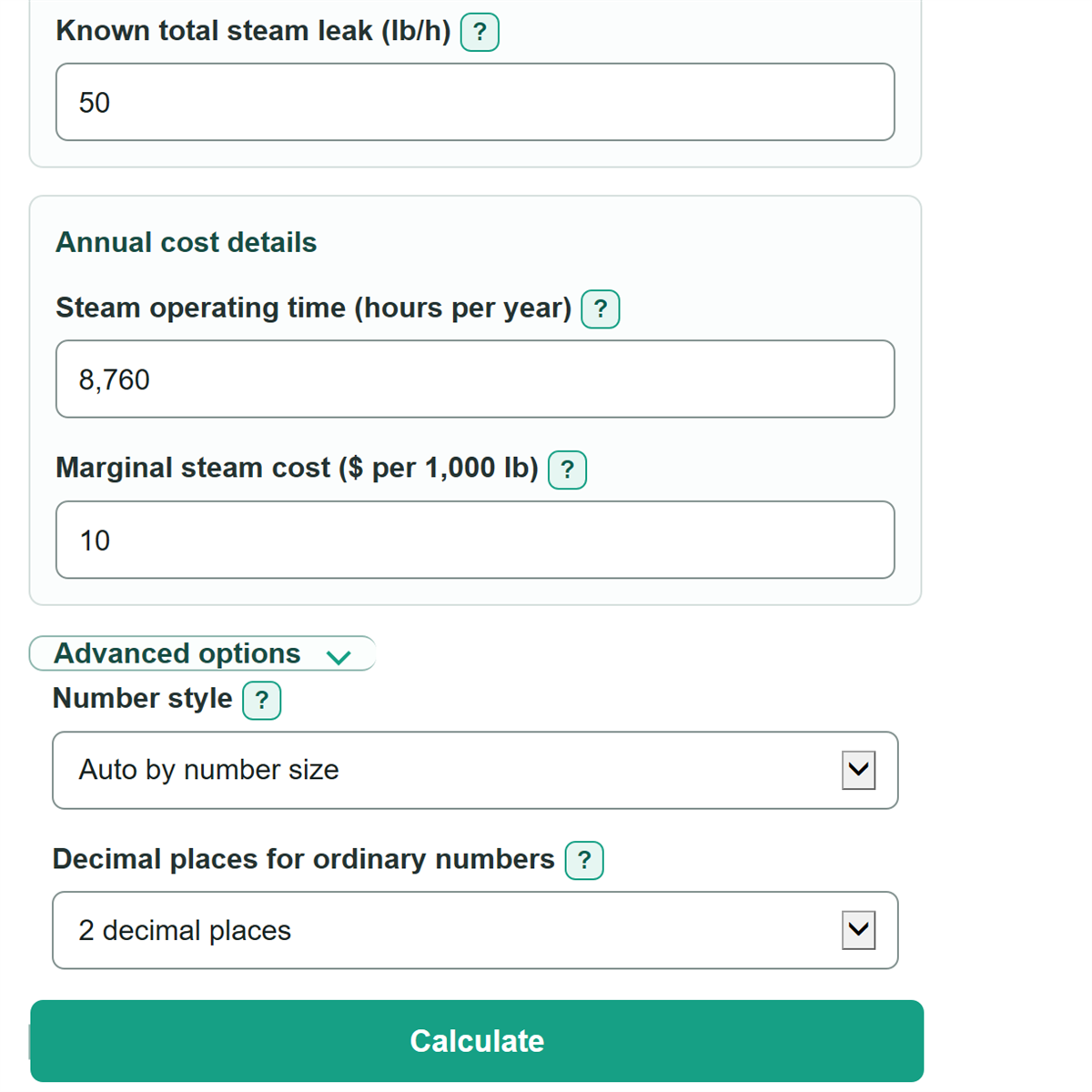
- Enter Steam operating time (hours per year) from the production schedule and Marginal steam cost ($ per 1,000 lb) from your site's marginal steam-cost estimate.
- Click Calculate. Check that Steam leak rate used matches the survey value or seems reasonable for the pressure, opening, and trap count entered before using Estimated annual avoidable energy cost to rank repairs.
Definitions
Known total steam leak (lb/h): A measured or survey-reported total live-steam loss per hour. This method does not use pressure, opening diameter, or trap count.
psig: Pounds per square inch gauge. It is pressure measured above local atmospheric pressure.
Actual steam opening diameter (inches): The internal hole through which steam can escape. It is not the nominal pipe or trap connection size.
Failed-open trap: A steam trap that allows live steam to pass rather than closing as intended. Steam-trap surveys are used to identify and assess these losses. [1]
Marginal steam cost ($ per 1,000 lb): The site-specific avoidable cost of producing 1,000 lb of steam, such as fuel and other usage-dependent costs included by the plant.
Estimated annual avoidable energy cost: The annual steam loss multiplied by the entered marginal steam cost. It estimates usage cost that may be avoided after repair.
Common mistakes and quick fixes
Mistake: Entering a nominal pipe or trap connection size as Actual steam opening diameter (inches).
Fix: Use the actual internal opening from a manufacturer sheet, inspection, or engineering record. Enter a known survey result instead if the opening is unknown.
Mistake: Entering absolute pressure in Steam pressure before the trap (psig).
Fix: Enter gauge pressure from the local gauge or pressure setpoint. The calculation adds atmospheric pressure internally.
Mistake: Counting traps with different pressures or opening sizes in Failed-open traps with these details.
Fix: Include only matching traps in one calculation. Run separate calculations for groups with different conditions.
Mistake: Using 8,760 in Steam operating time (hours per year) for equipment that runs only part of the year.
Fix: Replace it with actual runtime from a schedule, historian, or runtime meter.
Mistake: Using a fuel-bill price as Marginal steam cost ($ per 1,000 lb) without converting it to a steam-production cost.
Fix: Use a documented site marginal steam rate and exclude fixed charges unless a repair will truly reduce them.
Mistake: Treating Estimated annual avoidable energy cost as the complete repair budget.
Fix: Use it as an annual usage-cost estimate, then compare it separately with repair parts, labor, access, and outage costs.
Limitations & Key Assumptions / Boundary Conditions
- The known-rate method is only as accurate as the trap survey or leak measurement entered.
- The pressure-and-opening method is a simplified estimate for saturated steam discharged near atmospheric pressure. It requires at least 15 psig upstream gauge pressure and is not a manufacturer-rated trap capacity.
- The opening estimate uses the actual internal opening diameter. A nominal trap or pipe connection size can produce a very different result.
- Steam operating time must match the time that steam is actually available at the leaking trap. Zero hours gives zero annual loss and cost, even if the hourly leak is positive.
- The dollar result includes only costs covered by Marginal steam cost ($ per 1,000 lb). Fixed utility charges, repair labor, parts, access, outage costs, condensate credit, and process effects are outside this estimate unless the site rate already includes them.
Methodology
Calculation method
The calculator uses one of two separate paths. The known-rate path uses the entered Known total steam leak (lb/h). The pressure-and-opening path estimates total leak rate for matching failed-open traps with a simplified Napier steam-flow relation used for steam-system loss estimates. [2]
leak rate (lb/h) = known total steam leak (lb/h)
leak rate (lb/h) = 24.24 x opening diameter (in)^2 x (pressure (psig) + 14.696) x trap count
The 14.696 value converts the entered gauge pressure to absolute pressure for the opening estimate. The coefficient is 24.24 lb/(h*in^2*psia).
Annual loss and cost
Annual steam loss comes from the hourly leak rate and the entered operating time. Annual avoidable energy cost then applies the site's marginal cost basis.
annual steam lost (lb/year) = leak rate (lb/h) x operating time (hours/year)
annual avoidable energy cost ($/year) = annual steam lost (lb/year) x marginal steam cost ($ per 1,000 lb) / 1000
Worked example
A measured leak of 50 lb/h operating for 4,380 hours per year loses 219,000 lb per year. At $10 per 1,000 lb, the estimated annual avoidable energy cost is $2,190.
50 x 4,380 = 219,000 lb/year
219,000 x 10 / 1000 = $2,190/year
Calculation scope
The calculator keeps measured and opening-based leak estimates separate so they are not added together. It calculates steam loss and usage-cost estimates only; it does not calculate boiler efficiency, fuel conversion, condensate recovery, repair cost, or utility fixed charges.