
Calculate cooling tower evaporation, drift, blowdown, makeup water, and scheduled gallons from flow, range, operating time, and cycles.
Operating condition
Operating schedule
Cycles information
Advanced options
Model assumption
Result display
Calculation details
Table of contents
How to use our Cooling Tower Evaporation, Drift and Blowdown Calculator
- Choose "Planning target" if you have a treatment-plan target, or choose "Measured from water readings" if you have matching makeup and tower-water readings.
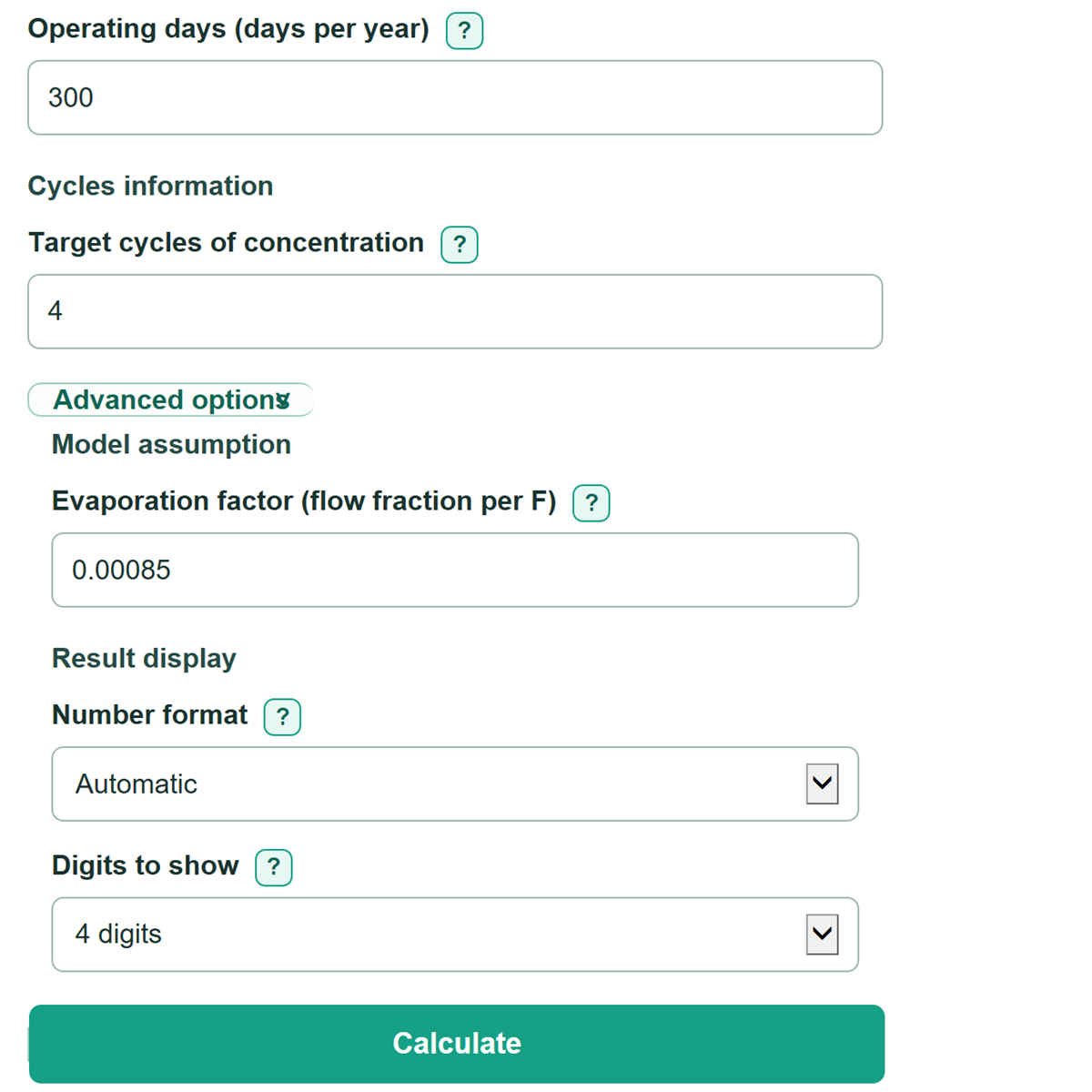
- Enter the Recirculating water flow (GPM), Tower range (F), Drift loss (percent of recirculating flow), Operating time (hours per day), and Operating days (days per year).
- For planning, enter Target cycles of concentration. For measured cycles, choose Water-reading type and enter both readings using the same basis and unit.
- Open Advanced options only if your site uses a different Evaporation factor (flow fraction per F) or you need a different number format.
- Check that Total makeup water needed is reasonable against a meter or design schedule, and keep peak GPM separate from Scheduled makeup water per year.
Definitions
Recirculating water flow (GPM): The water flow circulating between the cooling tower and the connected system, measured in gallons per minute.
Tower range (F): The hot-water temperature minus the cold-water temperature across the tower.
Drift loss: Liquid droplets that leave with the tower exhaust air. It is entered as a percent of recirculating flow.
Cycles of concentration: The ratio of dissolved material in tower water to dissolved material in makeup water. Higher cycles generally need less blowdown for the same evaporation rate.
Blowdown: Intentional discharge of concentrated tower water to control dissolved material buildup.
Makeup water: Incoming water that replaces evaporation, drift, and blowdown losses.
Conductivity (uS/cm): A water measurement related to dissolved ions. Use the same conductivity basis for both water readings.
TDS (mg/L): Total dissolved solids, a concentration measurement. Do not mix TDS with conductivity in the measured-cycles ratio.
Common mistakes and quick fixes
Mistake: Entering approach to wet-bulb temperature as Tower range (F).
Fix: Enter hot-water temperature minus cold-water temperature for Tower range (F).
Mistake: Typing 0.2 when the tower specification says 0.002% drift.
Fix: Enter the percentage printed in the specification in Drift loss (percent of recirculating flow), so 0.002% is entered as 0.002.
Mistake: Dividing tower conductivity by makeup TDS in measured mode.
Fix: Choose one Water-reading type and use matching readings for Makeup water conductivity (uS/cm) and Tower water conductivity (uS/cm).
Mistake: Treating Target cycles of concentration as a measured current condition.
Fix: Use "Measured from water readings" when current samples are available, then review Cycles of concentration used.
Mistake: Using Total makeup water needed as annual consumption.
Fix: Total makeup water needed is a peak GPM rate; use Scheduled makeup water per year for the entered operating schedule.
Mistake: Leaving an example Evaporation factor (flow fraction per F) in place without checking the site method.
Fix: Use the disclosed factor as a planning estimate or replace it with the factor required by your site water-balance method.
Limitations & Key Assumptions / Boundary Conditions
- Evaporation is a simplified planning estimate based on Recirculating water flow (GPM), Tower range (F), and the editable Evaporation factor (flow fraction per F). It is not a direct measurement or a manufacturer performance rating.
- The water balance includes only evaporation, drift, and blowdown. It does not include leaks, basin overflow, filter backwash, side-stream losses, manual draining, or other site-specific water uses.
- Measured cycles are only as reliable as the samples. Makeup and tower-water readings must use the same basis, be representative of current operation, and have tower-water concentration greater than makeup-water concentration.
- Scheduled gallons assume the entered peak rates apply for every entered operating hour and day. Changing load, weather, staging, or seasonal operation can change actual meter use.
- The calculator blocks a cycles-and-drift combination that would require negative blowdown. Review the drift specification, tower range, cycles target, and evaporation factor if this occurs.
- Zero operating hours or days produces zero scheduled volume while peak GPM rates can still be calculated.
Methodology
Water-balance method
The calculation treats makeup water as the water needed to replace evaporation, drift, and blowdown. Cooling-tower water management uses cycles of concentration and controlled blowdown to manage dissolved material in circulating water. [1]
cycles_used = target_coc
For the planning workflow, the entered target is used.
cycles_used = tower_water_reading / makeup_water_reading
For the measured workflow, both readings must be conductivity or both must be TDS.
evaporation_gpm = recirculation_gpm * tower_range_f * evaporation_factor_per_f
drift_gpm = recirculation_gpm * drift_percent / 100
blowdown_gpm = evaporation_gpm / (cycles_used - 1) - drift_gpm
makeup_gpm = evaporation_gpm + drift_gpm + blowdown_gpm
daily_makeup_gallons = makeup_gpm * 60 * operating_hours_per_day
annual_makeup_gallons = daily_makeup_gallons * operating_days_per_year
annual_blowdown_gallons = blowdown_gpm * 60 * operating_hours_per_day * operating_days_per_year
Worked example
With 1,000 GPM recirculating flow, a 10 F range, a 0.00085 evaporation factor, 0.002% drift, and 4 cycles, evaporation is 8.5 GPM, drift is 0.02 GPM, and blowdown is about 2.813 GPM. Total makeup water needed is about 11.33 GPM. At 12 hours per day for 300 days per year, scheduled makeup is 2,448,000 gallons per year.
Calculation choices
The factor is editable because evaporation varies with equipment and operating conditions. The calculation requires cycles greater than 1, rejects a negative blowdown result, and allows zero flow or zero schedule values. Peak GPM describes the entered operating condition; scheduled gallons apply that rate across the entered runtime and do not predict every change in actual tower load.