
Estimate the extra yearly fan electricity cost from a dirty HVAC filter and compare it with the cost of replacing all filters.
Advanced options
A larger positive amount means the dirty filter condition costs more to operate.
This is the added electricity caused by the entered pressure increase.
This is the estimated power increase while the fan runs.
This is one filter-purchase event. Labor, shipping, tax, and disposal are not added separately.
This is a simplified constant-airflow estimate. It does not prove filter compatibility, safe static pressure, indoor-air quality, or manufacturer-rated performance.
Table of contents
How to use our HVAC Filter Pressure Drop Energy Cost Calculator
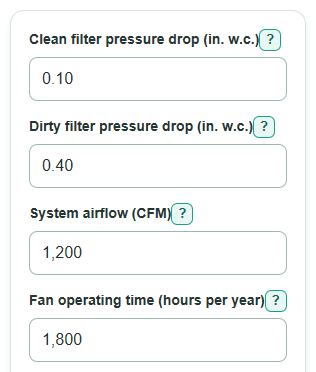
- Enter the clean and dirty filter-only pressure drops in in. w.c. Use values measured across the filter or listed for the same airflow.
- Enter System airflow, Fan operating time, and your delivered Electricity rate from equipment records, runtime history, and a utility bill.
- Enter the Price per replacement filter. Open Advanced options to adjust Fan efficiency, the number of filters changed together, or number formatting.
- Click Calculate and read Extra yearly electricity cost at dirty pressure first, then compare it with Yearly energy savings after one filter purchase.
- Sanity-check the result: dirty pressure should be at least clean pressure, and a higher pressure difference, airflow, runtime, or electricity rate should increase the added cost.
Definitions
Filter pressure drop: The air-pressure decrease from one side of a filter to the other. This calculator uses inches of water column (in. w.c.).
Clean filter pressure drop: Pressure drop across a newly installed or clean filter at the entered airflow.
Dirty filter pressure drop: Pressure drop across the current loaded filter, or the pressure drop chosen as the replacement point.
System airflow: The volume of air moved while the fan runs, measured in cubic feet per minute (CFM).
Fan efficiency: The share of electrical input converted to air-moving power. A 60% efficiency means 60% of input power becomes air power in this simplified calculation.
kWh: Kilowatt-hour, a unit of electrical energy used on utility bills.
Break-even operating hours: Fan runtime needed for the modeled avoided electricity cost to equal the price of all replacement filters.
Common mistakes and quick fixes
Mistake: Entering total HVAC static pressure as Clean filter pressure drop or Dirty filter pressure drop.
Fix: Enter only the pressure difference measured across the filter, in in. w.c.
Mistake: Using a filter data-sheet pressure value rated at a different airflow than System airflow.
Fix: Use a pressure-drop value that applies at the System airflow entered, or use a measurement at that airflow.
Mistake: Entering pascals instead of in. w.c. for Dirty filter pressure drop.
Fix: Convert the measurement to in. w.c. before entering it.
Mistake: Treating Fan operating time as all hours in a year when the blower does not run continuously.
Fix: Count only hours when air moves through the filter, using thermostat history or an operating schedule.
Mistake: Using a utility bill total that includes fixed fees as Electricity rate.
Fix: Use the applicable energy charge per kWh; fixed account fees and demand charges are not included.
Mistake: Entering the full purchase price for several filters in Price per replacement filter and also increasing Filters changed together.
Fix: Enter the price of one filter, then enter the number purchased in Filters changed together.
Limitations & Key Assumptions / Boundary Conditions
- This is a simplified constant-airflow estimate. It assumes the entered airflow and fan efficiency stay the same for the clean and dirty filter conditions.
- The dirty-versus-clean pressure difference is assumed to continue through every entered fan operating hour. Actual pressure drop changes as a filter loads and after it is replaced.
- Use filter-only pressure drop. The calculation does not include ducts, coils, grilles, dampers, or total external static pressure.
- The electricity result includes only a per-kWh energy rate. It excludes fixed utility fees, commercial demand charges, labor, shipping, tax, disposal, and maintenance effects.
- A positive yearly energy savings after one filter purchase compares one replacement event with one modeled year. It does not determine the correct filter-change schedule.
- The result does not prove filter compatibility, acceptable HVAC static pressure, indoor-air quality, equipment safety, or manufacturer performance.
Methodology
Calculation method
The calculator finds the added resistance by subtracting clean filter pressure drop from dirty filter pressure drop. It converts in. w.c. to pascals and CFM to cubic meters per second before estimating air-moving power. The pressure and airflow conversions follow standard SI unit guidance. [2]
Δp (pressure increase in Pa) = (dirty pressure - clean pressure) x 249.08891
Q (airflow in m3/s) = airflow in CFM x 0.00047194745
Added fan power (kW) = (Δp x Q) / (fan efficiency / 100) / 1000
Pressure times airflow gives air power. Dividing by fan efficiency estimates the added electrical input power.
Extra yearly fan electricity (kWh) = added fan power (kW) x fan operating time (hours per year)
Extra yearly electricity cost ($ per year) = extra yearly fan electricity x electricity rate ($/kWh)
Price of all filters changed together ($ per change) = price per replacement filter x filters changed together
Yearly energy savings after one filter purchase = extra yearly electricity cost - price of all filters changed together
Break-even operating hours = price of all filters changed together / (added fan power x electricity rate)
Worked example
With clean pressure of 0.10 in. w.c., dirty pressure of 0.40 in. w.c., 1,200 CFM, 60% fan efficiency, 1,800 operating hours, and $0.1730/kWh, the added fan power is about 0.0705 kW. That produces about 127.0 extra kWh and $21.96 in added yearly electricity cost. One $20 filter leaves about $1.96 in modeled yearly energy savings after purchase.
Rate and calculation scope
The default electricity rate of $0.1730/kWh is a 2025 US residential planning estimate from EIA. [1] A zero pressure increase produces zero added power, energy, and electricity cost. Break-even operating hours are unavailable when added power or the electricity rate is zero.