
Enter your Born-Haber or Born-Lande data to calculate lattice enthalpy of formation and its positive dissociation energy.
Born-Haber cycle data
Born-Lande model data
Advanced options
Table of contents
How to use our Lattice Energy Calculator
- Choose "Born-Haber cycle" when your assignment gives thermochemical steps, or choose "Born-Lande estimate" when it gives ion charges, separation, a Madelung constant, and a Born exponent.
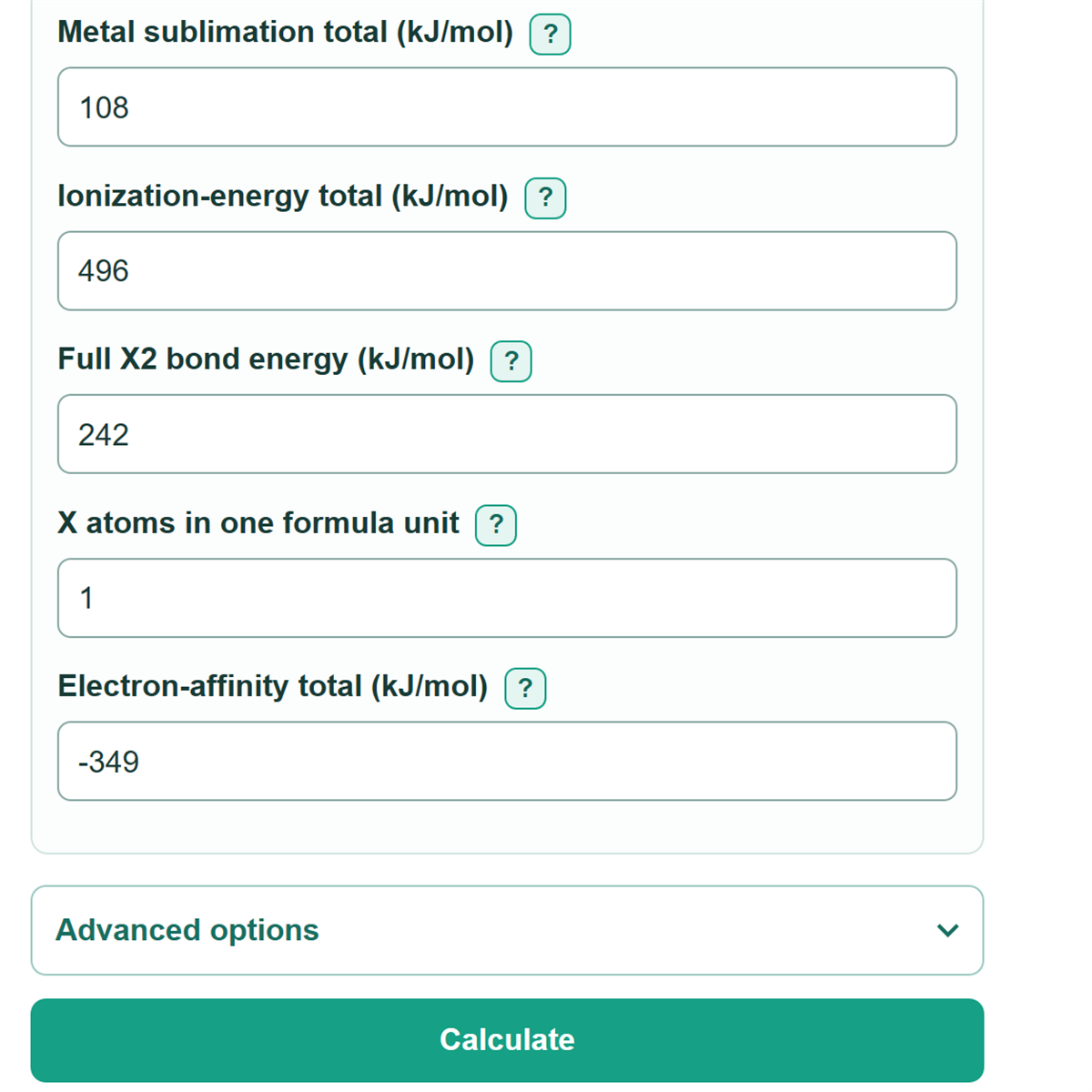
- For "Born-Haber cycle," enter each signed value exactly as printed and enter the full X2 bond energy, not half of it.
- For "Born-Lande estimate," enter positive charge magnitudes and type ion separation as pm, or add an explicit A or angstrom suffix.
- Click "Calculate." Check that the dissociation energy is the positive magnitude of the formation result, and check the displayed bond-breaking contribution before submitting work.
Definitions
Lattice enthalpy of formation: The energy change when gaseous cations and anions form one mole of an ionic solid. A negative value means energy is released.
Lattice dissociation energy: The positive energy required to separate one mole of an ionic solid into gaseous ions. It has the same magnitude as the reverse formation process.
Born-Haber cycle: A Hess's law energy cycle that combines atom formation, ionization, bond breaking, electron affinity, and lattice formation. [2]
Born-Lande equation: An ionic-model equation that estimates lattice formation enthalpy from ion charges, ion separation, crystal geometry, and a short-range repulsion correction. [3]
Madelung constant: A dimensionless number that accounts for the electrostatic arrangement of ions in a particular crystal structure.
Born exponent: A dimensionless number greater than 1 that sets the short-range repulsion correction in the Born-Lande estimate.
Ion separation: The closest cation-anion distance used in the Born-Lande equation. One angstrom equals 100 pm.
Common mistakes and quick fixes
Mistake: Treating lattice formation enthalpy and lattice dissociation energy as the same signed number.
Fix: Report formation with its calculated sign. Report dissociation as the positive magnitude for the reverse process.
Mistake: Entering half of the X 2 bond energy.
Fix: Enter the full bond energy for X 2 . The calculator multiplies it by the number of X atoms and divides by 2.
Mistake: Forgetting an ionization step or formula-unit multiplier.
Fix: Add every required ionization energy and formula-unit multiplier before entering "Ionization-energy total (kJ/mol)."
Mistake: Removing the negative sign from electron affinity or standard enthalpy of formation.
Fix: Copy the signed value from the assigned table. Negative thermochemical inputs are valid.
Mistake: Entering signed charges or meters in "Born-Lande estimate."
Fix: Enter positive charge magnitudes and use pm, A, or angstrom for "Closest ion separation (pm or angstrom)."
Mistake: Treating a Born-Lande estimate as an experimental thermochemical value.
Fix: Label it as an ionic-model estimate. Use "Born-Haber cycle" when the needed thermochemical data are supplied.
Limitations & Key Assumptions / Boundary Conditions
- Born-Haber results depend on the signed values and formula-unit totals entered from the assigned data.
- The X2 bond calculation applies only when the nonmetal reference is a diatomic X2 molecule and the supplied value is for one mole of X2 molecules.
- The Born-Lande method treats ions as point charges with a simplified short-range repulsion correction, so covalency and polarization can make its estimate differ from a thermochemical value.
- Born-Lande inputs require positive charge magnitudes, a positive finite ion separation, a positive Madelung constant, and a Born exponent greater than 1.
- All entries and results are per mole of ionic compound. Scale every worksheet term to the same formula-unit basis before entering it.
Methodology
Born-Haber calculation
The calculator adds the non-lattice steps for one mole of compound, then rearranges Hess's law to find the lattice-forming step. Enter electron affinity with the sign shown in the assigned data table. [2]
Bond-breaking contribution = full X2 bond energy × number of X atoms / 2
The division by 2 converts a bond energy for X2 molecules into the amount needed for the stated number of X atoms.
Cycle total before lattice formation = sublimation total + ionization-energy total + bond-breaking contribution + electron-affinity total
Lattice enthalpy of formation = standard enthalpy of formation - cycle total before lattice formation
Lattice dissociation energy = absolute value of lattice enthalpy of formation
Mini-example: formation enthalpy = -411 kJ/mol, sublimation = 108 kJ/mol, ionization = 496 kJ/mol, X2 bond energy = 242 kJ/mol, X atoms = 1, and electron affinity = -349 kJ/mol. Bond breaking is 242 × 1 / 2 = 121 kJ/mol. The pre-lattice total is 376 kJ/mol, so lattice formation is -787 kJ/mol and dissociation is 787 kJ/mol.
Born-Lande estimate
The calculator converts an explicit angstrom entry to pm and uses positive charge magnitudes. Its Coulomb factor, 138935.4576 kJ pm/mol, is derived from fundamental physical constants. [1]
Electrostatic term = -138935.4576 × Madelung constant × cation charge × anion charge / ion separation in pm
Lattice enthalpy of formation = electrostatic term × (1 - 1 / Born exponent)
The negative sign gives attraction in the lattice-forming direction. A Born exponent greater than 1 makes the repulsion correction positive and less than 1. This equation is a structural estimate, not a replacement for a Born-Haber calculation using complete thermochemical data. [3]