
Calculate pump hydraulic power, shaft power, and optional yearly electricity use from flow, head, fluid specific gravity, and efficiency.
Advanced options
Table of contents
How to use our Pump Head, Flow and Hydraulic Power Calculator
- Choose how you know the pump head: use Enter head from a pump curve for Total Dynamic Head (TDH), or Use pressure rise for a measured pressure difference.
- Enter Flow rate (gpm), the matching head value, Fluid specific gravity (water = 1.00), and Pump efficiency at this duty point (%).
- Click Calculate and use Pump shaft power required as the mechanical power estimate at that operating point.
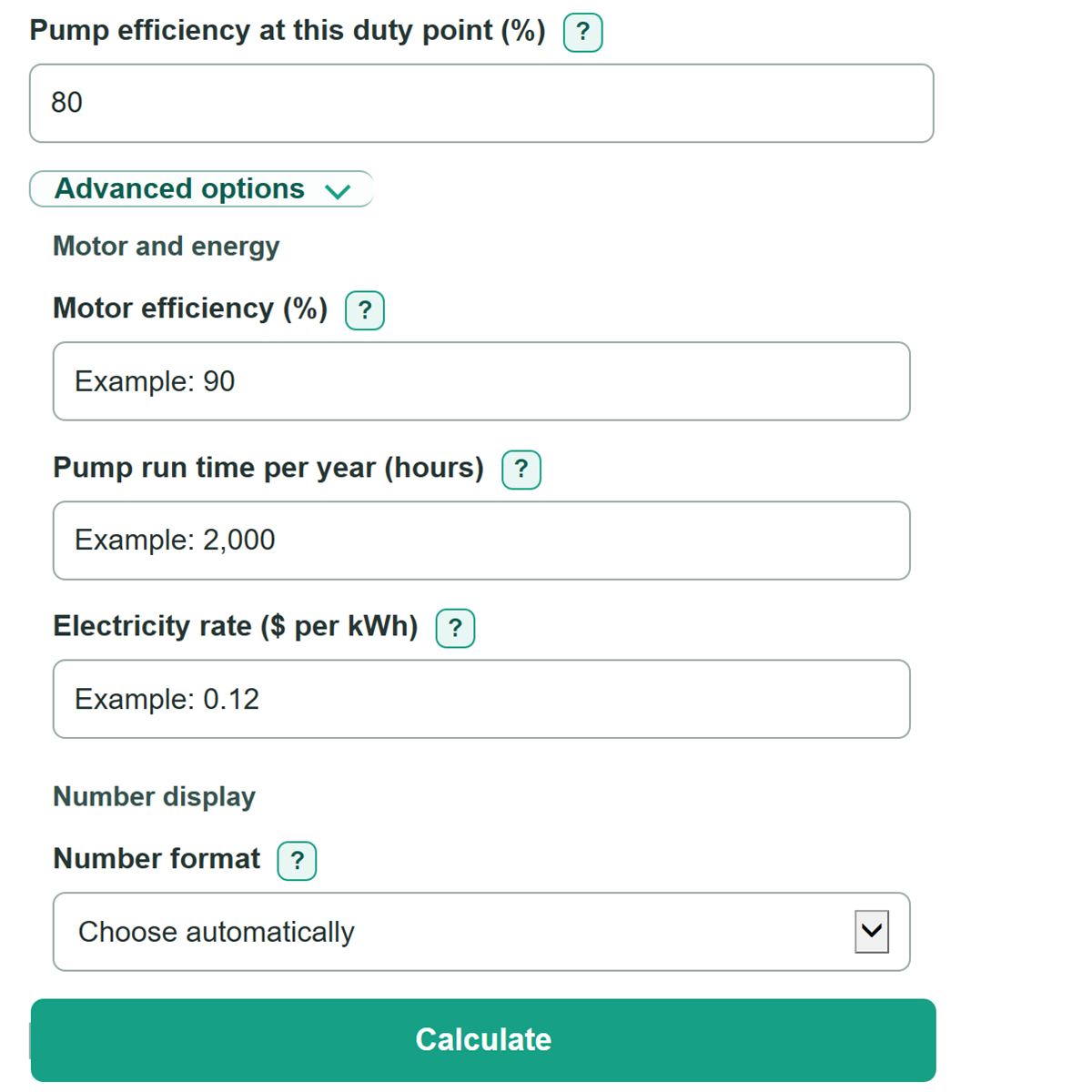
- For an electricity estimate, enter Motor efficiency (%), Pump run time per year (hours), and Electricity rate ($ per kWh).
- Sanity-check that the flow, head, and pump efficiency all came from the same point on the pump curve. Hydraulic power should be lower than pump shaft power when pump efficiency is below 100%.
Definitions
Total Dynamic Head (TDH): The total head the pump must add at a stated flow. It can include elevation change, pipe friction, and needed pressure.
Specific gravity: A unitless comparison of a fluid's density with water. Water is commonly entered as 1.00.
Hydraulic power: Useful power transferred to the moving fluid before pump losses.
Pump shaft power: Mechanical power required at the pump shaft after allowing for pump efficiency. It is often called brake horsepower.
Motor electrical input: Estimated electrical power entering the motor after allowing for motor efficiency.
kWh: Kilowatt-hours, a measure of energy. A pump using 1 kW for 1 hour uses 1 kWh.
Common mistakes and quick fixes
Mistake: Entering only the vertical lift as Total Dynamic Head (TDH) (ft) .
Fix: Use the TDH from the pump curve or system calculation, including pipe friction and required pressure where applicable.
Mistake: Using a Flow rate (gpm) from one duty point and Pump efficiency at this duty point (%) from another.
Fix: Read flow, head, and efficiency at one matching point on the same pump curve.
Mistake: Treating Pressure rise across pump (psi) as feet of head.
Fix: Select Use pressure rise and enter the fluid's Fluid specific gravity (water = 1.00) so the calculator converts pressure to fluid head.
Mistake: Entering 0.80 in Pump efficiency at this duty point (%) when the curve says 80%.
Fix: Enter 80, because this field uses percent rather than a decimal fraction.
Mistake: Treating Estimated motor electrical input as a motor-size recommendation.
Fix: Use it as a running-input estimate only, then check starting load, service factor, and manufacturer selection information.
Mistake: Expecting Estimated yearly pumping energy cost to include every bill charge.
Fix: It uses only the entered energy rate; add fixed charges, demand charges, and time-based pricing separately if they apply.
Limitations & Key Assumptions / Boundary Conditions
- This is a duty-point calculation. Flow, head, and pump efficiency must describe the same operating point.
- TDH is not always the same as vertical lift. Friction losses, suction conditions, and required discharge pressure can change the required head.
- The pressure-rise method uses 2.31 ft of water per psi, then adjusts head using the entered specific gravity. It does not replace a full system-head calculation.
- The calculation does not model viscosity corrections, variable speed behavior, cavitation, pump curve changes, or changing system resistance.
- Pump shaft power is not a final motor-size recommendation. Motor starting conditions, overload capability, service factor, and manufacturer requirements may require a different selection.
- Yearly energy and cost appear only when the optional motor efficiency, runtime, and electricity rate are supplied. Cost includes usage-based kWh charges only, not fixed charges, demand charges, or time-of-use pricing.
Methodology
Calculation method
The calculator first uses the entered TDH, or converts the entered pressure rise into head for the stated fluid. Pump curves connect head, flow, hydraulic horsepower, and efficiency at a pump duty point. [2]
Head used (ft) = pressure rise (psi) x 2.31 / specific gravity
For direct head entry, the entered Total Dynamic Head (TDH) (ft) is used without this conversion.
Hydraulic power (hp) = flow (gpm) x head (ft) x specific gravity / 3960
Pump shaft power (hp) = hydraulic power (hp) / pump efficiency as a decimal
The calculator converts horsepower to kilowatts using 0.7457 kW per hp.
Pump shaft power (kW) = pump shaft power (hp) x 0.7457
If Motor efficiency (%) is filled in, electrical input is calculated separately from pump shaft power. If yearly runtime is also provided, the calculator multiplies motor input kW by hours. It calculates cost only after an electricity rate is entered.
Motor input (kW) = pump shaft power (kW) / motor efficiency as a decimal
Yearly energy (kWh) = motor input (kW) x yearly run time (hours)
Yearly energy cost ($) = yearly energy (kWh) x electricity rate ($ per kWh)
Worked example
At 396 gpm, 100 ft of head, specific gravity 1.00, and 80% pump efficiency, hydraulic power is 10 hp and pump shaft power is 12.5 hp. That is 9.32125 kW at the shaft. With 90% motor efficiency, 2,000 yearly run hours, and an electricity rate of $0.12 per kWh, estimated motor input is 10.3569 kW, yearly use is 20,713.9 kWh, and usage-based cost is about $2,485.67.