
Size backup power for a well pump from its nameplate amps, starting surge, and planned pump run time.
Advanced options
Table of contents
How to use our Well Pump Backup Power Calculator
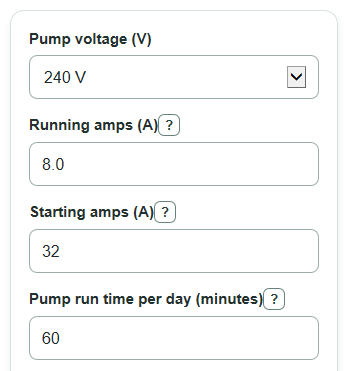
- Choose Pump voltage, then enter Running amps and Starting amps from the pump nameplate, control box, or motor label.
- Enter Pump run time per day as total pump-on minutes during the outage, not the total time people use water.
- Enter Backup length for how many outage days the pump plan should cover.
- Open Advanced options only if you want to change Power headroom, Running power factor, or Battery and inverter loss from the defaults.
- Click Calculate, then sanity-check the output: Minimum starting surge rating should usually be higher than Minimum running power rating, and Battery energy needed for planned pumping should double if pump minutes double.
Definitions
Pump voltage: The electrical voltage used by the well pump, commonly 120 V or 240 V in US homes.
Running amps: The current the pump uses after it is already running. A motor label may call this FLA, RLA, or full-load amps.
Starting amps: The brief higher current needed when the pump first turns on. A label may call this inrush amps or LRA.
Power headroom: Extra power added above the calculated pump load so the backup system is not sized right at its limit.
Running power factor: A number from 0 to 1 that helps convert volts times amps into real running power for an AC motor.
Battery and inverter loss: Extra energy added because batteries, inverters, and wiring do not deliver every stored watt-hour to the pump.
Minimum starting surge rating: The short-time kW rating a generator or inverter should meet to start the pump.
Minimum running power rating: The continuous kW rating a generator or inverter should meet while the pump is running.
Common mistakes and quick fixes
Mistake: Using Running amps for Starting amps because both are listed in amps.
Fix: Enter the brief turn-on current in Starting amps; if you do not know it, use a rough estimate such as several times Running amps.
Mistake: Entering total faucet-use time in Pump run time per day.
Fix: Use only the minutes when the well pump motor is actually on.
Mistake: Setting Pump voltage to 120 when the pump is wired for 240.
Fix: Match Pump voltage to the pump nameplate or control box before trusting Minimum starting surge rating.
Mistake: Lowering Power headroom to 0 and buying equipment that matches the exact calculated load.
Fix: Keep some Power headroom unless your generator, inverter, and pump manufacturer guidance supports a tighter size.
Mistake: Treating Battery energy needed for planned pumping as the whole-house battery size.
Fix: Add other backed-up loads separately; this calculator sizes the well pump load only.
Limitations & Key Assumptions / Boundary Conditions
- The calculator sizes the well pump only. Lights, refrigerators, furnace blowers, chargers, and other backup loads must be added separately.
- Starting amps must come from the pump or motor label when possible. A rough estimate can miss the real start-up surge.
- The power ratings use volts times amps for backup equipment sizing. Some generators and inverters have separate watt, VA, surge, and motor-start limits.
- Battery energy is based on planned pump run minutes, backup days, running power factor, and loss percent. It does not estimate gallons of water or pressure tank behavior.
- Soft starters, variable-speed drives, long wire runs, low voltage, high starting load, or worn pump equipment can change the surge needed to start the pump.
- A 0 minute Pump run time per day returns 0 kWh for pumping, but the pump still needs the shown starting and running power ratings if it will be used at all.
Methodology
Power ratings
The calculator first turns Pump voltage and amps into volt-amps. Volt-amps are useful for generator and inverter sizing because AC equipment can be limited by apparent power, not only real watts [2].
running_va = voltage * running_amps
starting_va = voltage * starting_amps
Power headroom is then added, and the result is divided by 1000 to show kW.
minimum_continuous_power_kw = running_va * (1 + power_headroom_percent / 100) / 1000
minimum_starting_power_kw = starting_va * (1 + power_headroom_percent / 100) / 1000
Battery energy
For energy, the calculator uses real running power. Electric energy is power multiplied by time [1].
running_pump_power_kw = voltage * running_amps * running_power_factor / 1000
pump_energy_per_day_kwh = running_pump_power_kw * pump_minutes_per_day / 60
battery_energy_needed_kwh = pump_energy_per_day_kwh * backup_days * (1 + system_loss_percent / 100)
Mini-example
For a 240 V pump with 8 running amps, 32 starting amps, 60 pump minutes per day, 1 backup day, 20 percent power headroom, 0.80 running power factor, and 15 percent battery and inverter loss:
running VA is 240 * 8 = 1920 VA, so the Minimum running power rating is 1920 * 1.20 / 1000 = 2.304 kW. Starting VA is 240 * 32 = 7680 VA, so the Minimum starting surge rating is 7680 * 1.20 / 1000 = 9.216 kW. Running pump power is 240 * 8 * 0.80 / 1000 = 1.536 kW. One hour of pumping uses 1.536 kWh per day, and with one day plus 15 percent loss the Battery energy needed for planned pumping is 1.536 * 1 * 1.15 = 1.7664 kWh.