
Convert a DWDM center value, calculate a fixed-grid center, and check how closely it matches the selected frequency grid.
Advanced options
Calculation details
Table of contents
How to use our DWDM Wavelength, Frequency and Channel Spacing Calculator
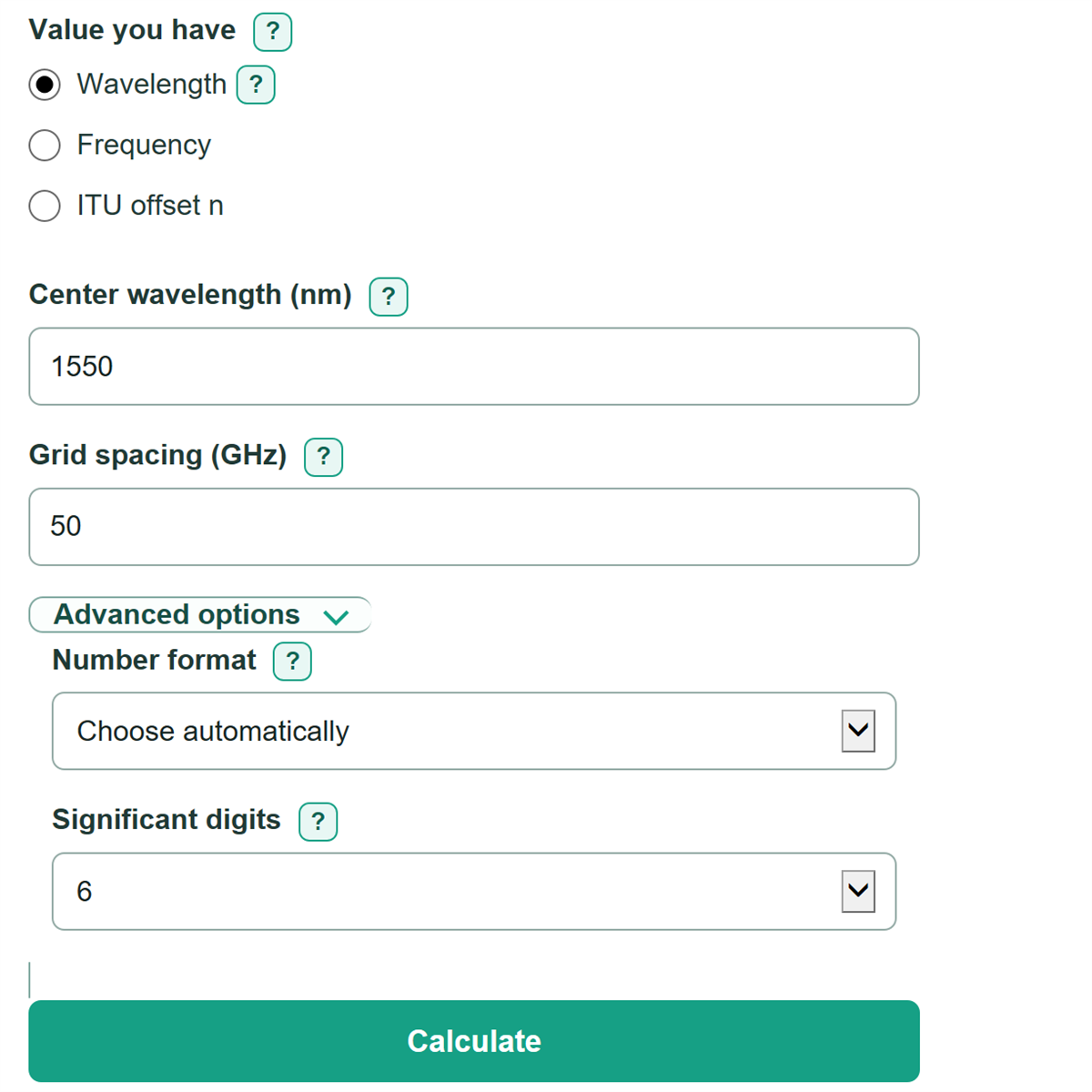
- Under "Value you have," choose Wavelength, Frequency, or ITU offset n based on the value printed in your source.
- Enter the active center value. For "Center frequency (THz)," a bare number is THz; type a GHz suffix for a GHz value, such as 193400 GHz.
- Enter "Grid spacing (GHz)" from the mux, ROADM, transceiver, or network plan, then select Calculate.
- Check "Frequency error from nearest grid point." Zero means the calculated center is exactly on the selected grid; also confirm that "Grid spacing used" matches the equipment plan.
Definitions
DWDM: Dense wavelength division multiplexing. It sends multiple optical channels through one fiber at different center frequencies.
Center wavelength: The vacuum wavelength of an optical channel, shown in nm (nanometers).
Center frequency: The optical frequency of the same channel, shown in THz (terahertz) or GHz (gigahertz). One THz equals 1,000 GHz.
Grid spacing: The frequency difference in GHz between neighboring points on a selected fixed grid.
ITU offset n: A signed whole-number count of grid steps from the 193.1 THz reference. It is not automatically a vendor Channel ID.
Grid alignment error: Calculated center frequency minus the nearest selected-grid center. A positive value is above that grid point; a negative value is below it.
Approximate wavelength spacing: The local nm difference corresponding to the selected GHz spacing near the calculated center. It changes as wavelength changes.
Common mistakes and quick fixes
Mistake: Entering 193400 in "Center frequency (THz)" and expecting GHz.
Fix: Type 193.4 for THz, or type 193400 GHz with the GHz suffix.
Mistake: Treating "ITU offset n from 193.1 THz" as a vendor Channel ID.
Fix: Enter n only when the channel plan explicitly defines it as a signed offset from 193.1 THz.
Mistake: Entering a fractional value such as 1.5 for "ITU offset n from 193.1 THz."
Fix: Enter a signed whole number, such as -4, 0, or 6.
Mistake: Using zero or a negative value for "Grid spacing (GHz)."
Fix: Enter a positive spacing from the equipment or network plan, such as 50 or 100.
Mistake: Assuming equal GHz spacing creates equal nm spacing everywhere.
Fix: Use "Approximate wavelength spacing at this center" only near the calculated center; compare it again after changing center wavelength.
Limitations & Key Assumptions / Boundary Conditions
- Results use vacuum wavelength and the exact speed of light. A value measured in a real fiber can differ because fiber propagation depends on refractive index and other system conditions.
- The grid check uses a fixed 193.1 THz reference and the entered fixed spacing. It does not calculate flexible-grid slots, slot widths, channel-plan ranges, or guard bands.
- The nearest ITU offset n is a mathematical grid position, not a universal mapping to a vendor Channel ID, port name, or tunable-optic setting.
- The wavelength-spacing result is a local estimate. Equal frequency steps do not remain equal wavelength steps across a wide spectral range.
- Displayed digits are formatting choices. They do not add measurement accuracy beyond the source label, instrument, or network plan.
Methodology
Center conversion
The calculator treats wavelength and frequency as two descriptions of one optical center. It uses the vacuum speed-of-light conversion constant c = 299792.458 nm THz, derived from the exact defined speed of light in vacuum. [1]
center_frequency_thz = 299792.458 / center_wavelength_nm
center_wavelength_nm = 299792.458 / center_frequency_thz
A frequency entered with a GHz suffix is divided by 1,000 before calculation. A bare frequency entry is interpreted as THz.
Fixed-grid position
For ITU offset mode, the calculator starts at 193.1 THz and adds the signed whole-number offset times the selected spacing, after converting GHz to THz. This follows the fixed-grid reference convention. [3]
center_frequency_thz = 193.1 + itu_offset_n * grid_spacing_ghz / 1000
It finds the nearest whole grid step, then subtracts that grid center from the calculated center. The sign is kept: positive is above the nearest grid center and negative is below it.
nearest_itu_offset_n = round((center_frequency_thz - 193.1) * 1000 / grid_spacing_ghz)
grid_alignment_error_ghz = (center_frequency_thz - nearest_grid_frequency_thz) * 1000
Local wavelength-spacing estimate
The calculator estimates the nm distance of one frequency step at the calculated center. This is a local conversion, so it should not be used as constant nm spacing over a whole band.
approx_wavelength_spacing_nm = center_wavelength_nm * center_wavelength_nm * (grid_spacing_ghz / 1000) / 299792.458
Worked example
With an ITU offset n of -4 and a grid spacing of 100 GHz, the center frequency is 193.1 + (-4 x 100 / 1000) = 192.7 THz. Its equivalent vacuum wavelength is about 1555.75 nm, and its grid alignment error is 0 GHz.
Calculation assumptions
The calculation requires a positive wavelength, frequency, and grid spacing. ITU offset n must be a whole number. Numbers are calculated with JavaScript floating-point arithmetic and then rounded only for display, so a copied equipment value may show a small nonzero alignment error if it was rounded before entry.