
Check an ECM circulator's flow margin at your design head, then estimate electricity savings and simple payback from your actual project numbers.
Table of contents
How to use our Hydronic Circulator Pump Size and ECM Upgrade Payback Calculator
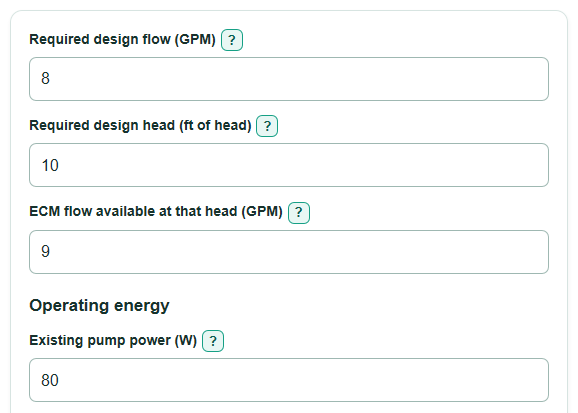
- Copy the required duty point into Required design flow and Required design head from a pump schedule, design, or contractor calculation.
- Read the proposed pump curve at that same head and enter the result in ECM flow available at that head.
- Enter Existing pump power and Proposed ECM pump power for the actual operating setting, plus Operating time and your usage-based Electricity rate.
- Enter ECM installed cost, Avoided standard replacement cost, and any Confirmed rebate or incentive shown in your quote or approval.
- Check the flow margin first. A negative margin means the proposed pump does not meet the entered duty point, so do not rely on its payback result for selection.
Definitions
Design flow: The system flow required at the design condition, entered in gallons per minute (GPM).
Design head: The pressure loss the circulator must overcome at the design flow, expressed as feet of head. In a closed loop, it is mainly piping and component friction, not building height.
ECM: Electronically commutated motor. ECM circulators can vary power use with the selected speed, control setting, and duty point.
Flow capacity margin: ECM flow available at the entered design head minus required design flow. A nonnegative value passes this simplified curve-point check.
Usage-based electricity rate: The part of an electric bill that changes with kilowatt-hours (kWh). The 17.30 cents/kWh default is a 2025 US residential planning estimate; replace it with the rate from your bill. [1]
Net incremental ECM upgrade cost: ECM installed cost minus avoided standard replacement cost and confirmed incentives.
Simple payback: Net incremental ECM upgrade cost divided by annual electricity savings when annual savings are positive.
Common mistakes and quick fixes
Mistake: Using building height as Required design head in a closed hydronic loop.
Fix: Enter total friction and component-loss head at the required flow, not vertical building height.
Mistake: Reading ECM flow available at that head from a different head or speed on the pump curve.
Fix: Use the proposed pump's flow where its intended setting crosses the entered Required design head.
Mistake: Entering maximum nameplate watts as Existing pump power or Proposed ECM pump power.
Fix: Use measured input power or a specification value at the actual duty point and control setting when available.
Mistake: Including a fixed monthly customer charge in Electricity rate.
Fix: Enter only the charges that change with kWh, and choose the matching Electricity rate unit.
Mistake: Using the full ECM installed cost even though a standard pump replacement was already needed.
Fix: Enter that baseline quote as Avoided standard replacement cost so the calculator uses the extra ECM cost.
Mistake: Treating an unapproved rebate as a Confirmed rebate or incentive.
Fix: Enter $0 until the incentive is documented for the proposed project.
Limitations & Key Assumptions / Boundary Conditions
- This is a simplified duty-point check using one user-entered pump-curve flow at one entered head. It is not a full manufacturer pump selection.
- It does not test fluid concentration, fluid temperature, control compatibility, minimum flow, noise, cavitation risk, electrical requirements, or installation restrictions.
- Annual savings depend directly on the entered operating watts, operating time, and electricity rate. Actual values can change with weather, controls, zones, and pump settings.
- Electricity savings exclude fixed monthly utility customer charges because those charges normally do not change with circulator kWh use.
- Simple payback includes electricity savings only. It does not include maintenance, repair, comfort, reliability, financing, inflation, or future utility-rate changes.
- A negative flow capacity margin means the entered pump-curve point falls short of the required flow, even if the ECM has favorable energy savings.
Methodology
Duty-point check
The calculator compares the proposed ECM curve flow with the required system flow at the same entered design head.
Flow capacity margin (GPM) = ECM flow available at that head - Required design flow
A margin of 0 GPM or more means the entered curve point reaches the entered flow. A negative margin means it is short by that many GPM.
Annual electricity use and cost
Each pump's annual electricity use is based on its entered operating input power and annual operating time. Watts are divided by 1,000 to convert to kilowatts.
Annual electricity use (kWh/year) = pump power (W) x Operating time (hours/year) / 1000
The Electricity rate is converted to dollars per kWh when cents per kWh is selected. Only kWh-dependent utility charges belong in this rate.
Annual electricity cost ($/year) = annual electricity use (kWh/year) x electricity rate ($/kWh)
ECM upgrade annual electricity savings = existing annual electricity cost - proposed ECM annual electricity cost
Upgrade cost and payback
The project comparison uses the added cost of choosing ECM instead of spending that would happen for a standard replacement.
Net incremental ECM upgrade cost ($) = ECM installed cost - Avoided standard replacement cost - Confirmed rebate or incentive
Simple ECM upgrade payback (years) = net incremental ECM upgrade cost / ECM upgrade annual electricity savings
Payback is shown only when annual electricity savings are positive. It is 0 years when the net incremental cost is $0 or less.
Worked example
With 8 GPM required and 9 GPM available at the entered head, the flow capacity margin is 1 GPM. With 80 W existing power, 25 W ECM power, 3,000 hours/year, and 17.30 cents/kWh, annual electricity savings are $28.55. If the ECM installed cost is $900 and the avoided standard replacement cost is $650, the $250 net incremental cost gives about 8.76 years of simple payback.