
Calculate the added water volume a heat-pump buffer tank or volumizer needs for run time and the equipment manual's minimum.
Water already in the system and manual requirement
Table of contents
How to use our Heat Pump Buffer Tank and Volumizer Size Calculator
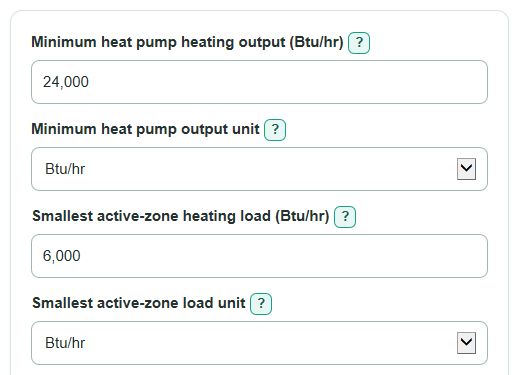
- Enter the lowest Minimum heat pump heating output from the applicable performance table, then choose the unit printed in that document.
- Enter the Smallest active-zone heating load that can operate while the heat pump is on. Use zero only if no active load removes heat during that cycle.
- Enter the required Minimum heat pump run time, the control's Tank temperature swing, Delta T, and the active system's known water content.
- Enter the manual's minimum total water volume if the exact heat-pump manual states one, then click Calculate.
- Check the Sizing check that controls and confirm the selected tank has usable water volume at least equal to the Smallest whole-gallon tank target.
Definitions
Minimum heat pump heating output: The lowest heat output the unit can deliver at the operating condition being checked, not its nominal or maximum rating.
Smallest active-zone heating load: Heat removed by the smallest zone or group that can operate during the heat-pump cycle.
Tank temperature swing, Delta T: The difference between the tank control's off and on temperatures, measured in degrees F.
Existing system water volume: Water already active in the heat pump, piping, heat exchangers, emitters, and existing tanks.
MBH: 1,000 Btu/hr.
Volumizer: A vessel used mainly to add water volume. A buffer tank can add volume and may also have a hydraulic role.
Common mistakes and quick fixes
Mistake: Using nominal or maximum capacity for Minimum heat pump heating output.
Fix: Copy the lowest heating output at the relevant water and outdoor conditions from the performance table.
Mistake: Entering the full building design load as Smallest active-zone heating load.
Fix: Use the smallest zone or group of zones that can be active during a heat-pump on-cycle.
Mistake: Treating Tank temperature swing, Delta T as the usual supply-to-return temperature drop.
Fix: Enter the tank control's off setpoint minus its on setpoint.
Mistake: Leaving out pipe, emitters, heat exchangers, or an existing tank from Existing system water volume.
Fix: Add all active water content from the piping takeoff and equipment documents.
Mistake: Selecting a tank only by its nameplate capacity after seeing Required added tank volume.
Fix: Confirm the product's usable water volume meets the Smallest whole-gallon tank target and its piping arrangement fits the design.
Limitations & Key Assumptions / Boundary Conditions
- The calculation uses water and a 500 hydronic sizing factor. Glycol mixtures, unusual fluid properties, or temperatures outside normal hydronic practice can change stored heat per gallon.
- It assumes the entered minimum heat-pump output and smallest active-zone load apply at the same operating condition.
- It sizes active water volume for the entered run time and tank temperature swing. It does not model control logic, defrost, pump flow, standby loss, or changing weather.
- The manual minimum is optional only when the exact heat-pump documentation gives no minimum total water-volume requirement. A blank field does not prove that no requirement exists.
- The result is an added usable-water-volume target. It does not approve tank piping, hydraulic separation, flow rates, pressure rating, placement, or controls.
- Nominal tank capacity can differ from usable active water volume because of internal parts, air space, and manufacturer restrictions.
Methodology
Calculation
The calculator converts capacity inputs to Btu/hr and volume inputs to US gallons. It subtracts the smallest active-zone load from minimum heat-pump output, with a floor of zero because a load equal to or greater than output creates no surplus heat to store.
excess output = maximum(0, minimum heat pump output - smallest active-zone heating load)
The runtime check estimates the total active system water volume needed to absorb that excess output for the requested on-cycle.
runtime system volume (gal) = run time (min) * excess output (Btu/hr) / (500 * tank temperature swing (F))
If a manual minimum total water volume is entered, the calculator uses the larger of that value and the runtime system volume.
controlling volume = maximum(runtime system volume, manual minimum when entered)
It then subtracts existing active system water volume. Added volume cannot be negative, while the separate margin remains signed.
required added volume = maximum(0, controlling volume - existing system volume)
existing water-volume margin = existing system volume - controlling volume
Worked example
With 24,000 Btu/hr minimum output, a 6,000 Btu/hr active-zone load, 8 minutes of run time, and a 10 F tank swing, the runtime system volume is 28.8 gallons. With 10 gallons already in the system, 18.8 gallons must be added, so the whole-gallon selection floor is 19 gallons. If the exact manual instead requires 50 gallons total, the manual controls and 40 gallons must be added.
Rounding
Calculations use unrounded values. Displayed gallon values are rounded for readability, but the Smallest whole-gallon tank target always rounds the unrounded required added volume up to the next whole gallon.