
Compare 120V and 240V heat pump water heater costs, electricity use, and estimated hot-water recovery for your busiest period.
Advanced options
Extra quote details
Hot-water recovery
Comparison results
Table of contents
How to use our 120V vs 240V Heat Pump Water Heater Calculator
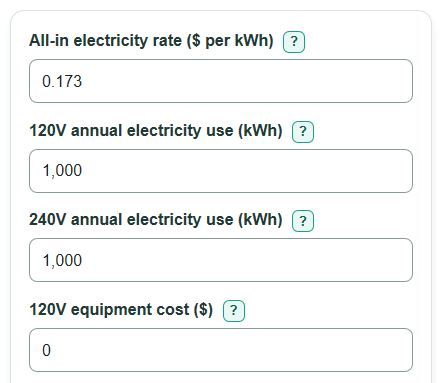
- Enter your utility bill's All-in electricity rate, including usage-based delivery charges but not a fixed account charge.
- Enter each exact model's 120V annual electricity use and 240V annual electricity use from its EnergyGuide label or specification sheet.
- Copy separate quote amounts into the equipment, base installation, and New 240V circuit cost fields. Do not enter the same electrical work twice.
- Open Advanced options if you have rebates, panel-work costs, or model recovery data. Enter tank size, recovery rate, Peak tank-water draw, and Peak-use time window to compare hot-water availability.
- Check the signed cost difference and peak hot-water margins. A positive margin means the estimate covers the entered busy period; a negative margin is an estimated shortfall.
Definitions
All-in electricity rate: The usage-based electricity cost per kWh, including applicable delivery charges. The default is a 2025 US planning average; replace it with your bill-based rate when possible. [1]
Net installed cost: Equipment, installation, electrical work, and other project costs minus the entered rebate or incentive.
Recovery rate: Gallons of tank water the model can restore in one hour under its stated test conditions and operating mode.
Peak hot-water margin: Estimated tank storage plus recovery during your busy period, minus the entered peak tank-water draw. A negative margin is a shortfall.
Simplified first-hour supply estimate: Tank size plus one hour of the entered recovery rate. It is not an official first-hour rating.
Full-tank recovery time: The estimated hours needed to add heat equal to one tank volume at the entered recovery rate.
Common mistakes and quick fixes
Mistake: Entering only the supply charge in All-in electricity rate.
Fix: Divide all usage-based electricity charges, including delivery charges, by billed kWh. Leave out a fixed account charge.
Mistake: Putting circuit work inside 240V base installation cost and again in New 240V circuit cost.
Fix: Put each quote line in one field only. Use New 240V circuit cost only for separately quoted breaker, wire, outlet or disconnect, and electrical labor.
Mistake: Assuming 120V recovery rate or 240V recovery rate from voltage alone.
Fix: Enter the published rate for the exact model and operating mode you plan to use.
Mistake: Entering faucet mixed-water use as Peak tank-water draw.
Fix: Estimate the hot water drawn from the tank during the busy period, then enter the elapsed Peak-use time window.
Mistake: Treating a possible rebate as certain in Confirmed 120V rebate or incentive or Confirmed 240V rebate or incentive.
Fix: Enter only an incentive that applies to your exact product, project timing, and program rules.
Limitations & Key Assumptions / Boundary Conditions
- Results depend on the exact model, operating mode, incoming water temperature, thermostat setting, and installation conditions. Voltage alone does not determine recovery.
- Peak hot-water margin treats the full tank size as available tank water and uses a steady published recovery rate. Real delivered shower water can differ because of mixing, temperature changes, and draw timing.
- The simplified first-hour supply estimate is not an official manufacturer first-hour rating and should not replace a model's published rating.
- Annual electricity cost is annual kWh times one blended electricity rate. It excludes fixed utility account charges and does not model time-of-use rates.
- Rebates and incentives are entered as confirmed amounts. Eligibility can depend on product requirements, income, location, installation date, and program funds.
- Check the exact installation instructions and local code requirements. A 120V model may still need a dedicated circuit or outlet, and a 240V project may need panel work.
Methodology
Cost calculations
Each option's net installed cost adds its entered project costs and subtracts its entered incentive. The 240V upfront comparison stays signed, so a negative amount means the 240V option costs less upfront.
120V net installed cost = equipment + base installation + circuit or outlet work + panel work + other costs - rebate
240V net installed cost = equipment + base installation + new 240V circuit + panel work + other costs - rebate
Extra upfront cost for 240V = 240V net installed cost - 120V net installed cost
Annual electricity calculations
Annual electricity cost is calculated separately for each model using its entered annual electricity use and the all-in electricity rate. The default rate is a US planning average from EIA, not a local quote. [1]
Annual electricity cost = annual electricity use in kWh x all-in electricity rate
240V annual electricity cost compared with 120V = 240V annual cost - 120V annual cost
Hot-water recovery calculations
The peak check adds recovery during the entered busy period to tank size, then subtracts the entered tank-water draw. For example, an 80-gallon tank with an 8 gallons-per-hour recovery rate over 60 minutes has 88 gallons of estimated supply. With a 90-gallon peak draw, its peak hot-water margin is -2 gallons.
Peak hot-water margin = tank gallons + recovery rate x (peak-use minutes / 60) - peak tank-water draw
Simplified first-hour supply estimate = tank gallons + recovery rate
Estimated time to recover one tank = tank gallons / recovery rate