
Compare gas and electric fireplace running costs at the same useful room heat using your rates, fireplace ratings, and schedule.
Advanced options
Table of contents
How to use our Gas vs Electric Fireplace Cost Calculator
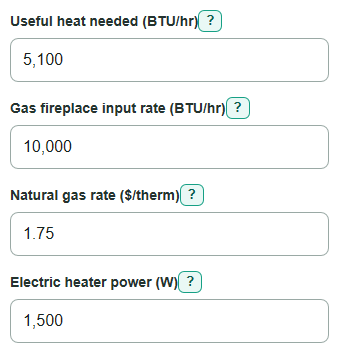
- Enter the room heat target in Useful heat needed, then copy each fireplace rating into Gas fireplace input rate and Electric heater power.
- Enter the usage-based rates from your utility bills in Natural gas rate and Electricity rate; leave fixed customer charges out of these fields.
- Open Advanced options and adjust Gas heat delivered to the room, your routine, and any fixed monthly charges if needed.
- Select Calculate, then read Lower-cost fireplace for matched heat and Seasonal run-cost savings first.
- Check Requested heat capacity check and Useful heat used for the cost comparison. If the comparison heat is lower than your target, one fireplace cannot meet the requested heat by itself.
Definitions
Useful heat: Heat that actually reaches the room, measured in BTU/hr.
Gas fireplace input rate: The fuel energy entering a gas fireplace each hour, before heat losses, measured in BTU/hr.
Gas heat delivered to the room: The percent of gas input treated as useful room heat in this comparison.
Therm: A natural gas billing energy unit equal to 100,000 BTU. [1]
kWh: A kilowatt-hour, the electricity unit used for utility billing.
Fixed charge: A monthly customer, meter, or service fee that usually stays the same even if fireplace runtime changes.
Common mistakes and quick fixes
Mistake: Entering gas heat delivered to the room in Gas fireplace input rate.
Fix: Use the fuel input rating from the fireplace label or manual, in BTU/hr.
Mistake: Using the full utility bill divided by energy use for Natural gas rate or Electricity rate.
Fix: Use usage-based supply and delivery charges only; enter a customer or meter fee in Fixed gas charge or Fixed electric charge.
Mistake: Entering flame-only power in Electric heater power.
Fix: Enter the heater-on wattage from the product label, because flame-only mode does not provide the compared room heat.
Mistake: Treating Gas heat delivered to the room as the gas input rating.
Fix: Enter the percent of gas input that reaches the room; use a manual value when available.
Mistake: Ignoring a shortfall in Requested heat capacity check.
Fix: If a fireplace falls short, use a higher-capacity model or treat the cost result as the cost for the lower matched heat shown in Useful heat used for the cost comparison.
Limitations & Key Assumptions / Boundary Conditions
- This calculator compares natural gas with an electric resistance-heating fireplace only. It does not cover propane, heat pumps, wood, pellets, or other fuels.
- It assumes gas efficiency stays the same at the compared heat level and that the fireplace can modulate or cycle down to that level. A real fireplace may have a minimum firing rate or different part-load efficiency.
- Electric heater power is treated as room heat at the point of use using 3.412141633 BTU/hr per watt. Heat lost through an open damper, exterior wall, or room airflow is not modeled.
- Run costs use variable energy charges only. Fixed charges are shown separately because they usually remain due when the utility service is already active.
- Season runtime uses 52 divided by 12 weeks per month. Actual calendar days, time-of-use electric rates, taxes, fuel riders, and changing utility prices can change the bill.
- A capacity shortfall means the calculator reduces both options to the heat that both can provide. It does not estimate the cost of another heater needed to cover the remaining heat.
Methodology
Matched heat method
The calculator first finds how much useful room heat each fireplace can provide. It then uses the lowest of the requested heat, gas capacity, and electric capacity. This prevents a lower-output fireplace from looking cheaper only because it supplies less heat.
gas_capacity_btu_per_hr = gas_input_rate * gas_efficiency / 100
electric_capacity_btu_per_hr = electric_heater_watts * 3.412141633
comparable_heat_output = min(useful_heat_needed, gas_capacity_btu_per_hr, electric_capacity_btu_per_hr)
Run-cost calculation
Gas cost converts the matched useful heat back to gas fuel input, then converts BTU to therms. Electric cost converts the same heat to watts, then kWh. One therm is 100,000 BTU, and the watt-to-BTU/hr conversion is 3.412141633. [1]
gas_cost_per_hour = (comparable_heat_output / (gas_efficiency / 100)) / 100000 * natural_gas_rate
electric_cost_per_hour = (comparable_heat_output / 3.412141633) / 1000 * electricity_rate
season_runtime_hours = hours_per_use * uses_per_week * season_months * (52 / 12)
season_run_cost = cost_per_hour * season_runtime_hours
For example, a 5,100 BTU/hr target, 75% gas efficiency, $1.75 per therm, and $0.1811 per kWh gives about $0.12 per hour for gas and $0.27 per hour for electric. At 208 seasonal hours, that is about $24.75 for gas and $56.30 for electric before fixed charges.
Calculation choices
Average monthly run cost is seasonal run cost divided by Heating-season length. Seasonal run-cost savings is the absolute difference between gas and electric seasonal run costs. Fixed charges are added only to the separate season-cost-plus-fixed-charge results, so they do not change the lower-cost fireplace or run-cost savings.