
Compare two PEX hot-water layouts for wait time, wasted water, yearly utility expense, and total cost over your chosen ownership period.
Trunk-and-branch layout
Advanced options
Pipe inside diameters
Water-heating assumptions
Table of contents
How to use our Home-Run PEX vs Trunk-and-Branch Cost Calculator
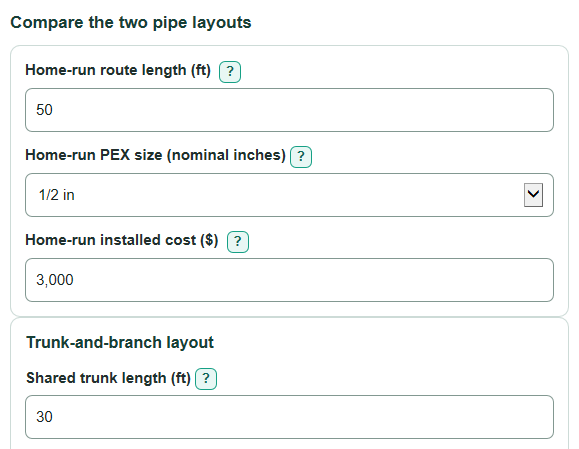
- Enter the measured Home-run route length and the complete Home-run installed cost for the representative fixture.
- Enter the separate Shared trunk length, Fixture branch length, and Trunk-and-branch installed cost. Do not include the shared trunk again in the branch length.
- Enter Cooled-pipe hot-water starts per day, Flow while waiting, your marginal water and sewer rates, and the matching water-heater energy rate.
- Choose a Comparison period. Open Advanced options if you need to replace the estimated inside diameters, water temperatures, efficiency, or days used per year.
- Check that the estimated time until hot water is believable for the route and fixture flow. If it is not, recheck route lengths, nominal PEX sizes, and the flow label before comparing ownership-period costs.
Definitions
Home-run layout: A layout with a dedicated hot-water pipe route from a manifold to a fixture.
Trunk-and-branch layout: A layout with a shared main pipe, called a trunk, followed by a smaller route to a fixture, called a branch.
Nominal PEX size: The labeled tubing size, such as 1/2 in or 3/4 in. It is not the same as the clear inside diameter.
Inside diameter: The open width inside the pipe. It is used to estimate how much water the pipe holds.
Cooled-pipe hot-water start: A hot-water draw that begins after water in the route has cooled, so colder water must be displaced first.
GPM: Gallons per minute, the fixture flow while waiting for hot water.
Marginal usage rate: The part of a water, sewer, electric, or gas bill that rises when usage rises. Fixed account charges are excluded.
UEF estimate: A decimal efficiency value used to estimate purchased energy needed to heat replacement water. A higher positive value means less purchased energy for the same delivered heat.
Common mistakes and quick fixes
Mistake: Adding the Shared trunk length to the Fixture branch length before entering it.
Fix: Enter each physical section once. The calculator adds Shared trunk length and Fixture branch length internally.
Mistake: Using nominal PEX size as if it were the exact inside diameter.
Fix: Choose the printed Home-run PEX size, Shared trunk PEX size, or Fixture branch PEX size, then replace the estimated inside diameter only when you have manufacturer data.
Mistake: Counting every faucet use in Cooled-pipe hot-water starts per day.
Fix: Count only draws after the route has cooled. Back-to-back draws may not waste a full route volume.
Mistake: Entering a total bill divided by total gallons as Water usage rate or Sewer usage rate.
Fix: Use the marginal volume charge that changes with gallons, not fixed meter, service, or customer charges.
Mistake: Using the electric rate when Water-heater fuel is Natural gas, or the gas rate when it is Electricity.
Fix: Choose the actual Water-heater fuel and copy the matching usage rate from that utility bill.
Mistake: Comparing quotes with different work included in Home-run installed cost and Trunk-and-branch installed cost.
Fix: Use the same scope for both, including applicable tubing, fittings, manifold, insulation, and labor.
Limitations & Key Assumptions / Boundary Conditions
- Pipe volume is estimated by treating each route as a straight, clear cylinder. Fittings, valves, manifolds, recirculation equipment, and tubing tolerances can change actual retained water.
- The listed inside-diameter suggestions are planning values for nominal SDR9 CTS PEX dimensions. Use the manufacturer dimension for the exact tubing if available.
- Estimated time until hot water is pipe volume divided by Flow while waiting. It does not model pressure loss, fixture mixing, heat loss while flowing, heater recovery, or simultaneous water use.
- Annual water sent down the drain assumes each counted Cooled-pipe hot-water start displaces one full representative route volume. Nearby or back-to-back draws can have less waste.
- Water and sewer savings use only marginal volume charges. Fixed service, meter, and customer charges usually remain.
- Ownership-period costs are undiscounted and exclude inflation, maintenance, equipment replacement, repairs, and changes in utility rates.
- The thermal estimate assumes liquid water weighs 8.34 lb per gallon and needs about 1 Btu per lb per degree F. Actual water properties vary slightly with temperature.
Methodology
Pipe volume and wait time
The calculator estimates water stored in each pipe section from its clear inside diameter, then converts cubic inches to US gallons. The home-run route has one section. The trunk-and-branch route adds the shared trunk and final branch as separate sections.
V = π x d2 / 4 x L x 12 / 231
In this formula, V is pipe volume in gallons, d is inside diameter in inches, and L is route length in feet. The 231 conversion is cubic inches per US gallon.
wait time (seconds) = pipe volume (gal) / flow (GPM) x 60
For example, a 50 ft home-run with a 0.475 in inside diameter holds about 0.460 gal. At 1.5 GPM, the estimated time until hot water is about 18.4 seconds.
Yearly water and energy expense
Each layout's annual waiting-water estimate multiplies its pipe volume by Cooled-pipe hot-water starts per day and Days used per year.
annual wasted gallons = pipe volume x starts per day x active days per year
Water and sewer expense uses the two marginal rates. Heating expense uses the water temperature rise, 8.34 lb per gallon, an estimated 1 Btu per lb per degree F, the selected fuel conversion, water-heater efficiency, and the selected fuel price. Electricity uses 3,412 Btu per kWh; natural gas uses 100,000 Btu per therm.
temperature rise (F) = Heated water temperature - Incoming water temperature
annual utility cost = water and sewer cost + water-heating cost
Ownership-period comparison
Each ownership-period cost combines its installed cost with yearly utility expense multiplied by Comparison period. The signed comparison subtracts trunk-and-branch cost from home-run cost.
ownership-period cost = installed cost + yearly utility cost x years
Ownership-period cost difference = home-run cost - trunk-and-branch cost
A positive difference means home-run costs more over the chosen period; a negative difference means home-run costs less. The calculator uses an editable 2025 US electricity planning estimate of $0.168 per kWh when electricity is selected; replace it with your bill's usage rate. [2] Use marginal utility charges rather than fixed service charges. [1]