
Estimate annual savings and simple payback for a steam-to-hot-water heating conversion using your bills, quote, and savings cases.
Project quote
Fuel-savings cases
Advanced options
Calculation details
Table of contents
How to use our Steam-to-Hot-Water Heating Conversion Payback Calculator
- Choose Current steam system. This does not change the math, but it reminds you to make sure the quote matches the actual piping setup.
- Enter Annual variable heating spending from 12 months of heating-related usage charges. Leave out fixed service charges and non-heating gas use when possible.
- Enter the quote details in Gross conversion project cost, Confirmed incentives, and Avoided repair or replacement cost.
- Enter cautious, most-likely, and optimistic values for the low, base, and high fuel-savings cases. The low value must be no more than base, and base must be no more than high.
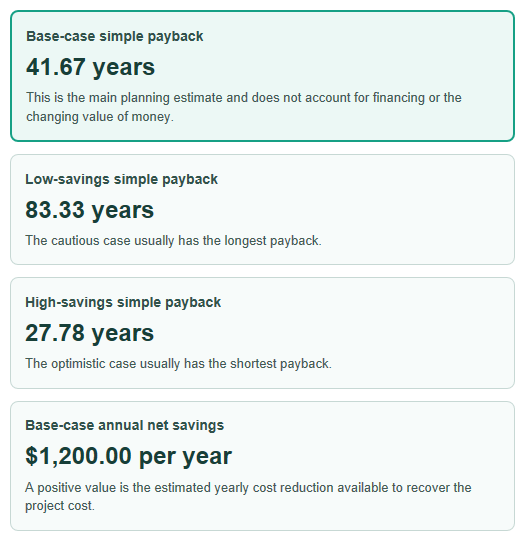
- Click Calculate. Check that the base-case annual net savings and payback make sense against your quote; open Advanced options only if a utility account will close or recurring costs will change.
Definitions
Variable heating spending: The part of annual fuel spending that changes with fuel use for space heating. It excludes fixed account charges.
Confirmed incentives: Rebates, grants, credits, or other funding that is approved and reduces the project cost.
Avoided repair or replacement cost: The cost of necessary like-for-like steam-system work that would be needed even without converting to hot water.
Annual net savings: Fuel savings plus fixed charges avoided, minus added recurring costs such as pump electricity or maintenance.
Simple payback: The number of years for annual net savings to equal the net project cost. It does not account for inflation, financing, taxes, or the time value of money.
One-pipe steam and two-pipe steam: Steam distribution layouts identified by radiator piping. They can affect conversion scope and must be reviewed in the project quote.
Common mistakes and quick fixes
Mistake: Using the full gas bill as Annual variable heating spending even though it also covers hot water, cooking, or laundry.
Fix: Enter only usage-based heating spending, or estimate the heating-only share before adding the 12-month total.
Mistake: Putting customer or meter charges into Annual variable heating spending.
Fix: Keep fixed charges out of that field. Use Fixed utility charges avoided ($ per year) only when the related utility account will actually close.
Mistake: Entering an expected rebate as Confirmed incentives before it is approved.
Fix: Include only documented incentives that are confirmed for this project.
Mistake: Treating the entire Gross conversion project cost as extra cost even when a steam boiler repair or replacement is already needed.
Fix: Put the like-for-like work that would happen anyway in Avoided repair or replacement cost.
Mistake: Entering Low fuel-savings case above Base fuel-savings case or High fuel-savings case below it.
Fix: Enter savings so low is no more than base, and base is no more than high.
Mistake: Entering a pump or maintenance increase as a negative Added recurring cost ($ per year).
Fix: Use a positive number for added annual cost. Use a negative number only when recurring costs are expected to decrease.
Limitations & Key Assumptions / Boundary Conditions
- This is a planning estimate based on user-entered spending, project costs, and savings percentages. It does not size equipment or confirm that a conversion is feasible.
- Annual variable heating spending should cover space heating only. Including domestic hot water, cooking, laundry, or other fuel uses can overstate estimated savings.
- The low, base, and high fuel-savings cases are assumptions. Actual savings can differ because of weather, building use, controls, insulation, fuel prices, installation quality, and equipment operation.
- Fixed utility charges count as savings only if the related utility account closes. Lower gas use alone may not remove those charges.
- Simple payback does not include loan interest, inflation, tax treatment, future repairs, replacement timing, resale value, or discounted cash flow.
- A one-pipe or two-pipe selection is only a scope reminder. A contractor or engineer should verify radiator suitability, return piping, controls, pumps, water treatment, venting, and code requirements.
- If annual net savings are zero or negative while net project cost is positive, simple payback is not reached under that case.
Methodology
Calculation steps
The calculator starts with the added project cost that needs to be recovered. Confirmed incentives and necessary like-for-like replacement work are subtracted from the gross conversion quote.
net project cost = gross conversion project cost - confirmed incentives - avoided repair or replacement cost
It then calculates fuel savings separately for each low, base, and high case. The percentage applies only to annual variable heating spending.
annual fuel savings = annual variable heating spending x fuel-savings case / 100
Annual net savings adds fixed charges that will truly disappear and subtracts added recurring costs. A negative recurring-cost entry means an added yearly saving.
annual net savings = annual fuel savings + fixed utility charges avoided - added recurring cost
When net project cost is positive and annual net savings is positive, simple payback divides one by the other. If net project cost is zero or negative, payback is shown as 0 years. If annual net savings is zero or negative, payback is shown as not reached.
simple payback = net project cost / annual net savings
Worked example
Suppose annual variable heating spending is $6,000, the gross conversion project cost is $50,000, confirmed incentives are $5,000, and avoided replacement cost is $15,000. The net project cost is $30,000. With a 20% base fuel-savings case and no fixed-charge or recurring-cost adjustment, annual net savings are $1,200 and base-case simple payback is 25 years. A 10% low case gives $600 per year and 50 years; a 30% high case gives $1,800 per year and about 16.7 years.