
Estimate the LED wattage, savings, payback time, and amp-load change for replacing metal halide fixtures.
Advanced options
Table of contents
How to use our Metal Halide to LED Conversion Calculator
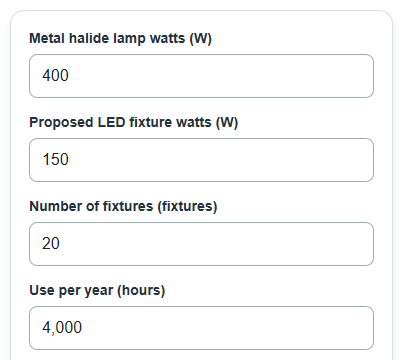
- Enter Metal halide lamp watts, Proposed LED fixture watts, Number of fixtures, Use per year, and Electricity rate.
- Open Advanced options if you want to change ballast overhead, light output, costs, maintenance, controls savings, voltage, or demand-charge values.
- Use Metal halide mean light per watt and Current fixture light getting out to tune the old-light estimate if you know fixture data.
- Click Calculate and read the top cards first: Suggested LED watts for similar light, Chosen LED light compared with current, Simple payback time, and Total amp load reduction.
- Sanity-check the result: near 100% light usually means a close brightness match, while a negative Total amp load reduction means the LED plan draws more current at the selected voltage.
Definitions
Lumens: A measure of light output. More lumens means more visible light.
Lumens per W: Light output per watt of input power. A higher value means more light for the same electric power [4].
Metal halide ballast overhead: Extra power used by the ballast that runs the metal halide lamp. The calculator adds this percent to Metal halide lamp watts.
kWh: Kilowatt-hour, a unit of electricity use. Electric bills commonly charge energy in $ per kWh [1].
Demand charge: A bill charge based on peak kilowatts, not total kWh. Leave it at 0 if it does not apply.
Amps: Electrical current. In this calculator, amps are estimated as watts divided by Circuit voltage.
Simple payback time: Project cost after rebates divided by first-year cash saved. If yearly cash saved is zero or negative, there is no simple payback.
Common mistakes and quick fixes
Mistake: Entering total fixture power in Metal halide lamp watts when Metal halide ballast overhead is also above 0.
Fix: Use the lamp watts only, or set Metal halide ballast overhead to 0 if your watt value already includes ballast power.
Mistake: Using fixture count for one room in Number of fixtures but using yearly hours for a larger building in Use per year.
Fix: Match Number of fixtures and Use per year to the same project area.
Mistake: Treating Proposed LED fixture watts as the same thing as light output.
Fix: Check Chosen LED light compared with current, because LED fixture light per watt controls how much light those watts produce.
Mistake: Leaving Electricity rate too low because only the supply charge was copied from the bill.
Fix: Use the energy charge in $/kWh that best matches what you pay for added or saved electricity.
Mistake: Adding Demand charge without changing Demand timing factor for lights that are not always on during the billing peak.
Fix: Keep Demand timing factor at 100 only when the lighting load normally affects peak demand; otherwise use a lower percent.
Mistake: Reading Simple payback time as a full investment return study.
Fix: Use Simple payback time as a first pass only; it does not include financing, taxes, utility rate changes, or fixture life.
Limitations & Key Assumptions / Boundary Conditions
- The light match is a rough lumen-based estimate, not a room lighting layout or photometric study.
- The calculator uses mean metal halide light per watt and fixture efficiency entries; dirty lenses, old reflectors, lamp age, mounting height, beam shape, and wall colors can change real light levels.
- Energy savings assume the entered Use per year is correct and that Extra LED hours cut by controls only reduces LED run time.
- Demand-charge savings are manual estimates. Actual bills may use ratchets, time periods, minimum charges, or other rules not included here.
- Amps are estimated with watts divided by Circuit voltage. The result does not adjust for power factor, starting current, harmonics, phase balance, or code load calculations.
- Simple payback time ignores financing, taxes, depreciation, inflation, utility rate changes, disposal costs, and fixture life.
- Project cost after rebates can be negative if the entered Rebate or incentive is larger than the entered fixture and install costs; the calculator keeps that value instead of forcing it to zero.
Methodology
Power and light setup
The current fixture power starts with Metal halide lamp watts and adds Metal halide ballast overhead. A ballast is the device that runs the lamp, and ballast efficiency is treated separately in metal halide equipment definitions [3].
current_system_watts_per_fixture = mh_lamp_watts * (1 + ballast_overhead_percent / 100)
The old usable light estimate uses lamp watts, Metal halide mean light per watt, and Current fixture light getting out. Lumens and lumens per watt are standard lighting terms for light output and lighting efficacy [4].
current_usable_lumens = mh_lamp_watts * mh_mean_lumens_per_watt * mh_luminaire_efficiency_percent / 100
suggested_led_watts = current_usable_lumens / led_lumens_per_watt
chosen_led_light_percent = led_fixture_watts * led_lumens_per_watt / current_usable_lumens * 100
Energy, savings, and payback
Electricity use is calculated in kilowatt-hours, the common unit used to measure electric energy [1]. The calculator converts watts to kilowatts by dividing by 1000.
old_kwh_per_year = current_system_watts_per_fixture * fixture_count * annual_hours / 1000
led_kwh_per_year = led_fixture_watts * fixture_count * annual_hours * (1 - controls_savings_percent / 100) / 1000
yearly_energy_saved = old_kwh_per_year - led_kwh_per_year
yearly_electricity_cost_saved = yearly_energy_saved * electricity_rate
Maintenance savings and demand-charge savings are added to get First-year cash saved.
yearly_maintenance_saved = (mh_maintenance_per_fixture_year - led_maintenance_per_fixture_year) * fixture_count
yearly_demand_cost_saved = ((current_system_watts_per_fixture - led_fixture_watts) * fixture_count / 1000) * (coincidence_factor_percent / 100) * demand_charge_per_kw_month * 12
first_year_cash_saved = yearly_electricity_cost_saved + yearly_maintenance_saved + yearly_demand_cost_saved
project_cost_after_rebates = (led_fixture_cost + install_cost_per_fixture - rebate_per_fixture) * fixture_count
simple_payback_years = project_cost_after_rebates / first_year_cash_saved
If First-year cash saved is 0 or negative, the calculator shows Simple payback time as N/A because the entered plan does not pay back through yearly savings.
Amp-load check
The amp-load check uses the basic electric relationship that power equals voltage times current, rearranged as current equals power divided by voltage [1].
old_total_amps = current_system_watts_per_fixture * fixture_count / voltage
led_total_amps = led_fixture_watts * fixture_count / voltage
total_amp_load_reduction = old_total_amps - led_total_amps
amp_load_reduction_percent = total_amp_load_reduction / old_total_amps * 100
Mini-example
For 20 fixtures with 400 W metal halide lamps, 15% ballast overhead, 75 lumens/W, 70% fixture efficiency, and 140 lumens/W LEDs, the old usable light is 400 * 75 * 0.70 = 21000 lumens per fixture. The suggested LED size is 21000 / 140 = 150 W. If the proposed LED is 150 W, the light match is 100%. With 4000 hours per year and $0.14/kWh, old yearly energy is 460 * 20 * 4000 / 1000 = 36800 kWh and LED yearly energy is 150 * 20 * 4000 / 1000 = 12000 kWh, so yearly energy saved is 24800 kWh. At 277 V, amp load drops by about (460 * 20 / 277) - (150 * 20 / 277) = 22.38 A.
Sources
- Measuring electricity - U.S. Energy Information Administration (EIA) - EIA
- U.S. DOE / EERE - Successful Selection of LED (street lighting webcast slides) (PDF) - Energy
- U.S. DOE e-CFR (10 CFR 431.322) - Definition: ballast efficiency for HID/metal halide lamp+ballast combinations - Cornell
- U.S. DOE (PDF) - Lighting specification guidance: definitions incl. lumen output and efficacy (lumens per watt) - Energy