
Convert pints to pounds or pounds to pints using your material's density and the US liquid, Imperial, or US dry pint type.
Table of contents
How to use our Pint to Pound Conversion Calculator
- Choose whether the amount you have is in pints or pounds.
- Enter the amount from your recipe, package, container, or scale reading.
- Choose the pint type named by your source: US liquid, Imperial, or US dry.
- Enter the material name, then copy its density and density unit from a product label, manufacturer information, or other suitable reference.
- Check that the result shows the intended material, pint type, and density. For loose or packed dry ingredients, compare with a scale if the weight needs to be accurate.
Definitions
Density: The mass that fits in a given volume. Density connects a volume in pints to a mass in pounds.
Pint type: The selected volume definition: US liquid pint, Imperial pint, or US dry pint. These are different volumes. [1]
g/mL: Grams per milliliter, a common density unit. Its numeric value is the same as kilograms per liter.
lb per US gallon: Pounds of material in one US liquid gallon. The calculator changes this value to g/mL before converting.
Ounces by weight: One sixteenth of a pound. They differ from fluid ounces, which measure volume.
Common mistakes and quick fixes
Mistake: Treating every pint as the same size.
Fix: Choose the pint type stated by the recipe or package. US liquid, Imperial, and US dry pints have different volumes.
Mistake: Assuming 1 pint always weighs 1 pound.
Fix: Enter a density for the actual material. A pint measures volume, while a pound measures mass.
Mistake: Using water density for oil, honey, flour, or another material.
Fix: Use a density source that matches the material and its condition.
Mistake: Choosing g/mL when the source lists lb per US gallon, or the reverse.
Fix: Choose the density unit printed beside the number. Do not guess a density unit from the number alone.
Mistake: Mixing up fluid ounces and ounces by weight.
Fix: Read the ounce remainder as ounces by weight. It is not a fluid-ounce volume.
Mistake: Typing a decimal with a comma, such as 1,01.
Fix: Use a decimal point for decimals. Commas are accepted only as thousands separators, such as 1,000.5.
Limitations & Key Assumptions / Boundary Conditions
- The answer is only as accurate as the density entered. Density can change with temperature, concentration, moisture, and product formulation.
- A US dry pint has a defined volume, but loose dry foods and materials can weigh differently when chopped, settled, clumped, or packed differently.
- The calculator accepts amounts of zero or more. Negative amounts and density values of zero or less are not valid for this physical conversion.
- Select the pint type from the original source. US liquid, Imperial, and US dry pints cannot be substituted for one another.
- Use a scale or a manufacturer specification for shipping, laboratory, commercial, or recipe work where a small weight difference matters.
Methodology
How it calculates
A pint measures volume and a pound measures mass, so there is no single pint-to-pound factor. The calculator selects the chosen pint volume, converts the entered density to g/mL when needed, and then calculates mass or volume.
mass in pounds = pints x pint volume (L) x density (g/mL) x 2.2046226218487757
volume in pints = pounds / (pint volume (L) x density (g/mL) x 2.2046226218487757)
When density is entered in lb per US gallon, it is normalized before either formula is used.
density (g/mL) = density (lb per US gallon) / (2.2046226218487757 x 3.785411784)
The calculation uses 0.473176473 L per US liquid pint, 0.56826125 L per Imperial pint, and 0.5506104713575 L per US dry pint. The pound and volume conversion constants follow NIST unit conversion references.
Worked example
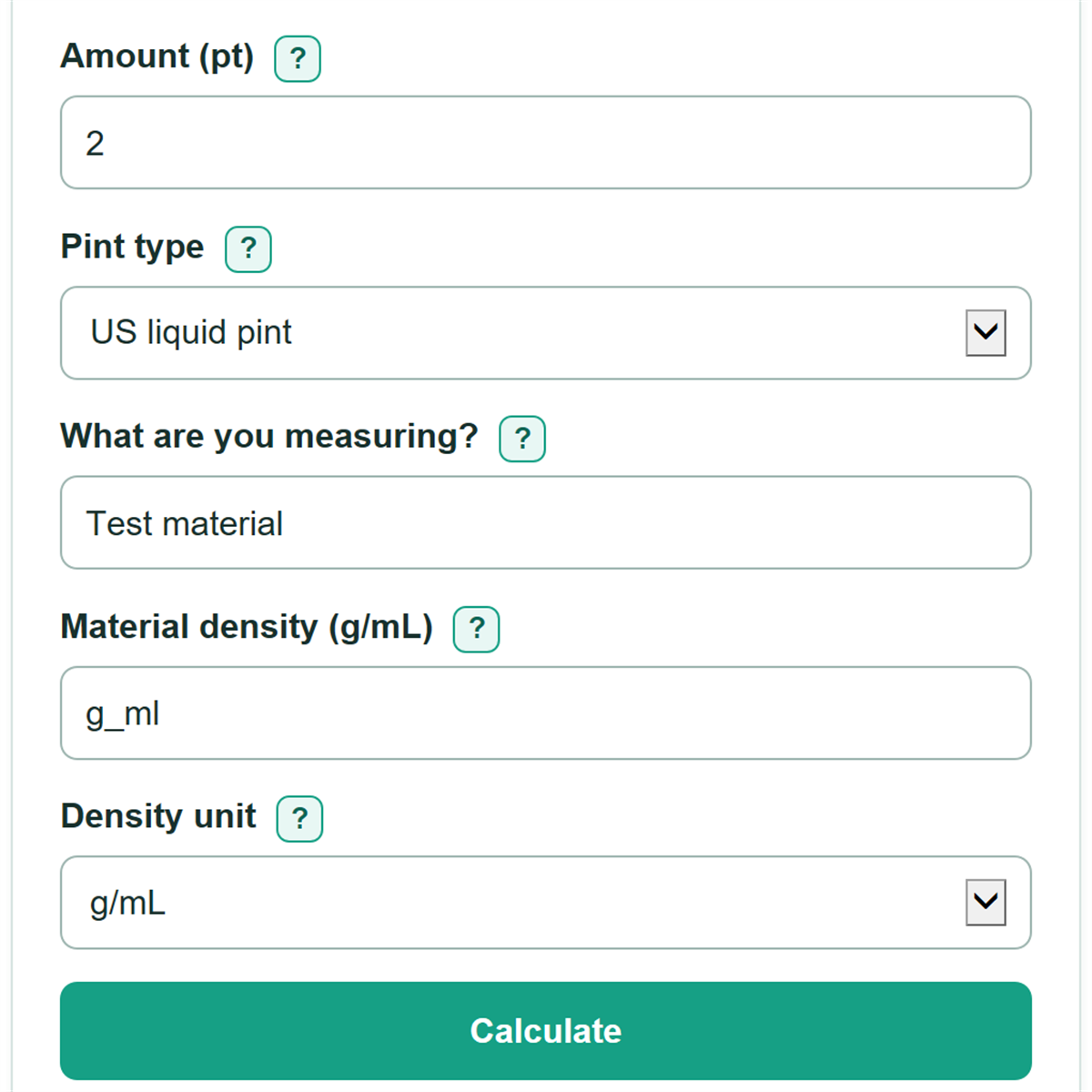
For 2 US liquid pints of a material with density 1.00 g/mL, the converted mass is about 2.09 lb. That is 2 whole pounds and about 1.38 ounces by weight.
2 x 0.473176473 x 1.00 x 2.2046226218487757 = 2.086351113005 lb
Calculation choices
The pounds-and-ounces display starts with the unrounded pound amount, removes the whole pounds, and multiplies the remaining fraction by 16. An amount of zero is valid and converts to zero. The calculation uses the density you enter, so it does not assume that every material has water-like density.