
Estimate water savings, usage-based bill savings, and full installed PRV payback using charges from your bill and costs from your quote.
Table of contents
How to use our Water PRV Savings and Payback Calculator
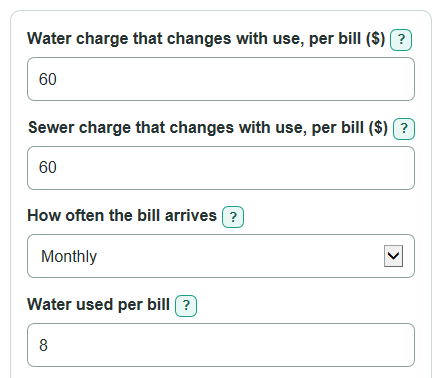
- Copy the usage-only parts of your bill into "Water charge that changes with use, per bill ($)" and "Sewer charge that changes with use, per bill ($)". Do not include fixed service or meter charges.
- Choose "How often the bill arrives," then enter "Water used per bill" and select the matching "Water-use unit on the bill."
- Enter a conservative planning estimate in "Expected water-use reduction (percent)."
- Copy your quote into "Valve and materials cost ($)" and "Labor, permit, and other installation cost ($)," then enter any confirmed "PRV rebate or credit ($)."
- Click Calculate. Check that "Quoted installed project cost" matches the full quote and that the payback still makes sense if the expected reduction is lower than planned.
Definitions
PRV: Pressure reducing valve, a plumbing valve that lowers incoming water pressure to a chosen downstream pressure.
Usage-based charge: A water or sewer bill charge that changes with the amount of water used. Fixed charges do not belong in this calculator. [1]
CCF or HCF: A utility-bill unit equal to 100 cubic feet of water, or about 748 gallons. [1]
kgal: One thousand gallons.
Rebate or credit: A confirmed payment or discount that reduces the upfront project cost.
Simple payback: The estimated years of bill savings needed to recover the net upfront project cost. It does not include financing, inflation, maintenance, or future rate changes.
Common mistakes and quick fixes
Mistake: Entering the entire utility bill in "Water charge that changes with use, per bill ($)".
Fix: Include only charges tied to water use; leave out base, service, meter, stormwater, tax, and past-due charges.
Mistake: Choosing Monthly when "Water used per bill" comes from a bill covering two months.
Fix: Set "How often the bill arrives" to Every 2 months so yearly water and bill savings use the correct number of bills.
Mistake: Treating an 8 CCF entry as 8 gallons in "Water used per bill".
Fix: Select CCF or HCF in "Water-use unit on the bill" when the bill uses either term; both mean 100 cubic feet.
Mistake: Using a promised savings claim as "Expected water-use reduction (percent)."
Fix: Use a local estimate or conservative scenario. This planning percentage controls "Estimated yearly bill savings" and is not guaranteed.
Mistake: Calculating payback from only "Valve and materials cost ($)."
Fix: Include labor, permits, and other work in "Labor, permit, and other installation cost ($)" so "Full installed payback" uses the complete project cost.
Mistake: Assuming a positive financial result confirms the installation will work.
Fix: Use the "Pressure and installation check" reminder and have a qualified plumber confirm pressure, flow capacity, valve size, and code requirements.
Limitations & Key Assumptions / Boundary Conditions
- The expected reduction is a user-entered planning assumption. Actual savings depend on leaks, fixtures, irrigation, water habits, occupancy, pressure change, and local conditions.
- Only water and sewer charges that change with use are counted. Fixed service, meter, stormwater, tax, and past-due charges are excluded unless your bill specifically makes them usage-based.
- Sewer charges may not decrease at the same rate as metered water use. Enter $0 for "Sewer charge that changes with use, per bill ($)" when local sewer billing will not fall.
- The result uses simple payback and a fixed five-year horizon. It does not model financing, interest, maintenance, water-rate changes, tax effects, or replacement costs.
- A financial estimate does not establish a safe pressure setting, adequate upper-floor flow, correct valve size, code compliance, or installation suitability. A qualified plumber should check those items.
- If a rebate exceeds the quote, net upfront cost can be negative and payback is shown as 0 years. Confirm the rebate terms before treating that credit as available.
Methodology
Calculation method
The calculator first converts the entered usage-only water and sewer charges into a yearly amount. It intentionally leaves out fixed bill charges because those usually do not change with water use. [1]
annual_usage_charge = (water_usage_charge + sewer_usage_charge) * bills_per_year
The expected reduction is changed from a percent to a decimal, then applied to yearly usage-based charges.
savings_fraction = savings_percent / 100
annual_bill_savings = annual_usage_charge * savings_fraction
Water use is converted to gallons before yearly water savings are calculated. CCF and HCF are each treated as 748 gallons, while one kgal is 1,000 gallons. [1]
gallons_per_bill = ccf: water_use_per_bill * 748; kgal: water_use_per_bill * 1000; gallons: water_use_per_bill
annual_water_saved = gallons_per_bill * bills_per_year * savings_fraction
The full project cost includes both material and installation amounts. The rebate remains signed, so a rebate larger than the quote creates a negative net upfront cost rather than being changed to zero.
gross_installed_cost = valve_materials_cost + installation_cost
net_upfront_cost = gross_installed_cost - rebate
simple_payback_years = net_upfront_cost / annual_bill_savings
Payback is shown as 0 years when net upfront cost is zero or negative. It is shown as N/A when net upfront cost is positive and estimated yearly bill savings are zero.
five_year_net_savings = annual_bill_savings * 5 - net_upfront_cost
Worked example
With $60 water charges and $60 sewer charges each month, a 20 percent expected reduction gives yearly bill savings of $288. If materials cost $250, installation costs $500, and there is no rebate, net upfront cost is $750. Simple payback is about 2.60 years, and estimated net savings after five years are $690.
What this estimate leaves out
This is a simple financial estimate, not a valve-sizing or pressure-setting calculation. It assumes the entered percentage applies equally to the entered water and sewer usage charges, and it holds future rates and yearly water use constant.