
Estimate the steam shower room rating you need, check a candidate generator, and plan its electricity cost from your own usage.
Your estimate
Table of contents
How to use our Steam Shower Generator Size and Operating Cost Calculator
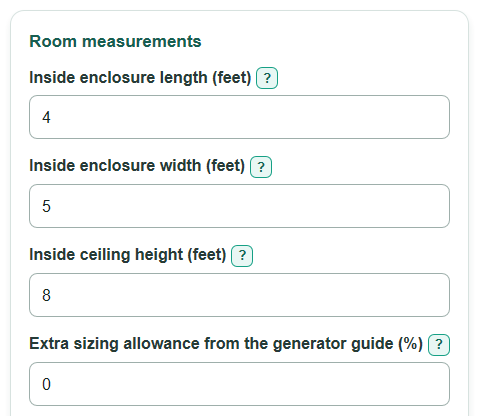
- Measure the finished inside steam enclosure and enter Inside enclosure length, Inside enclosure width, and Inside ceiling height in feet.
- Find the construction adjustment in the sizing guide for the exact generator brand, then enter its total in Extra sizing allowance from the generator guide.
- Copy the candidate model's kW and maximum room rating into Candidate generator power and Candidate generator maximum room rating.
- Enter expected use in Steam time per session and Steam sessions per week, then add the variable per-kWh charges from your utility bill in All-in electricity rate.
- Calculate and check that Candidate generator capacity room left is zero or positive; then compare the per-session, monthly, and annual cost with your planned use.
Definitions
Measured enclosure volume: The inside steam-room space in cubic feet, found from finished length, width, and ceiling height.
Sizing allowance: An extra percentage from a generator maker's guide for conditions such as finishes, glass, exterior walls, windows, skylights, or unheated areas.
Generator room rating: The maximum adjusted room volume in cubic feet that a specific generator model is listed to serve.
Capacity room left: The candidate generator's room rating minus the calculated minimum rating needed. A negative value means the candidate is undersized.
kW: Kilowatts, a measure of rated electrical power.
kWh: Kilowatt-hours, a measure of electrical energy. One kWh equals one kW used for one hour.
All-in electricity rate: The variable cents-per-kWh charges that apply to added use, usually including supply and delivery charges but excluding fixed monthly charges.
Common mistakes and quick fixes
Mistake: Measuring the full bathroom instead of the sealed steam area for Inside enclosure length, Inside enclosure width, and Inside ceiling height.
Fix: Measure only the finished interior space that will hold steam.
Mistake: Entering a guessed percentage for Extra sizing allowance from the generator guide.
Fix: Use the total allowance from the sizing guide for the exact generator brand and model line. Enter 0 only when its guide requires no allowance.
Mistake: Using Candidate generator power as the Candidate generator maximum room rating.
Fix: Enter kW in Candidate generator power and the listed adjusted cubic-foot limit in Candidate generator maximum room rating.
Mistake: Treating a negative Candidate generator capacity room left as zero.
Fix: A negative number is a shortage in cubic feet. Compare a higher-rated model using the same manufacturer's sizing guide.
Mistake: Including a fixed monthly utility customer charge in All-in electricity rate.
Fix: Include only supply and delivery charges billed per kWh. Fixed charges do not change because of one more steam session.
Mistake: Reading Estimated electricity cost per session as a guaranteed bill amount.
Fix: It assumes Candidate generator power is drawn for the full Steam time per session, so actual use may be lower when the heater cycles.
Limitations & Key Assumptions / Boundary Conditions
- The room-capacity result is a planning requirement, not a universal generator kW recommendation. Use the sizing guide for the exact brand and product line.
- The entered sizing allowance must already combine all manufacturer-required adjustments. This calculator does not create or verify material, glass, wall, window, skylight, or heat-loss adjustments.
- Electricity use assumes the generator draws its full rated kW for the entire Steam time per session. Real use can differ because of warm-up, thermostat cycling, room conditions, controls, and user habits.
- Monthly estimates use 52 weeks divided by 12 months. A specific calendar month can have more or fewer sessions.
- Costs include only electricity charges that change per kWh. They exclude fixed utility charges, water and sewer, equipment, installation, construction, maintenance, and water treatment.
- A zero Steam sessions per week correctly gives zero monthly and annual cost while retaining the per-session estimate.
Methodology
Room-capacity check
The calculator first finds the finished inside enclosure volume. It then adds only the total percentage entered from the selected generator maker's sizing guide. Manufacturer methods can differ, so the result is compared with the candidate model's listed room rating rather than converted into a universal kW size. [2]
raw_volume_cf = length_ft * width_ft * height_ft
allowance_volume_cf = raw_volume_cf * sizing_allowance_percent / 100
minimum_rated_capacity_cf = raw_volume_cf + allowance_volume_cf
capacity_margin_cf = candidate_capacity_cf - minimum_rated_capacity_cf
A positive capacity margin means the candidate rating covers the calculated requirement. A negative margin is kept as a signed shortage in cubic feet.
Electricity estimate
Rated power in kW is multiplied by session time in hours to estimate energy. The session energy is multiplied by the entered cents-per-kWh rate and divided by 100 to produce dollars. Monthly use is an average based on 52 weeks and 12 months.
energy_per_session_kwh = generator_power_kw * session_minutes / 60
cost_per_session = energy_per_session_kwh * electricity_rate / 100
cost_per_month = cost_per_session * sessions_per_week * 52 / 12
cost_per_year = cost_per_session * sessions_per_week * 52
Worked example
A 4 ft by 5 ft by 8 ft enclosure has 160 cu ft of measured volume. With a 25% sizing allowance, it needs a 200 cu ft room rating. A candidate rated for 250 cu ft has 50 cu ft of capacity room left. At 9 kW for 20 minutes, one session uses 3 kWh. At 18.44 cents per kWh, that is about $0.55 per session, $9.59 per average month at four weekly sessions, and $115.07 per year.
Assumptions and limits
The default electricity rate is a US residential planning estimate for May 2026; replace it with the variable per-kWh charges from your bill. [1] The cost calculation uses rated full-power operation and excludes fixed utility charges and non-electric ownership costs. It does not model generator cycling, water use, or model-specific controls.