
Estimate greenhouse heater size, seasonal energy use, and heating costs from your structure, temperatures, covering, fuel price, and bill charges.
Advanced options
Table of contents
How to use our Greenhouse Heating Cost Calculator
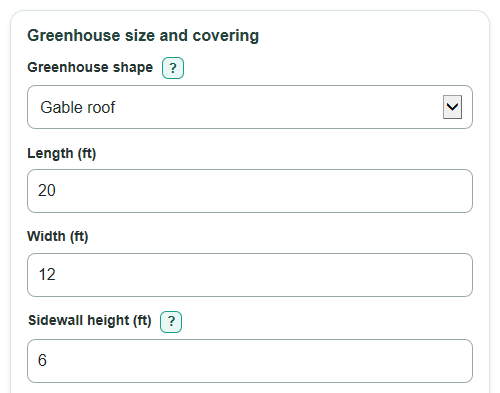
- Choose the Greenhouse shape and Greenhouse covering, then enter outside Length, Width, Sidewall height, and Peak height.
- Enter your minimum Indoor target temperature, a local Cold design temperature for heater sizing, and an Average outdoor temperature during heating for seasonal cost.
- Set the Heating period, choose the Heating energy source, and enter its usage-only Energy price and Heater efficiency.
- Open Advanced options if needed to adjust air leaks, extra heater capacity, a known covering U-factor, or bill charges that belong to greenhouse heating.
- Click Calculate, then check that the Recommended heater capacity matches the cold-weather plan and that the purchased energy unit matches your bill or fuel invoice.
Definitions
BTU/hr: British thermal units per hour, a measure of heating output. The Recommended heater capacity is shown in this unit.
U-factor: Heat lost each hour through one square foot for each 1 F temperature difference. A lower Covering U-factor used means better insulation.
Cold design temperature: A cold outdoor planning temperature used to size heating equipment. It is different from the seasonal average.
Heater efficiency: The percent of purchased fuel or electricity that becomes useful heat in the greenhouse.
Therm: A natural-gas billing unit equal to 100,000 BTU. Electricity, propane, and heating oil use different energy purchase units. [1]
Electric demand charge: A charge based on peak electric power in kW, usually billed per kW-month, separate from the per-kWh energy charge.
Common mistakes and quick fixes
Mistake: Using the Average outdoor temperature during heating as the Cold design temperature.
Fix: Use a cold local planning temperature for Cold design temperature and keep the seasonal average in Average outdoor temperature during heating.
Mistake: Entering floor dimensions but guessing Sidewall height or Peak height.
Fix: Measure the outside Sidewall height and Peak height because the Estimated roof and wall covering area includes walls and roof, not the floor.
Mistake: Copying the full utility bill into Energy price.
Fix: Enter only the usage rate in Energy price, then add a greenhouse-specific Monthly customer or tank charge or Seasonal delivery or service fees separately if needed.
Mistake: Leaving Heater efficiency at 100 for a combustion heater without checking its rating.
Fix: Use the rated Heater efficiency from the nameplate, manual, or installer information.
Mistake: Treating Estimated seasonal billed cost as the added cost caused only by the greenhouse.
Fix: Set Monthly customer or tank charge to 0 when that account charge would exist even without greenhouse heating.
Limitations & Key Assumptions / Boundary Conditions
- This is a steady-state planning estimate. It does not model hourly weather, solar gain, wind, cloud cover, thermal curtains, soil heat storage, or heater cycling.
- The roof and wall area assumes a regular gable or hoop structure with the entered outside dimensions. It excludes the floor, doors, vents, framing details, and attached buildings.
- The air-leak setting is a percentage allowance, not a measured ventilation or infiltration test.
- The seasonal estimate assumes the Average outdoor temperature during heating applies for all 24 hours of every entered Heating period day.
- Estimated seasonal billed cost includes only entered monthly charges, seasonal fees, and, for electricity, an entered Electric demand charge. Taxes and unrelated account loads are excluded.
- Use the Recommended heater capacity as a starting point. Equipment selection must also meet local electrical, combustion-air, venting, safety, and code requirements.
Methodology
Calculation steps
The calculator first finds exposed roof and wall area from the selected greenhouse shape. It uses the covering preset unless a Covering U-factor override is entered. The temperature difference is never allowed to go below zero, so no heating is estimated when the entered outdoor temperature is at or above the indoor target.
Gable area = 2 x Length x Sidewall height + 2 x Length x sqrt((Width / 2)^2 + (Peak height - Sidewall height)^2) + Width x (Sidewall height + Peak height)
Cold heat loss = U-factor x Covering area x max(Indoor target - Cold design temperature, 0) x (1 + Air leaks / 100)
Recommended heater capacity = Cold heat loss x (1 + Extra heater capacity / 100)
Seasonal useful heat uses the Average outdoor temperature during heating, 24 hours per day, and the Heating period. Heater headroom does not increase seasonal energy use because it is a sizing allowance only.
Seasonal useful heat = U-factor x Covering area x max(Indoor target - Average outdoor temperature, 0) x 24 x Heating period x (1 + Air leaks / 100)
Purchased energy = Seasonal useful heat / (Heater efficiency / 100) / Fuel BTU per purchase unit
Seasonal energy-use cost = Purchased energy x Energy price
Fuel conversions use 3,412.142 BTU per kWh, 100,000 BTU per therm, 91,452 BTU per propane gallon, and 138,500 BTU per heating-oil gallon. [1] The starting electricity price is a US residential planning value; replace it with your bill's usage rate. [2]
Bill charges
Monthly customer or tank charges are multiplied by Months with added charges. Seasonal delivery or service fees are added once. Electric demand charges apply only when electricity is selected and use the recommended electric input power.
Added bill charges = Monthly charge x Months billed + Seasonal fees + Electric demand rate x Electric input kW x Months billed
Estimated seasonal billed cost = Seasonal energy-use cost + Added bill charges
Worked example
For a 20 ft by 12 ft gable greenhouse with 6 ft sidewalls, a 14 ft peak, double-layer polyethylene, a 60 F indoor target, and a 10 F cold design temperature, the covering area is 880 sq ft. With a 0.70 U-factor, 10 percent air-leak allowance, and 20 percent extra heater capacity, the recommended heater capacity is 40,656 BTU/hr. Using a 30 F average outdoor temperature for 120 days gives about 17,158 kWh at 100 percent electric efficiency before bill charges.
Scope of the math
Results are intended for planning and budgeting. Local weather patterns, wind exposure, nighttime setpoints, actual air leakage, heater controls, and fuel billing rules can make real energy use and bills differ from this estimate.