
Estimate how much solar net metering could lower your electric bill using home use, solar production, and utility credit rates.
Advanced options
Solar use and billing rules
Long-term projection
Table of contents
How to use our Net Metering Savings Calculator
- Choose How do you want to enter home use?, then enter either Annual home use or 12 Monthly home use from bills values.
- Enter Annual solar production, Retail electricity rate, and Export credit rate from your solar proposal, utility bill, or net metering plan.
- Open Advanced options only if you want to change Solar used at home, Fixed monthly charge, How export credits can be used, or projection settings.
- Select Calculate and read First-year net metering savings first, then compare it with Estimated annual bill after solar and Average monthly savings in the first year.
- Sanity-check Annual home use used in estimate and, in monthly mode, Monthly use high-low spread; a strange total or spread usually means one bill value was missed or typed wrong.
Definitions
Net metering: A billing setup where a customer with solar gets credit for electricity sent to the grid [2].
Annual home use: The total electricity your home uses in one year, measured in kilowatt-hours.
Annual solar production: The total electricity your solar system is expected to make in one year, measured in kilowatt-hours.
Retail electricity rate: The price you pay for each kilowatt-hour bought from the grid. Electric rates are commonly stated in $ per kWh [1].
Export credit rate: The credit value for each extra solar kilowatt-hour sent to the grid.
Solar used at home: The percent of solar production your home uses right away before any extra power is exported.
Fixed monthly charge: A customer charge that usually stays on the bill even if solar lowers energy charges.
Credit limit policy: The rule that says whether export credits can reduce only energy charges, count against the whole bill, or not count at all.
Common mistakes and quick fixes
Mistake: Using one unusual winter or summer bill as Annual home use.
Fix: Use Monthly home use from bills if you have 12 bills, or make Annual home use match a normal full year.
Mistake: Entering a blended bill total into Retail electricity rate instead of a $ per kWh rate.
Fix: Use the Retail electricity rate from the energy part of the bill, not the full bill divided by kWh if fixed charges are included.
Mistake: Setting Export credit rate equal to Retail electricity rate when your plan pays a lower buyback rate.
Fix: Enter the actual Export credit rate from your utility net metering or net billing schedule.
Mistake: Leaving Solar used at home at 60 percent without checking whether your home uses power during sunny hours.
Fix: Adjust Solar used at home lower for homes empty during the day and higher for homes with daytime loads.
Mistake: Choosing All export credits count when your plan only lets credits reduce energy charges.
Fix: Set How export credits can be used to Credits lower energy charges only if credits cannot reduce fixed charges or create a payout.
Mistake: Treating Total savings over the chosen years as a guaranteed contract amount.
Fix: Use Total savings over the chosen years as a simple planning estimate and update it if rates, usage, or policy rules change.
Limitations & Key Assumptions / Boundary Conditions
- The calculator uses one retail electricity rate and one Export credit rate. It does not model time-of-use rates, tiered rates, demand charges, taxes, or minimum bills.
- Annual home use stays the same in every projection year. Changes from an EV, heat pump, new appliances, weather, or people moving in or out can change savings.
- Solar used at home is a yearly percent. Real self-use changes hour by hour with sunshine, appliance use, batteries, and utility metering rules.
- Fixed monthly charge is added for all 12 months and is not increased in future years.
- How export credits can be used is a simplified policy choice. State and utility rules vary, and some plans include true-ups, rollover limits, avoided-cost rates, or separate delivery charges [3].
- A negative Estimated annual bill after solar is kept only when All export credits count is selected. It means credits exceed charges under that simplified rule, not that your utility must pay that exact amount.
- The projection raises both Retail electricity rate and Export credit rate by the same yearly percent and reduces Annual solar production by the same yearly loss percent.
Methodology
How the calculator builds home use
If How do you want to enter home use? is set to Annual home use, that value is used directly. If it is set to Monthly home use from bills, the calculator requires exactly 12 nonnegative monthly kWh values and adds them.
annual_usage_kwh = month_1_kwh + month_2_kwh + ... + month_12_kwh
monthly_usage_high_low_spread = highest_month_kwh - lowest_month_kwh
How solar value is split
The calculator first estimates how much solar is used by the home right away. That amount is capped so it cannot be more than Annual solar production or Annual home use. The rest of the solar production is treated as exported energy.
solar_used_at_home_kwh = min(annual_solar_kwh * solar_used_at_home_percent / 100, annual_solar_kwh, annual_usage_kwh)
exported_kwh = max(annual_solar_kwh - solar_used_at_home_kwh, 0)
grid_energy_kwh = max(annual_usage_kwh - solar_used_at_home_kwh, 0)
How first-year savings are calculated
The no-solar bill includes energy charges plus 12 Fixed monthly charge amounts. The solar bill keeps the fixed charges, adds any grid energy bought after direct solar use, then subtracts export credits allowed by How export credits can be used.
baseline_bill = annual_usage_kwh * retail_rate_per_kwh + fixed_monthly_charge * 12
gross_export_credit = exported_kwh * export_credit_per_kwh
if policy is energy_only: export_credit_used = min(gross_export_credit, grid_energy_kwh * retail_rate_per_kwh)
if policy is all_credits: export_credit_used = gross_export_credit
if policy is no_credit: export_credit_used = 0
estimated_bill_after_solar = fixed_monthly_charge * 12 + grid_energy_kwh * retail_rate_per_kwh - export_credit_used
first_year_savings = baseline_bill - estimated_bill_after_solar
average_monthly_savings = first_year_savings / 12
Worked mini-example
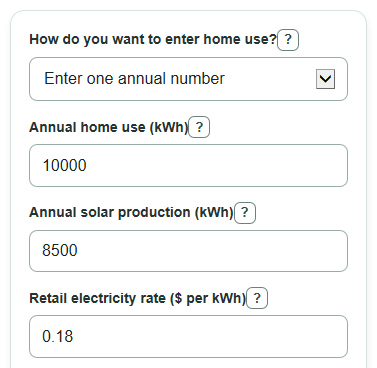
Suppose Annual home use is 10,000 kWh, Annual solar production is 8,500 kWh, Solar used at home is 60 percent, Retail electricity rate is $0.18 per kWh, Export credit rate is $0.08 per kWh, and Fixed monthly charge is $15. Solar used at home is 5,100 kWh, exported solar is 3,400 kWh, and grid energy after direct solar use is 4,900 kWh. The no-solar bill is $1,980. With the energy-only credit rule, export credit used is $272, the after-solar bill is $790, and First-year net metering savings is $1,190.
How the projection is added
For each projection year, the calculator updates the rates and solar production, recalculates that year's savings, and adds the yearly savings together.
retail_rate_y = retail_rate_per_kwh * (1 + electricity_rate_increase_percent / 100)^(year_number - 1)
export_rate_y = export_credit_per_kwh * (1 + electricity_rate_increase_percent / 100)^(year_number - 1)
solar_kwh_y = annual_solar_kwh * (1 - solar_output_loss_percent / 100)^(year_number - 1)
projected_savings_total = savings_year_1 + savings_year_2 + ... + savings_last_year