
Estimate a solar carport's size, first-year energy, payback year, and long-term dollar value from the parking spaces you want covered.
Table of contents
How to use our Solar Carport Calculator
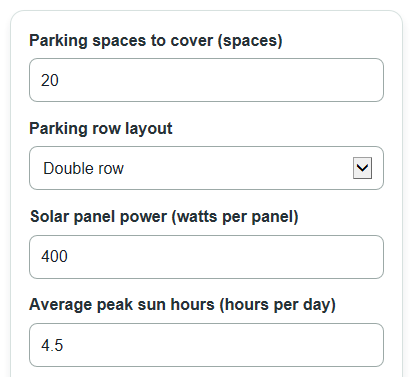
- Enter Parking spaces to cover, then choose Parking row layout as Single row or Double row.
- Enter Solar panel power, Average peak sun hours, and Electricity rate using values that match your panel choice, location, and bill credit value.
- Open Advanced options if you want to change Parking space width, Solar panel area, System losses, Installed cost, Federal tax credit, Years to count, or discount assumptions.
- Click Calculate and read Money gain in today's dollars first, then compare the two break-even outputs and the physical size outputs.
- Sanity-check the answer by asking if Estimated number of solar panels and First-year solar energy look reasonable for your covered parking footprint and local sun.
Definitions
Peak sun hours: The number of hours per day that would give the same solar energy as a full day of changing sunlight.
kWh: Kilowatt-hour, a unit of energy used on electric bills. A 1 kW load running for 1 hour uses 1 kWh.
System losses: Energy lost to heat, wiring, inverter conversion, dirt, mismatch, and downtime before solar energy reaches usable electricity.
Roof area filled with panels: The percent of the canopy roof area that can actually be covered by solar panels after spaces and edges are left clear.
Today's-dollar discount rate: The yearly rate used to make future savings comparable to money today.
Money gain in today's dollars: The present value of future bill savings minus the upfront cost after the entered tax credit. Negative means the entered assumptions do not pay back on a today's-dollar basis.
Common mistakes and quick fixes
Mistake: Putting total lot spaces into Parking spaces to cover when only some spaces will have a canopy.
Fix: Enter only the spaces under the planned solar carport in Parking spaces to cover.
Mistake: Using Average peak sun hours as the number of daylight hours.
Fix: Use peak sun hours, which are full-sun equivalent hours per day, not sunrise-to-sunset time.
Mistake: Entering Solar panel power in kilowatts instead of watts per panel.
Fix: For a 400 W panel, enter 400 in Solar panel power, not 0.4.
Mistake: Setting Roof area filled with panels to 100 percent and expecting every square foot to hold panels.
Fix: Leave room for gaps, edges, service access, and layout limits in Roof area filled with panels.
Mistake: Treating Federal tax credit as guaranteed cash back.
Fix: Use Federal tax credit only as a test assumption and check project eligibility with a tax professional.
Mistake: Reading Money gain in today's dollars as a simple total of future savings.
Fix: This output subtracts Upfront cost after entered tax credit and discounts future savings using Today's-dollar discount rate.
Limitations & Key Assumptions / Boundary Conditions
- The calculator is for early planning. It is not a structural design, electrical design, bid, permit drawing, or tax filing guide.
- Parking dimensions, row layout, and Roof area filled with panels are simplified. Columns, drains, setbacks, fire lanes, ADA spaces, landscape islands, and drive aisles can reduce usable area.
- Solar energy depends on location, tilt, shade, panel direction, weather, soiling, snow, equipment performance, and maintenance. Average peak sun hours and System losses are user assumptions.
- The model assumes each produced kWh is worth the entered Electricity rate. Net metering rules, demand charges, time-of-use rates, export limits, and unused energy can change savings.
- Installed cost is entered as $ per watt and does not break out trenching, interconnection upgrades, engineering, foundations, batteries, financing fees, insurance, or maintenance.
- Federal tax credit is only an entered percent. Eligibility, tax appetite, bonus credits, depreciation, state incentives, and nonprofit rules are outside this calculator.
- Payback is checked once per whole year. A project that breaks even between years is shown at the next whole year.
Methodology
Layout and panel count
The calculator first turns covered parking spaces into an estimated canopy length and depth. A single row uses one stall depth. A double row uses two stall depths and rounds the number of bays up when the space count is odd.
single row length = parking spaces * parking space width
single row depth = parking space depth
double row length = ceil(parking spaces / 2) * parking space width
double row depth = 2 * parking space depth
canopy footprint = canopy length * canopy depth
panel count = floor(canopy footprint * roof area filled with panels / 100 / solar panel area)
The panel count is rounded down because the layout cannot use part of a panel.
System size and energy
System size is the whole panel count times the power rating of each panel. Energy is estimated from system size, average peak sun hours, and the entered loss percent.
system size kW = panel count * solar panel power / 1000
daily kWh = system size kW * average peak sun hours * (1 - system losses / 100)
annual kWh = daily kWh * 365
Cost, savings, and payback
The cost model starts with installed cost per watt, subtracts the entered tax credit percent, then values the first year of solar energy at the entered electricity rate.
net upfront cost = system size kW * 1000 * installed cost per watt * (1 - federal tax credit / 100)
first-year savings = annual kWh * electricity rate
For each later year, savings rise with the entered electricity price increase and fall with the entered panel power fade.
savings in year y = first-year savings * (1 + yearly rate increase)^(y - 1) * (1 - panel power fade)^(y - 1)
money gain in today's dollars = -net upfront cost + sum of savings in year y / (1 + today's-dollar discount rate)^y
Simple payback is the first whole year when running savings reach net upfront cost. Discounted payback uses the same test after each year's savings are converted to today's dollars.
Mini-example
With 20 spaces in a double row, 9 ft by 18 ft spaces, 400 W panels, 22 sq ft per panel, 85 percent roof coverage, 4.5 peak sun hours, 14 percent losses, $3.50 per watt installed cost, a 30 percent tax credit, and $0.16 per kWh, the footprint is 90 ft by 36 ft, or 3,240 sq ft. That fits 125 panels, for a 50 kW system. First-year energy is about 70,628 kWh, first-year savings are about $11,300, and net upfront cost is about $122,500. With 2 percent yearly electricity price growth, 0.5 percent yearly panel fade, a 6 percent today's-dollar discount rate, and 25 years counted, the money gain in today's dollars is about $43,600 and discounted payback is year 16.